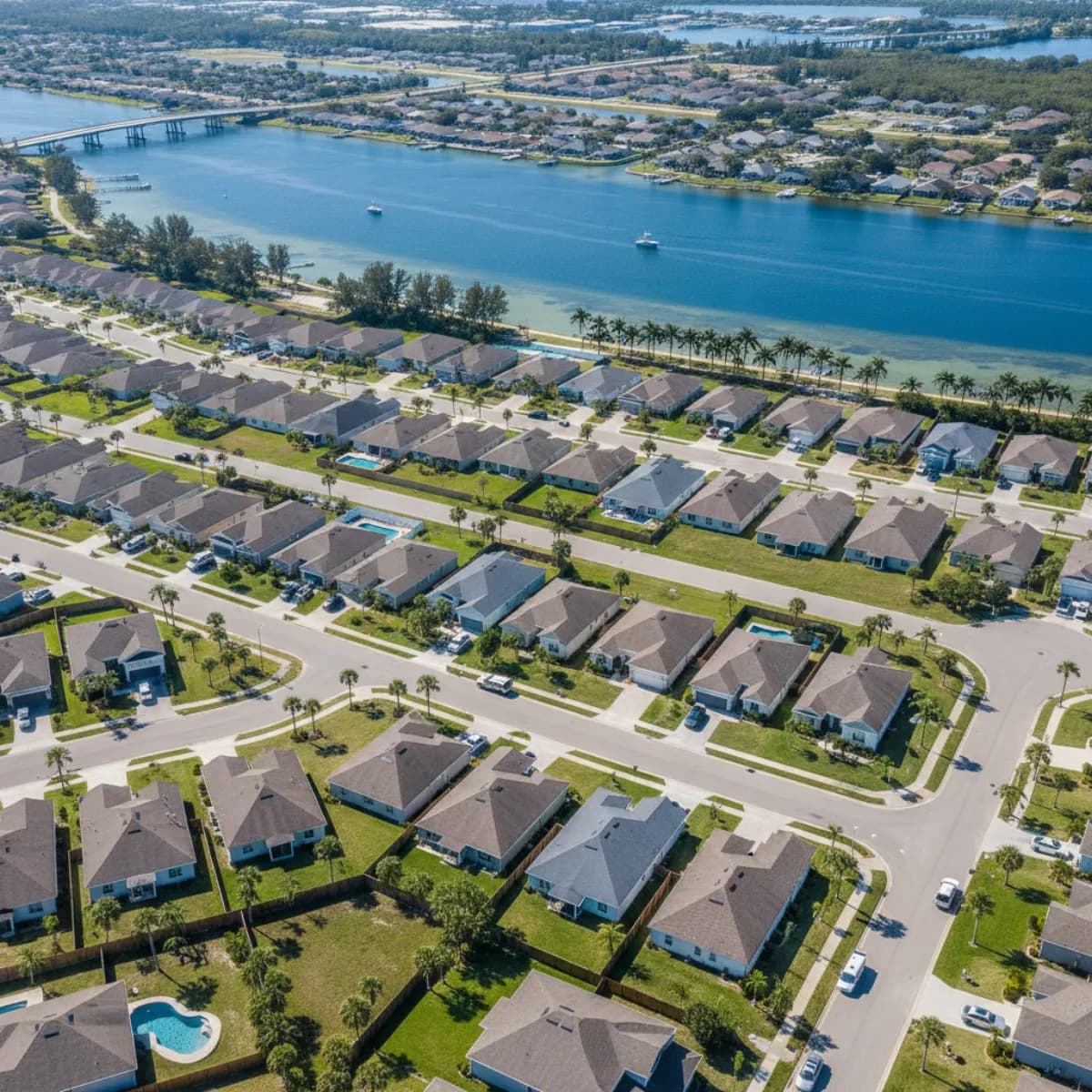
Brevard County's Space Coast
Instant Roof Replacement Quotes in Palm Bay, FL
Palm Bay is Brevard County's largest city and the heart of Florida's Space Coast — a growing community of approximately 120,000 residents with a housing stock spanning from 1970s ranch homes to modern developments. Situated in a 130+ mph wind zone with direct Atlantic hurricane exposure, every roof replacement must meet stringent Florida Building Code requirements. Get instant quotes from pre-vetted CCC-licensed contractors who specialize in hurricane-rated roofing for Palm Bay's affordable housing market.
Free Quotes
no obligations ever
Contractor Bids
standardized scope comparison
Until You Choose
no spam, no lead resale
FL Contractors
CCC-licensed, insured, reviewed
Palm Bay at a Glance
Population
Brevard County's largest city
MPH Wind Zone
FBC design wind speed
Region
Near Kennedy Space Center
Avg Roof Cost
Shingles to metal range
Housing Stock
Many aging roofs nearing replacement
Hurricane Damage
Matthew & Irma back-to-back
Why Palm Bay Homeowners Need Hurricane-Ready Roofs
Palm Bay sits on Florida's central Atlantic coast in Brevard County, directly in the path of hurricanes that track up the Eastern Seaboard or curve westward from the open Atlantic. The city's location on the Space Coast — just south of Cape Canaveral and Kennedy Space Center — means there is no geographic buffer between Palm Bay and the full force of Atlantic hurricanes. Unlike cities on Florida's Gulf Coast, which benefit from the relatively shallow and warm Gulf waters that can weaken storms, Palm Bay faces the deep Atlantic where hurricanes maintain or intensify their power right up to landfall.
This vulnerability was demonstrated in devastating fashion during 2016 and 2017. Hurricane Matthew tracked along Brevard County's coastline in October 2016 as a powerful Category 3-4 storm, with the eye passing just offshore. Wind gusts exceeding 100 mph raked through Palm Bay, tearing shingles from rooftops, peeling back flashing, and driving rain into exposed roof decks across thousands of homes. The damage was particularly severe in Palm Bay's older neighborhoods — subdivisions built during the 1970s, 1980s, and 1990s housing boom when construction standards were less rigorous than today's Florida Building Code. Many of these homes had original roofs with 20-year shingles, three-tab profiles, and minimal wind resistance features. Matthew exposed every weakness.
Just eleven months later, Hurricane Irma arrived in September 2017 as one of the most powerful Atlantic hurricanes ever recorded. Although Irma's center tracked up Florida's west coast, its massive wind field extended well into Brevard County, delivering sustained tropical storm force winds and gusts exceeding 90 mph to Palm Bay. For homes that had not completed repairs from Matthew, Irma compounded the damage — widening existing leaks, displacing temporary tarps, and further degrading compromised roof systems. The back-to-back storms created a roofing crisis across Brevard County that strained contractor capacity for years afterward.
Today, many Palm Bay homes still carry deferred maintenance and unremediated storm damage from this period. Roofs that were patched rather than replaced after Matthew and Irma are now approaching the end of their serviceable life. Combined with the natural aging of Palm Bay's predominately 1970s-2000s housing stock, the city has a substantial inventory of homes in urgent need of full roof replacement. RoofVista connects Palm Bay homeowners with pre-vetted CCC-licensed contractors who understand the local housing stock, Brevard County permitting requirements, and the specific wind mitigation features that maximize insurance savings in this high-exposure market.
Roofing Challenges Unique to Palm Bay
Palm Bay's location between the Atlantic Ocean and the Indian River Lagoon creates a distinctive set of environmental challenges for residential roofing. The combination of direct hurricane exposure, salt air from dual waterfront proximity, intense UV radiation, and seasonal tropical downpours demands roofing systems that can perform under sustained stress. Understanding these challenges helps homeowners make informed decisions about materials, installation methods, and maintenance schedules.
! Atlantic Hurricane Exposure
Palm Bay's position on the central Atlantic coast places it directly in the hurricane corridor. The 130+ mph FBC design wind speed reflects the real threat: hurricanes like Matthew (2016) and Irma (2017) delivered wind gusts exceeding 100 mph to the area. Unlike inland Florida cities that benefit from friction-based wind reduction as storms move over land, Palm Bay receives the full brunt of oceanic wind speeds. Every roofing system must be engineered for this reality — from the nail pattern in the decking to the wind rating of every shingle and component.
- - 130+ mph FBC design wind speed
- - Direct Atlantic hurricane landfall path
- - Enhanced nail patterns required (6-nail for shingles)
- - Hurricane clips at every truss-to-wall connection
~ Dual Waterfront Salt Air
Palm Bay is bordered by the Atlantic Ocean to the east (via the barrier islands) and the Indian River Lagoon — one of the most biologically diverse estuaries in North America — running through the city's eastern edge. This dual waterfront exposure means salt-laden air reaches virtually every neighborhood. Homes in eastern Palm Bay along the lagoon shoreline face the most aggressive corrosion, but even homes in western subdivisions experience enough salt exposure to degrade standard galvanized fasteners within 5-8 years. The high humidity amplifies corrosion effects year-round.
- - Indian River Lagoon and Atlantic exposure
- - Hot-dipped galvanized or stainless fasteners recommended
- - Marine-grade coatings for metal roofing near water
- - Annual corrosion inspections for lagoon-side homes
= Intense UV & Heat Load
Central Florida's latitude delivers approximately 233 sunny days per year in Palm Bay, with a UV index regularly reaching 10-11 (very high to extreme) from April through September. Roof surface temperatures routinely exceed 150 degrees F during summer months. This relentless thermal cycling — expansion and contraction with each day-night cycle — stresses shingle adhesive strips, degrades underlayment, and accelerates the oxidation of asphalt roofing compounds. Standard 3-tab shingles, already uncommon in new installations, often last only 12-15 years in Palm Bay versus their 20-year rated lifespan. Architectural shingles with SBS-modified asphalt resist UV degradation significantly better.
- - UV Index 10-11 (extreme) April through September
- - SBS-modified asphalt extends shingle life 5-10 years
- - Light-colored roofing reduces cooling costs 10-15%
- - Algae-resistant (AR) shingles prevent dark streaking
# Tropical Rainfall & Humidity
Palm Bay receives approximately 52 inches of rainfall annually, heavily concentrated in the June-September wet season when afternoon thunderstorms are a near-daily occurrence. These storms frequently produce intense rainfall rates exceeding 2 inches per hour, combined with gusty winds that drive rain horizontally under shingle edges and into flashing joints. The high ambient humidity (averaging 75-80% year-round) promotes algae growth, mold, and moisture accumulation in attic spaces. Proper attic ventilation and algae-resistant roofing materials are critical investments in this climate.
- - 52 inches annual rainfall (June-Sept concentrated)
- - Wind-driven rain penetration during thunderstorms
- - 75-80% average humidity promotes algae and mold
- - Proper ridge and soffit ventilation essential
Palm Bay Roof Replacement Cost by Material
Palm Bay's affordable housing market translates to more accessible roof replacement costs compared to South Florida's coastal metros. The typical Palm Bay home is a single-story or two-story home with 1,400-2,200 square feet of roof area — smaller and simpler than the multi-level, complex roof geometries common in Miami or Fort Lauderdale. However, all installations must still meet the full Florida Building Code for the 130+ mph wind zone, including FBC-approved products, enhanced fastening patterns, and Brevard County inspection requirements. Labor rates in Brevard County average $40-$60/hour, lower than the $55-$85/hour range in Miami-Dade.
Architectural Shingles
#1: Architectural (Dimensional) Shingles
Architectural shingles are the dominant roofing material across Palm Bay, installed on an estimated 70-80% of residential re-roofs in the area. Their popularity reflects the practical needs of the market: they offer 130+ mph wind ratings when installed with the FBC-required enhanced nail pattern (6-nail for high-wind zones), come in a wide range of colors that complement Palm Bay's typical concrete block and stucco home exteriors, and provide the most cost-effective path to full code compliance. Leading manufacturers including GAF, Owens Corning, and CertainTeed offer product lines specifically designed for Florida's high-wind coastal zones, with 30-year limited warranties that include enhanced wind coverage. For Palm Bay's budget-conscious market, architectural shingles deliver the best balance of hurricane performance, aesthetics, and affordability.
Best For:
Most Palm Bay homes, best value for code compliance
Lifespan:
20-30 years (Palm Bay climate)
Cost Range:
$9,500 - $16,000
Wind Rating:
130+ mph (FBC-approved)
Standing Seam Metal
#2: Standing Seam Metal
Standing seam metal roofing is the fastest-growing segment in Palm Bay's residential roofing market, driven by homeowners who watched neighbors' shingle roofs fail during Matthew and Irma while metal roofs survived largely intact. A properly installed standing seam system with concealed fasteners and continuous interlocking panels creates a monolithic wind barrier that consistently exceeds the 130+ mph requirement — many systems test to 160+ mph. For homes near the Indian River Lagoon, the key specification is marine-grade coating: Galvalume steel with a PVDF (Kynar 500) fluoropolymer finish or aluminum panels provide decades of salt air resistance. The higher upfront cost is offset by a 40-60 year expected lifespan — effectively eliminating the need for a second roof replacement — and the highest wind mitigation insurance credits available.
Best For:
Lagoon-side homes, maximum hurricane protection
Lifespan:
40-60 years
Cost Range:
$15,000 - $22,000
Corrosion Protection:
Kynar/PVDF coating for coastal areas
Impact-Resistant Shingles
#3: Impact-Resistant (Class 4) Shingles
Impact-resistant shingles occupy a smart middle ground for Palm Bay homeowners who want better-than-standard hurricane performance without the higher cost of metal roofing. These shingles use SBS (Styrene-Butadiene-Styrene) polymer-modified asphalt that is more flexible and impact-resistant than standard architectural shingles. They earn a Class 4 rating under UL 2218 impact testing — the highest available — which qualifies homeowners for additional insurance discounts on top of standard wind mitigation credits. In Palm Bay, where summer thunderstorms occasionally produce hail and wind-driven debris is a hurricane hazard, the impact resistance provides tangible protection. The SBS modification also improves UV resistance, extending the shingle's serviceable life by 5-10 years compared to standard asphalt in Palm Bay's intense sun environment.
Best For:
Insurance savings, storm debris protection
Lifespan:
25-35 years
Cost Range:
$11,000 - $18,000
Impact Rating:
Class 4 (UL 2218)
Palm Bay Average Roof Cost: Architectural shingles $9,500-$16,000. Impact-resistant shingles $11,000-$18,000. Standing seam metal $15,000-$22,000. Palm Bay's costs reflect the area's affordable housing market while still including all FBC 130+ mph wind zone compliance requirements. Get your exact price with a free instant estimate.
Palm Bay's Aging Housing Stock: When to Replace Your Roof
Palm Bay experienced its most significant residential growth during three distinct periods: the original development boom of the 1970s-1980s (when thousands of concrete block homes were built on large lots across the city's grid-pattern subdivisions), the 1990s expansion driven by the Space Coast aerospace industry, and the early 2000s pre-recession building surge. Each era brought different construction standards, and understanding what generation of home you own helps determine your roofing situation.
1970s-1980s Homes
Built before modern FBC requirements, these homes typically have the weakest roof-to-wall connections (toe-nailing rather than hurricane clips), thinner roof decking, and roofing systems designed for lower wind speeds. Many have been re-roofed at least once, but the underlying structural connections may not meet current code. If your 1970s-80s home has not had a full re-roof with modern FBC-compliant materials and enhanced fastening, it is likely your highest priority.
Priority: High - likely needs replacement
1990s Homes
Built during the transition to stricter codes but before the 2002 statewide FBC adoption, these homes fall in a gray area. Some were built to Brevard County's pre-FBC standards, which were better than the minimums of the 1970s-80s but not as rigorous as today's code. Original roofs from this era are now 25-35 years old — well past the typical lifespan of the 3-tab and early architectural shingles commonly used at the time.
Priority: Medium-High - approaching end of life
2000s-Present Homes
Homes built after 2002 were constructed under the modern Florida Building Code with enhanced wind resistance requirements. These homes have the best structural foundation for roofing — hurricane straps, properly spaced decking fasteners, and code-compliant original installations. If you purchased a home built after 2002 and the original roof is still in place (now 20+ years old), a replacement with modern materials will take advantage of the existing code-compliant structure.
Priority: Moderate - monitor condition
Brevard County Building Requirements for Roofing
FBC Compliance for Palm Bay's Wind Zone
Florida Product Approval (FL Number)
Every roofing product installed in Palm Bay must carry a valid Florida Product Approval (FL number) from the Florida Building Commission. This certification confirms the product has been tested and approved for use in the applicable wind zone. Unlike Miami-Dade's NOA requirement, the Florida Product Approval system covers the rest of the state and is generally less restrictive, but still requires independent testing for wind uplift, impact resistance (where applicable), and water penetration. Product approvals can be verified through the Florida Building Code Product Approval database at floridabuilding.org.
130+ MPH Wind Zone Requirements
Palm Bay's location in the 130+ mph wind speed zone mandates enhanced installation methods compared to lower-wind Florida zones. For asphalt shingles, this means a 6-nail pattern (rather than 4-nail) per shingle with specific nail placement to maximize wind uplift resistance. Roof deck attachment requires 8d ring-shank nails at 6-inch spacing along panel edges. Roof-to-wall connections must use approved hurricane clips or straps — toe-nailing alone does not meet code. These requirements apply to all new construction and re-roof projects.
Permit Process (City of Palm Bay)
All roof replacements require a building permit from the City of Palm Bay Building Department. The application must include the contractor's CCC or RC license number, Florida Product Approval (FL) numbers for all materials, and proof of current insurance. Brevard County requires inspections at the dry-in stage (verifying underlayment installation and deck attachment) and final inspection (completed roof covering, flashing, and ventilation). Permit fees range from $150-$400 depending on project scope and home size.
Florida CCC Licensing
Florida requires all roofing contractors to hold a Certified Roofing Contractor (CCC) license issued by the DBPR, or a Registered Roofing Contractor (RC) license specific to Brevard County. Verify any contractor at myfloridalicense.com before signing a contract. Licensed contractors must carry workers' compensation insurance and a minimum $10,000 surety bond. All RoofVista contractors in Brevard County hold active CCC licenses and meet all state and local requirements.
Insurance & Wind Mitigation for Palm Bay Homeowners
Reducing Your Insurance Costs with a New Roof
Brevard County homeowners face some of the highest property insurance rates in Florida, driven by the area's direct Atlantic hurricane exposure and historical storm damage. For many Palm Bay homeowners, roof condition and age are the primary factors determining insurance availability and cost. The good news is that a new, code-compliant roof is one of the most effective tools for reducing premiums and expanding your carrier options.
Roof Age & Insurance Impact
- - Many insurers won't write policies on roofs older than 15 years
- - Citizens Property Insurance requires roof inspection after 15 years
- - Coverage may be denied if roof has less than 5 years useful life
- - SB 4-D (2022) protects roofs under 15 years from age-based denial
- - A new roof typically reduces premiums 15-35% in Brevard County
Wind Mitigation Credits (OIR-B1-1802)
- - Florida law mandates discounts for wind-resistant features
- - Hurricane clips/straps: significant premium reduction
- - Secondary water resistance (peel-and-stick): major discount
- - Impact-resistant roof covering: additional 10-15% savings
- - Hip roof geometry: lower premium than gable roofs
- - Annual savings of $800-$3,000 common in Brevard County
Our pre-vetted Palm Bay contractors understand the direct relationship between roofing and insurance. They can recommend installations specifically designed to maximize your wind mitigation credits and improve your insurability, helping offset the cost of your roof replacement through long-term premium savings.
Palm Bay Neighborhoods We Serve
Palm Bay covers over 100 square miles across Brevard County, making it one of the largest cities by area in Florida. From waterfront properties along the Indian River Lagoon to inland subdivisions near the Emerald Lakes and the Turkey Creek Sanctuary, our pre-vetted contractors serve every Palm Bay community. Each area presents unique roofing considerations based on its proximity to water, housing era, and exposure profile.
Northeast Palm Bay (NE)
- - Closest to Indian River Lagoon
- - Highest salt air corrosion exposure
- - Mix of 1970s-1990s homes
- - Marine-grade fasteners recommended
- - Metal roofing increasingly popular
Port Malabar / Bayfront
- - Original Palm Bay development area
- - Older 1960s-1980s housing stock
- - Many original or first-replacement roofs
- - Concrete block construction typical
- - Affordable architectural shingle market
Southwest Palm Bay
- - Newer developments (1990s-2000s)
- - Post-Andrew code construction
- - Better baseline wind resistance
- - Planned communities with HOAs
- - Larger homes, higher roof areas
Malabar / Viera Adjacent
- - Bordering Town of Malabar
- - Mix of rural and suburban properties
- - Larger lot sizes, diverse roof styles
- - Some tile and metal installations
- - Near I-95 corridor access
Emerald Lakes / West
- - Central Palm Bay location
- - 1980s-1990s residential development
- - Standard concrete block/stucco homes
- - Architectural shingles predominant
- - Moderate salt exposure (inland)
Palm Bay Estates / South
- - Southern Palm Bay communities
- - Near Sebastian Inlet access
- - Mix of age groups in housing stock
- - Budget-friendly replacement market
- - Growing new construction areas
Nearby Florida Cities
Get instant roofing quotes in other Space Coast and Central Florida cities. Our pre-vetted contractors serve the entire Brevard County region and beyond.
Frequently Asked Questions About Palm Bay Roofing
Frequently Asked Questions
How much does a roof replacement cost in Palm Bay, FL?
Architectural shingle roofs cost $9,500-$16,000 in Palm Bay. Standing seam metal ranges $15,000-$22,000. Palm Bay's affordable housing market keeps costs below South Florida averages, but FBC hurricane compliance requirements — 130+ mph wind-rated products, enhanced fastening, and Brevard County inspections — still factor into pricing.
What wind speed rating is required for roofs in Palm Bay?
Palm Bay is in the FBC 130+ mph wind speed zone due to its coastal Atlantic location. All roofing products must carry a Florida Product Approval demonstrating compliance with these wind resistance standards. While not in the HVHZ like Miami-Dade, Palm Bay's requirements are still among the highest in the state.
How did Hurricane Matthew and Irma affect Palm Bay roofing?
Hurricane Matthew (2016) tracked along Brevard County's coast as a Category 3-4 storm, causing widespread shingle blow-offs and water intrusion across Palm Bay. Hurricane Irma (2017) followed 11 months later, compounding damage. Many homes with 1970s-1990s construction still carry deferred damage from these storms.
What roofing materials work best in Palm Bay's climate?
Architectural shingles are most popular and cost-effective, offering 130+ mph wind ratings with proper installation. Standing seam metal is growing in popularity for its superior hurricane and salt air resistance. Impact-resistant (Class 4) shingles qualify for insurance discounts. All materials must carry Florida Product Approval.
How does Palm Bay's proximity to the coast affect roofing?
Palm Bay sits between the Atlantic Ocean and the Indian River Lagoon, creating dual salt air exposure. Homes near the lagoon experience accelerated corrosion on fasteners, flashing, and metal components. Marine-grade coatings and stainless steel fasteners are recommended for coastal-adjacent properties.
Can a new roof reduce my homeowner's insurance in Palm Bay?
Yes. Florida law mandates insurance discounts for verified wind mitigation features. A new code-compliant roof with hurricane clips, sealed underlayment, and impact-resistant covering can save 20-45% on the wind portion of your premium — often $800-$3,000 annually in Brevard County.
What permits are required for roof replacement in Palm Bay?
All roof replacements require a permit through the City of Palm Bay Building Department. Applications need Florida Product Approval numbers, CCC license verification, and proof of insurance. Inspections include dry-in and final stages. Permit fees range $150-$400.
What contractor license is required for roofing in Palm Bay?
Florida requires a Certified Roofing Contractor (CCC) license from the DBPR. Licensed contractors must carry workers' comp and a $10,000 surety bond. Verify any contractor at myfloridalicense.com. All RoofVista contractors in Brevard County hold active CCC licenses.
Florida Roofing Resources
Florida State Overview
All Florida roofing resources and city pages
Florida Roof Replacement Cost Guide
Detailed pricing for all FL regions and materials
Hurricane-Resistant Roofing in Florida
Wind zone requirements and storm-rated products
Florida Roofing Building Codes
FBC requirements by wind zone
Wind Mitigation Guide for Florida
Insurance discounts and inspection details
Florida Contractor Licensing
CCC license requirements and DBPR verification
Get Your Palm Bay Roof Quote in Minutes
Enter your address to compare instant quotes from pre-vetted CCC-licensed Florida contractors who specialize in hurricane-rated roofing for Brevard County's Space Coast