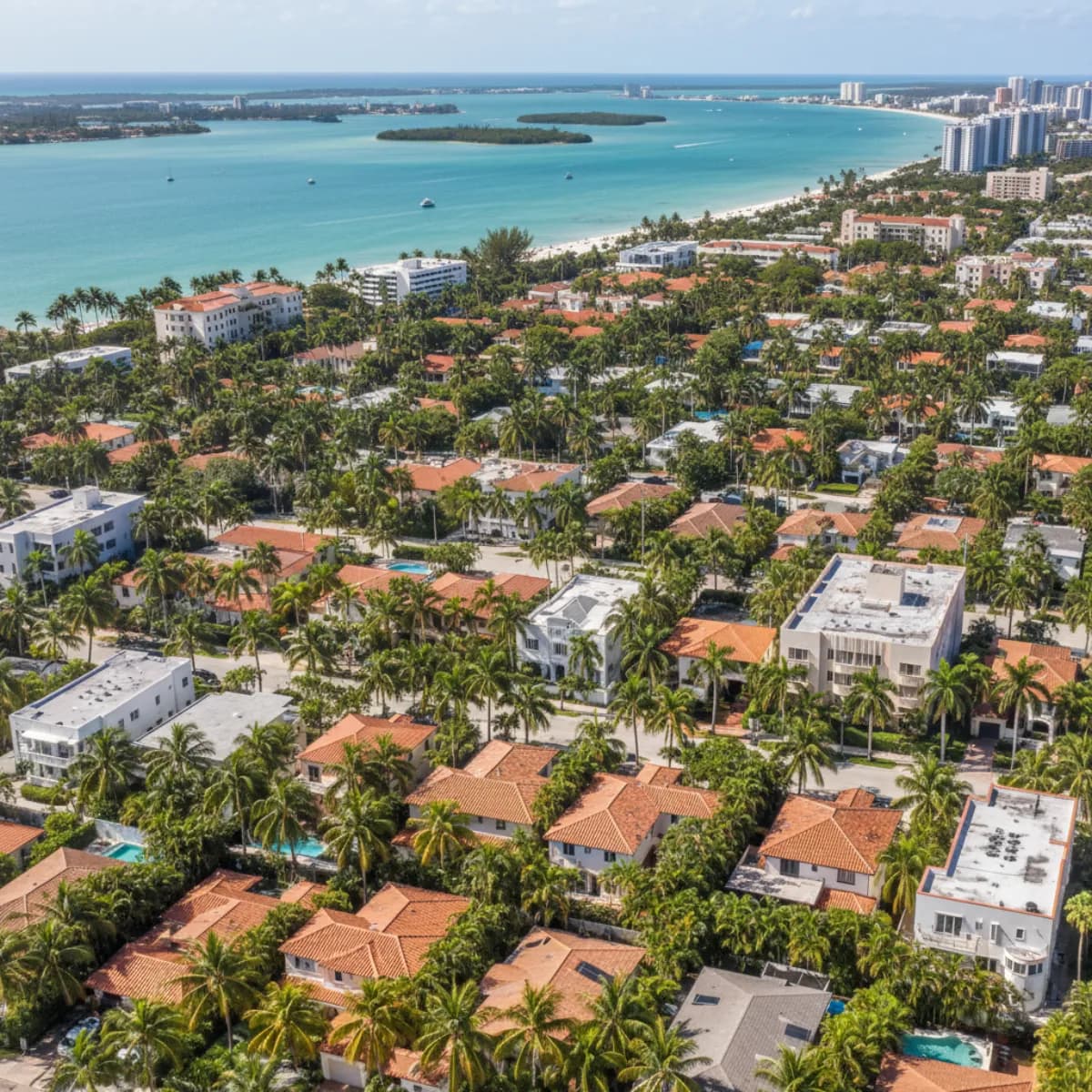
America's Strictest Building Code Zone
Instant Roof Replacement Quotes in Miami, FL
Miami sits in the High Velocity Hurricane Zone (HVHZ) — the strictest building code zone in the United States. Every roofing product must carry a Miami-Dade Notice of Acceptance, and every installation must withstand Category 5 winds. Get instant quotes from pre-vetted Florida CCC-licensed contractors who specialize in HVHZ-compliant roofing across Coral Gables, Coconut Grove, Brickell, Miami Beach, and every Miami-Dade neighborhood.
Free Quotes
no obligations ever
Contractor Bids
standardized scope comparison
Until You Choose
no spam, no lead resale
FL Contractors
CCC-licensed, insured, reviewed
Miami at a Glance
Population (City)
2.7M+ in Miami-Dade County
MPH Wind Rating
Category 5 hurricane design
Building Code Zone
Strictest in the United States
Permit Cost
Miami-Dade re-roof permits
Product Certification
Required for all roofing products
Hurricane Andrew
Catalyst for HVHZ building codes
Why Miami Has the Strictest Roofing Code in America
On August 24, 1992, Hurricane Andrew made landfall in Homestead as a Category 5 storm with sustained winds of 165 mph and gusts exceeding 175 mph. The destruction was catastrophic: 25,524 homes destroyed, 101,241 damaged, and $27.3 billion in damage (over $58 billion in today's dollars). Investigations revealed that a staggering number of failures were caused not by the storm's raw power, but by substandard building practices and inadequate code enforcement. Roofs were torn away by winds well below their rated capacity because fasteners, underlayment, and installation methods failed to meet even the existing standards of the time.
The result was a complete overhaul of South Florida's building codes. Miami-Dade County created the High Velocity Hurricane Zone (HVHZ), which established the most stringent building requirements in the United States. Every roofing product sold for installation in the HVHZ must undergo independent testing and receive a Miami-Dade Notice of Acceptance (NOA) — a certification process that goes far beyond the standard Florida Product Approvals used in the rest of the state. Today, more than three decades after Andrew, Miami's building code remains the gold standard for hurricane resistance in residential construction, and homes built or re-roofed under these codes have proven dramatically more resilient in subsequent storms.
For homeowners, this means that a Miami roof replacement is not just about aesthetics or weatherproofing — it is an engineering project. Every component, from the underlayment to the ridge cap adhesive, must be NOA-certified. Every installation method must follow the specific protocols outlined in the product's NOA documentation. And every project must pass the HVHZ inspection process, which is the most rigorous in the state. RoofVista's pre-vetted contractors in Miami-Dade understand these requirements inside and out, and our standardized quotes make it easy to compare pricing from contractors who all meet the same high bar.
Roofing Challenges Unique to Miami
Miami's subtropical coastal location creates a combination of environmental stresses that are unmatched anywhere else in the continental United States. Roofing materials and installation methods must simultaneously withstand hurricane-force winds, salt air corrosion, extreme UV degradation, torrential rainfall, and relentless year-round heat. Here are the primary challenges that define Miami roofing.
! Category 5 Hurricane Winds
Miami's HVHZ building code requires all roofing systems to withstand design wind speeds of 185+ mph — equivalent to a Category 5 hurricane. This is not a theoretical requirement. Miami-Dade County has been struck or threatened by major hurricanes including Andrew (1992, Cat 5), Wilma (2005, Cat 3), Irma (2017, Cat 4), and Ian (2022). Every roofing product must pass wind uplift testing under TAS 202 protocols, and installation methods must use enhanced nail patterns, hurricane clips, and sealed roof-to-wall connections.
- - 185+ mph design wind speed (HVHZ requirement)
- - TAS 202 wind uplift testing for all products
- - Enhanced 6-nail pattern for shingles
- - Hurricane clips at every truss-to-wall connection
~ Salt Air Coastal Corrosion
With Biscayne Bay to the east and the Everglades to the west, virtually all of Miami-Dade County is exposed to salt-laden ocean air. This corrosive environment attacks metal fasteners, flashing, gutters, and roofing components with relentless efficiency. Standard galvanized steel fasteners can begin corroding within 2-3 years in coastal Miami zones. Homes on Miami Beach, Key Biscayne, and barrier island communities face the most severe salt exposure, but even inland neighborhoods like Doral and Kendall experience significant corrosion effects.
- - Stainless steel or hot-dipped galvanized fasteners required
- - Marine-grade coatings for metal roofing
- - Aluminum or copper flashing (no standard steel)
- - Annual inspections for corrosion on coastal homes
= Extreme UV & Year-Round Heat
Miami receives approximately 248 sunny days per year, with a UV index that regularly reaches 11+ (extreme) during summer months. Roof surface temperatures routinely exceed 160 degrees F in summer. This relentless UV exposure causes accelerated degradation of asphalt shingles, dries out sealant strips, and breaks down polymer-based underlayment. Standard 3-tab shingles, already uncommon in Miami due to HVHZ requirements, may last only 12-15 years compared to their 20-year rated lifespan. High-quality, UV-resistant materials with SBS-modified asphalt technology are essential for longevity in Miami's climate.
- - UV Index 11+ (extreme) during summer months
- - SBS-modified shingles resist UV degradation
- - Reflective tile and metal reduce attic temperatures
- - Light-colored roofing lowers cooling costs 10-20%
# Tropical Rainfall & Wind-Driven Rain
Miami averages 62 inches of rainfall per year — roughly 50% more than the national average — concentrated in intense tropical downpours from May through October. When combined with hurricane-force winds, rain becomes a horizontal projectile that exploits any gap in the roofing system. HVHZ code requires all roofing assemblies to pass TAS 100 wind-driven rain testing. Secondary water resistance (SWR) is critical: a self-adhering peel-and-stick underlayment or foam-adhered roof deck provides backup waterproofing if the primary roofing is compromised during a storm.
- - 62 inches annual rainfall (concentrated May-Oct)
- - TAS 100 wind-driven rain testing required
- - Secondary water resistance (SWR) recommended
- - Peel-and-stick underlayment for wind mitigation credit
Miami Roof Replacement Cost by Material
Miami roofing costs reflect the premium required for HVHZ-compliant materials and installation methods. All products must carry a valid Miami-Dade NOA, which limits the available product pool and increases material costs compared to non-HVHZ Florida markets. Installation labor rates in Miami-Dade average $55-$85/hour, and the enhanced fastening, underlayment, and inspection requirements add 15-25% to total project costs compared to standard Florida installations.
Concrete Tile
#1: Concrete Tile (Barrel & Flat)
The dominant roofing material across South Florida, concrete tile accounts for an estimated 60-70% of residential roofs in Miami-Dade County. The barrel (S-tile) profile is ubiquitous in Miami's Spanish Colonial, Mediterranean Revival, and contemporary architecture throughout Coral Gables, Coconut Grove, and Miami Beach. Concrete tile provides inherent wind resistance (individual tiles weigh 9-12 lbs each), Class A fire rating, and a 50-75 year lifespan. With proper NOA-compliant foam adhesive or mechanical fastening, concrete tile systems routinely pass 185+ mph wind tests. The natural thermal mass of concrete also reduces cooling costs by absorbing and slowly releasing heat rather than transferring it directly to the attic space.
Best For:
Most Miami homes, Spanish/Mediterranean styles
Lifespan:
50-75 years
Cost Range:
$25,000 - $55,000
Wind Rating:
185+ mph (NOA-certified)
Standing Seam Metal
#2: Standing Seam Metal
Standing seam metal roofing has surged in popularity across Miami for its exceptional hurricane performance, longevity, and modern aesthetics. A properly installed standing seam system with concealed fasteners and continuous interlocking panels creates a virtually impenetrable wind barrier that consistently exceeds HVHZ requirements. The key in Miami's coastal environment is specifying marine-grade coatings: Galvalume steel with PVDF (Kynar 500) fluoropolymer coating or aluminum panels resist salt corrosion far better than standard galvanized finishes. Standing seam is particularly popular in Wynwood, the Design District, and contemporary renovations throughout Brickell and Edgewater, where its clean lines complement modern architecture.
Best For:
Modern homes, maximum hurricane protection
Lifespan:
40-70 years
Cost Range:
$22,000 - $50,000
Corrosion Protection:
Marine-grade PVDF coating required
Impact-Resistant Shingles
#3: Impact-Resistant SBS-Modified Shingles
For Miami homeowners seeking HVHZ compliance at the most accessible price point, impact-resistant SBS-modified asphalt shingles are the answer. SBS (Styrene-Butadiene-Styrene) polymer modification makes these shingles more flexible and impact-resistant than standard asphalt, allowing them to pass the stringent TAS 201 large missile impact test required for HVHZ installation. These shingles also carry a Class 4 hail impact rating under UL 2218 testing. The SBS modification provides superior UV resistance compared to standard oxidized asphalt, which is critical in Miami's extreme sun environment. When installed with the HVHZ-required 6-nail pattern and compatible NOA-certified underlayment, these shingles can achieve 150+ mph wind ratings, making them a cost-effective option for homes in areas like Kendall, Doral, and Homestead.
Best For:
Budget-conscious homeowners, ranch-style homes
Lifespan:
20-30 years (Miami climate)
Cost Range:
$12,000 - $30,000
Impact Rating:
Class 4 (UL 2218) + TAS 201
TPO / Flat Roof
#4: TPO & Modified Bitumen (Flat Roofs)
Miami's architectural heritage includes a tremendous number of flat-roofed structures — from the iconic Art Deco buildings of South Beach to mid-century modern homes in the MiMo Historic District along the Upper East Side to contemporary Brickell condominiums. White TPO (Thermoplastic Polyolefin) membrane is the standard choice for flat roofs in Miami, providing excellent heat reflection in a city where reducing cooling loads is a year-round priority. In the HVHZ, TPO systems must be mechanically attached or fully adhered with NOA-certified adhesives, and the system must pass wind uplift testing at HVHZ design pressures. Modified bitumen provides superior waterproofing and puncture resistance, making it ideal for flat roofs with rooftop equipment or foot traffic.
Best For:
Art Deco, MiMo, and flat-roofed homes
Lifespan:
20-30 years
Cost Range:
$10,000 - $25,000
Energy Savings:
White TPO reflects 80%+ solar energy
Miami Average Roof Cost: Impact-resistant shingles $12,000-$30,000. Concrete tile $25,000-$55,000. Standing seam metal $22,000-$50,000. Flat/TPO $10,000-$25,000. Miami costs include the HVHZ premium — NOA-certified products, enhanced installation methods, and rigorous inspections add 15-25% compared to non-HVHZ Florida markets. Get your exact price with a free instant estimate.
Miami-Dade Building Requirements for Roofing
HVHZ Regulatory Requirements
Miami-Dade Notice of Acceptance (NOA)
Every roofing component installed in the HVHZ must have a valid Miami-Dade NOA — issued by the Miami-Dade County Product Control Division after independent testing to TAS (Testing Application Standards) protocols. This includes shingles, tiles, underlayment, fasteners, flashing, adhesives, ridge caps, and vents. NOAs are publicly searchable at the Miami-Dade Product Control website. Using products without a valid NOA is a code violation that will fail inspection and may void your insurance coverage.
TAS Testing Protocols
Products seeking NOA certification must pass multiple TAS tests: TAS 201 (large missile impact — a 2x4 timber fired at 50 fps), TAS 202 (uniform static air pressure for wind uplift resistance), TAS 203 (wind-driven rain resistance), and TAS 100 (overall assembly performance). These tests simulate the extreme conditions of a Category 5 hurricane striking Miami and are significantly more demanding than the Florida Product Approval tests used in the rest of the state.
Permit Process (Miami-Dade)
Permit applications must include NOA numbers for all products, a signed and sealed engineer's drawing (required for tile and metal installations), the contractor's CCC license number, and a Notice of Commencement filed with the county clerk. Inspections occur at three stages: initial tie-off (verifying deck preparation and fastening), dry-in (underlayment and secondary water barrier), and final (completed installation). Inspectors specifically verify that every product on the roof matches its listed NOA number.
Wind Mitigation Requirements
Florida Building Code Section 1609 establishes minimum wind design criteria for the HVHZ. All roof-to-wall connections must use approved hurricane straps or clips. Roof decking must be fastened with ring-shank nails at 6-inch spacing (compared to 12-inch in non-HVHZ areas). Secondary water resistance (SWR) is strongly recommended and qualifies homeowners for significant insurance discounts through the OIR-B1-1802 wind mitigation inspection form.
Florida CCC Licensing
Florida requires all roofing contractors to hold a Certified Roofing Contractor (CCC) license issued by the Department of Business and Professional Regulation (DBPR). In Miami-Dade County, contractors must additionally register with the county and demonstrate competency with HVHZ requirements. Verify any contractor's license status at myfloridalicense.com. All RoofVista contractors in Miami carry active CCC licenses, workers' compensation insurance, and a minimum $10,000 surety bond.
Miami Neighborhoods We Serve
From the historic Mediterranean estates of Coral Gables to the high-rises of Brickell and the suburban communities of Kendall and Doral, our pre-vetted contractors serve every corner of Miami-Dade County. Each neighborhood presents unique roofing considerations based on its architectural character, proximity to the coast, and local building department requirements.
Coral Gables
- - Mediterranean Revival architecture
- - Strict Board of Architects review
- - Barrel tile dominant (terra cotta)
- - Historic district material restrictions
- - Separate city permitting from Miami-Dade
Coconut Grove
- - Mix of historic and modern homes
- - Dense tree canopy (debris concerns)
- - Bayfront salt air exposure
- - Peacock Park historic district
- - Tile and metal predominant
Little Havana & Wynwood
- - Older housing stock (1920s-1960s)
- - Flat roofs with parapet walls common
- - Modified bitumen and TPO systems
- - Wynwood Arts District renovations
- - Budget-conscious material options
Miami Beach & Key Biscayne
- - Maximum salt air corrosion exposure
- - Art Deco Historic District restrictions
- - MiMo (Miami Modern) preservation
- - Flat roof systems predominant
- - Marine-grade fasteners mandatory
Brickell & Downtown
- - High-rise and mid-rise condominiums
- - Contemporary flat roof systems
- - TPO and built-up roofing
- - Commercial-grade specifications
- - HOA board approval processes
Kendall, Doral & Homestead
- - Post-Andrew construction (code-compliant)
- - Suburban ranch and two-story homes
- - Concrete tile and shingle mix
- - Homestead: Hurricane Andrew ground zero
- - Large planned communities with HOAs
Insurance Considerations for Miami Homeowners
Florida's Roofing Insurance Crisis & Wind Mitigation
Florida's homeowner insurance market is the most volatile in the nation, and Miami-Dade County is at the epicenter. Multiple private insurers have left the Florida market entirely since 2020, leaving many homeowners dependent on Citizens Property Insurance — the state-backed insurer of last resort that now insures over 1.4 million policies statewide. For Miami homeowners, roof condition and age are the single most important factors in obtaining and maintaining affordable coverage.
Roof Age & Insurance Eligibility
- - Many insurers refuse policies on roofs older than 15 years
- - Citizens requires inspection for roofs over 15 years
- - Coverage may be denied if roof has less than 5 years useful life
- - SB 4-D (2022) protects roofs under 15 years from age-based denial
- - Roof replacement often reduces premiums 20-40% immediately
Wind Mitigation Discounts
- - Florida law mandates insurance discounts for wind mitigation
- - OIR-B1-1802 inspection form documents wind-resistant features
- - Hurricane clips/straps: significant premium reduction
- - Secondary water resistance (peel-and-stick): major discount
- - Impact-resistant covering: additional savings of 10-20%
- - Hip roof geometry: lower premium than gable roofs
Our pre-vetted Miami contractors understand the direct connection between roofing and insurance. They can recommend installations specifically designed to maximize your wind mitigation credits and improve your insurability, potentially saving thousands annually on premiums.
Understanding Wind Mitigation in Miami
Wind mitigation is not just a building code concept in Miami — it is a financial strategy. Florida Statute 627.0629 requires all insurance companies to provide premium discounts for verified wind-resistant construction features. A licensed wind mitigation inspector evaluates your home using the OIR-B1-1802 form and documents specific construction details that determine your discount eligibility. For many Miami homeowners, the annual insurance savings from a new, code-compliant roof effectively pay for a significant portion of the roof replacement over time.
Key Wind Mitigation Features Evaluated
Roof Covering
The type and age of your roof covering. FBC-compliant or Miami-Dade NOA products installed after 2002 qualify for the highest credits. Impact-resistant materials (Class 4 shingles, concrete tile) provide additional discounts.
Roof Deck Attachment
How the plywood decking is fastened to the trusses. Ring-shank nails at 6-inch spacing (Dimension A) qualify for the highest credit. Standard smooth-shank nails at 12-inch spacing receive minimal or no discount.
Roof-to-Wall Connection
How the roof trusses attach to the walls. Single wraps, double wraps, and hurricane clips each provide increasing levels of discount. Toe-nailing (the lowest standard) receives no credit.
Secondary Water Resistance
A sealed roof deck using self-adhering peel-and-stick underlayment provides backup waterproofing if the primary roof covering is lost in a storm. This is one of the highest-value wind mitigation credits available.
Frequently Asked Questions About Miami Roofing
How much does a roof replacement cost in Miami, FL?
Roof replacement in Miami typically costs between $12,000 and $30,000 for impact-resistant SBS-modified asphalt shingles on a standard single-family home. Concrete tile roofs — the most common material in South Florida, accounting for an estimated 60-70% of residential roofs in Miami-Dade County — range from $25,000 to $55,000 depending on tile profile (barrel vs. flat), home size, and roof complexity. Standing seam metal with marine-grade corrosion-resistant coatings runs $22,000-$50,000. Flat roof TPO or modified bitumen systems range from $10,000 to $25,000. Miami's costs are shaped by several unique factors: all products must carry a valid Miami-Dade NOA (which limits the product pool and increases material costs), installation must follow HVHZ-enhanced fastening protocols (6-nail patterns, hurricane clips, sealed underlayment), labor rates average $55-$85/hour, and the HVHZ inspection process is the most rigorous in Florida. These factors combine to make Miami roofing 15-25% more expensive than comparable work in non-HVHZ Florida markets.
What is the HVHZ and how does it affect roofing in Miami?
The High Velocity Hurricane Zone (HVHZ) is a specially designated building code zone covering all of Miami-Dade County and Broward County. Established in the aftermath of Hurricane Andrew's catastrophic damage in 1992, the HVHZ enforces the strictest wind resistance building standards in the United States. For roofing, the HVHZ requires that every product installed — shingles, tiles, underlayment, fasteners, flashing, adhesives, ridge caps, and vents — carry a valid Miami-Dade Notice of Acceptance (NOA). Products that carry a standard Florida Product Approval (used in the rest of the state) are NOT acceptable in the HVHZ unless they also have a separate NOA. The HVHZ requires design wind speeds of 185+ mph (Category 5 equivalent), enhanced fastening methods including 6-nail patterns for shingles and foam adhesive or mechanical fastening for tiles, and a multi-stage inspection process that verifies NOA compliance for every component. This higher standard has proven its value: homes built or re-roofed under HVHZ codes have consistently shown dramatically better performance in subsequent hurricanes including Wilma (2005) and Irma (2017).
What is a Miami-Dade NOA and why does my roof need one?
A Miami-Dade Notice of Acceptance (NOA) is a product certification issued by the Miami-Dade County Product Control Division. It certifies that a roofing product has been independently tested and has passed the rigorous Testing Application Standards (TAS) protocols required for use in the HVHZ. The key TAS tests include: TAS 201 (large missile impact testing, where a 2x4 timber is fired at the product at 50 feet per second), TAS 202 (uniform static air pressure testing for wind uplift resistance), TAS 203 (wind-driven rain resistance testing), and TAS 100 (overall assembly performance under simulated hurricane conditions). Every component of your roofing system needs its own NOA — not just the shingles or tiles, but also the underlayment, fasteners, flashing, ridge caps, and adhesives. NOAs have expiration dates and must be current at the time of installation. Using any product without a valid NOA is a code violation that will result in a failed inspection, may void your homeowner's insurance, and could create legal liability for the contractor. You can verify NOA status through the Miami-Dade County Product Control website. All RoofVista contractors in Miami-Dade use only current, verified NOA products.
What roofing materials are best for Miami's hurricanes and climate?
Miami's combination of Category 5 hurricane potential (185+ mph winds), year-round salt air corrosion, extreme UV exposure (UV Index 11+ in summer), 62 inches of annual rainfall, and temperatures that push roof surfaces above 160 degrees F demands the most durable roofing materials available. Concrete tile (50-75 year lifespan) is the most popular choice in Miami-Dade County, offering inherent wind resistance through its weight (9-12 lbs per tile), Class A fire rating, and natural thermal mass that reduces cooling costs. The barrel (S-tile) profile is the signature look of Miami's Mediterranean and Spanish Colonial architecture. Standing seam metal with marine-grade PVDF (Kynar 500) coatings provides maximum hurricane performance and resists salt air corrosion — ideal for coastal properties in Miami Beach, Key Biscayne, and along Biscayne Bay. Impact-resistant SBS-modified asphalt shingles offer the most affordable HVHZ-compliant option, with polymer modification that provides superior flexibility, UV resistance, and impact performance (Class 4 under UL 2218). For Miami's many flat-roofed structures, white TPO membrane reflects 80%+ of solar energy while withstanding ponding water from tropical downpours.
How do wind mitigation inspections save money on Miami home insurance?
Florida Statute 627.0629 requires all property insurance companies operating in the state to offer premium discounts for homes with verified wind mitigation features. A licensed wind mitigation inspector completes the OIR-B1-1802 form, which evaluates your home across several key categories: roof covering type and FBC/NOA compliance, roof deck attachment method (nail type and spacing), roof-to-wall connection type (toe nails, clips, single wraps, or double wraps), roof geometry (hip roofs receive higher credits than gable roofs), secondary water resistance (sealed roof deck), and opening protection (impact windows and shutters). For Miami homeowners, the potential savings are substantial. A new HVHZ-compliant roof with hurricane clips or straps, ring-shank nails at 6-inch spacing, peel-and-stick SWR underlayment, and impact-resistant roof covering can qualify for 30-60% savings on the wind portion of the insurance premium. Given that wind coverage often represents 60-70% of total premium cost in coastal Miami, these savings can amount to $2,000-$6,000 or more annually. Over the 25-30 year life of a shingle roof, the cumulative insurance savings can offset a significant portion — or even exceed — the cost of the roof replacement itself.
What is the permit process for roof replacement in Miami?
All roof replacements in Miami-Dade County require permits, whether through the Miami-Dade County Building Department for unincorporated areas or through the relevant municipal building department for incorporated cities like Miami, Coral Gables, Miami Beach, or Homestead. The permit application must include: valid NOA numbers for every product to be installed, a signed and sealed structural engineer's drawing (required for tile and metal roof installations), the contractor's active CCC license number, proof of workers' compensation and general liability insurance, and a Notice of Commencement filed with the Miami-Dade County Clerk. Permit fees typically range from $300-$700 depending on project scope and jurisdiction. The HVHZ inspection process is multi-stage and more rigorous than in any other Florida jurisdiction. Inspectors verify: initial tie-off (deck preparation, fastener type and spacing, hurricane strap installation), dry-in (underlayment type and installation, secondary water resistance if applicable), and final inspection (completed roof covering, ridge caps, flashing, and overall NOA compliance for every product). Inspectors will physically verify that the products on the roof match their NOA documentation. Our contractors handle the entire permitting and inspection process on your behalf.
Does my Miami roof's age affect my homeowner's insurance?
Roof age is arguably the single most important factor in obtaining and maintaining affordable homeowner's insurance in Miami-Dade County. Florida's insurance market has contracted dramatically since 2020, with multiple carriers leaving the state entirely and those remaining implementing strict underwriting criteria. Many private insurers will not write new policies on homes with roofs older than 15 years, regardless of the roof's actual condition. Citizens Property Insurance — Florida's state-backed insurer of last resort, which now covers over 1.4 million policies — requires a roof inspection for homes with roofs older than 15 years and may deny coverage if the roof has less than 5 years of estimated remaining useful life. Florida Senate Bill 4-D, enacted in 2022, prohibits insurers from refusing to write or renew policies solely based on roof age for roofs under 15 years old, providing some protection for homeowners with relatively new roofs. However, in practice, older roofs still face significantly higher premiums, higher deductibles, and limited carrier options. A new roof replacement immediately improves your insurability profile, typically reduces premiums by 20-40%, and qualifies you for maximum wind mitigation discounts. For many Miami homeowners, the insurance savings alone justify the investment in a new roof.
What contractor license is required for roofing in Miami, FL?
Florida law requires all roofing contractors to hold one of two license types issued by the Department of Business and Professional Regulation (DBPR): a Certified Roofing Contractor (CCC) license, which is valid statewide, or a Registered Roofing Contractor (RC) license, which is valid only in the county where it is registered. The CCC license is the preferred credential and is required for contractors working across multiple counties. To obtain a CCC license, contractors must pass a state examination, demonstrate a minimum of 4 years of roofing experience, and maintain a $10,000 surety bond plus workers' compensation and general liability insurance. In Miami-Dade County, contractors working in the HVHZ must additionally register with the Miami-Dade County Building Department and demonstrate familiarity with HVHZ-specific requirements including NOA product verification, TAS testing protocols, and enhanced installation standards. Verify any contractor's license status at myfloridalicense.com — this free tool shows license type, status, disciplinary history, and insurance verification. Every RoofVista contractor in Miami-Dade holds an active CCC license, carries the required insurance, and has demonstrated competency with HVHZ roofing requirements.
Florida Roofing Resources
Florida State Overview
All Florida roofing resources and city pages
Florida Roof Replacement Cost Guide
Detailed pricing for all FL regions and materials
Hurricane-Resistant Roofing in Florida
HVHZ requirements, NOA products, and wind ratings
Florida Roofing Building Codes
FBC, HVHZ, and local requirements
Wind Mitigation Guide for Florida
Insurance discounts and inspection details
Florida Contractor Licensing
CCC license requirements and DBPR verification
Get Your Miami Roof Quote in Minutes
Enter your address to compare instant quotes from pre-vetted CCC-licensed Florida contractors who specialize in HVHZ-compliant roofing, Miami-Dade NOA products, and Category 5 hurricane protection