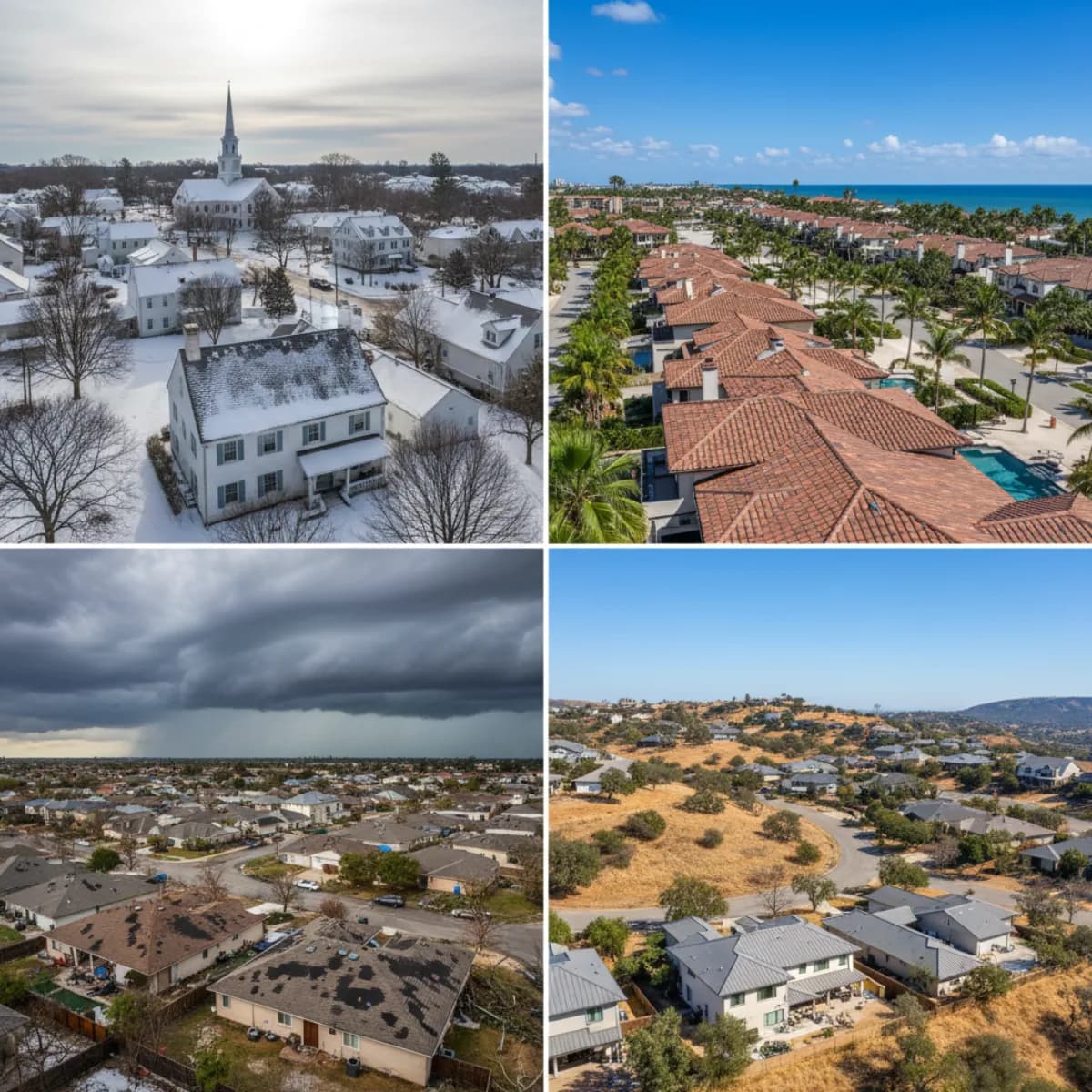
Best Roofing Materials by Climate Zone
Your climate is the single biggest factor in how long your roof lasts. This interactive guide ranks 8 roofing materials across 12 states based on wind, snow, heat, hail, salt air, and fire resistance — so you pick the right material the first time.
Satellite-measured roof area. Instant pricing. No spam.
12
States Analyzed
8
Materials Compared
6
Climate Factors Rated
96
State-Material Combinations
Why Climate Is the #1 Factor in Roofing Material Selection
A roofing material that lasts 30 years in San Diego may fail in 15 years in Buffalo. The difference is climate stress. Every roofing material has specific strengths and weaknesses when exposed to wind, snow, heat, hail, salt air, and fire — and your local climate determines which stresses your roof will face for its entire lifespan.
According to the Insurance Institute for Business and Home Safety (IBHS), climate-inappropriate roofing material selection is a leading cause of premature roof failure. Homeowners in hail-prone areas of Texas who choose standard 3-tab shingles instead of impact-resistant alternatives file claims at 3 times the rate. Coastal New England homeowners who install untreated cedar shakes see 40% shorter lifespans than those who choose salt-resistant alternatives. In California wildfire interface zones, non-Class A fire-rated materials are not just a bad choice — they are illegal.
This guide eliminates the guesswork. We rate 8 common roofing materials across 6 climate performance factors, then weight those ratings against the specific climate challenges in each of our 12 service states. The result is a personalized ranking that tells you exactly which material will perform best on your home — and which materials to avoid.
Four Climate Zones Across Our 12 States
Each climate zone presents unique challenges that determine which roofing materials perform best and which ones fail prematurely.
Northeast Snow Belt
MA, CT, RI, NH, VT, ME, NY, NJ, PA
The Northeast Snow Belt is defined by freeze-thaw cycles, heavy snowfall (up to 120 inches annually in Vermont), ice dam formation, and nor'easter winds exceeding 70 mph. Materials must resist thermal expansion and contraction, shed snow effectively, and handle moisture infiltration from ice dams. The limited installation season (April through November) also affects contractor availability and pricing.
Gulf Coast Hurricane Zone
FL, TX (Gulf Coastal Areas)
The Gulf Coast faces the most intense wind events in the continental United States. Hurricane-force winds exceeding 130 mph, wind-driven rain, salt air corrosion, and extreme humidity create an environment where only the most wind-resistant and moisture-tolerant materials survive. Florida building code mandates a minimum 110 mph wind rating for all roofing materials. Post-Hurricane Sandy, New Jersey coastal codes have adopted similar requirements.
Sun Belt / Extreme Heat
TX (Inland), CA (Inland/Southern)
Extreme heat zones expose roofing materials to sustained temperatures above 100°F, intense UV radiation that degrades organic compounds, and thermal cycling that causes expansion and contraction damage. Standard asphalt shingles lose granules 40% faster in extreme heat zones compared to temperate climates. Reflective and high thermal mass materials outperform traditional options here while also reducing cooling costs by 10 to 25 percent.
Wildfire Interface Zone
CA (WUI Designated Areas)
California's Wildland-Urban Interface (WUI) zones require Class A fire-rated roofing materials by law. Ember exposure, radiant heat, and direct flame contact are all tested in the ASTM E108 fire rating standard. Cedar shakes are explicitly banned in WUI zones. Metal, tile, and slate all meet Class A requirements, while standard asphalt shingles must be specifically rated. Santa Ana winds compound fire risk by carrying embers miles from the fire source.
Climate Zone Roof Material Advisor
Select your state and top priority below. Our algorithm cross-references your climate challenges with each material's performance ratings to produce a personalized ranking with match scores.
Select Your State
Material Deep Dives: Performance by Climate
How each of the 8 roofing materials performs across different climate zones, with specific recommendations for each state.
1. 3-Tab Shingles
3-tab shingles are the most affordable roofing option but also the most climate-sensitive. Their single-layer construction and lower wind ratings make them vulnerable in extreme conditions. In temperate climates with moderate wind and precipitation, 3-tab shingles provide adequate protection at the lowest cost. In harsh climates, they fail prematurely and cost more in the long run due to early replacement.
Best States
PA (southeast), NJ (inland) — Moderate climates with lower wind and hail exposure allow 3-tab shingles to reach their full 15-20 year lifespan. Budget homeowners in these areas get acceptable performance.
Worst States
FL, TX, CA — Florida building code eliminates most 3-tab products (110 mph minimum). Texas heat and hail destroy them in 12-15 years. California fire codes exclude many non-Class A rated 3-tab products.
Lifespan (Cold)
12-18 years
Lifespan (Hot)
12-15 years
Lifespan (Temperate)
15-20 years
Cost Range
$3.50-$5.50/sqft
- + Lowest upfront cost of any roofing material
- + Widely available; any roofer can install
- + Easy to repair individual damaged tabs
- - Shortest lifespan in extreme heat or cold
- - Low wind rating (60-80 mph typical)
- - No hail resistance; cracks on impact
2. Architectural Shingles
Architectural shingles (also called dimensional or laminated shingles) are the most popular residential roofing material in the United States. Their multi-layer construction provides better wind resistance, longer lifespans, and a more dimensional aesthetic compared to 3-tab alternatives. Architectural shingles perform acceptably in most climates but are outperformed by specialized materials in extreme conditions.
Best States
MA, CT, NY, PA, NJ — Northeast states with moderate-to-heavy snow and freeze-thaw cycles. Architectural shingles with ice and water shield provide the best value proposition in these climates.
Worst States
FL, TX (Gulf), CA (WUI) — Standard architectural shingles underperform in extreme heat, high wind, and fire zones. Upgraded versions (algae-resistant, high-wind) mitigate some concerns but add cost.
Lifespan (Cold)
20-25 years
Lifespan (Hot)
18-22 years
Lifespan (Temperate)
25-30 years
Cost Range
$5.00-$8.50/sqft
- + Best overall value for most climates
- + 110-130 mph wind ratings available
- + Wide variety of colors and profiles
- - Shorter lifespan than metal, slate, or tile
- - Vulnerable to moss and algae in humid areas
- - Moderate hail resistance (not Class 4)
3. Impact-Resistant Shingles
Impact-resistant shingles are engineered with a modified polymer backing or rubberized asphalt layer that absorbs hail impact without cracking. Class 4 impact-rated shingles withstand a 2-inch steel ball dropped from 20 feet. They are the preferred material in hail-prone regions because insurance companies offer 10 to 28 percent premium discounts for Class 4 rated roofs. Their enhanced construction also improves wind resistance to 110-130 mph.
Best States
TX, PA, NY, NJ — Texas hail alley and Pennsylvania hail corridor make impact-resistant shingles the smart financial choice. Insurance discounts often offset the premium cost within 3-5 years.
Worst States
FL, CA — Florida requires wind ratings that many impact shingles meet, but salt air and humidity still limit lifespan. California WUI zones need Class A fire rating, which not all impact shingles carry.
Lifespan (Cold)
25-30 years
Lifespan (Hot)
22-28 years
Lifespan (Temperate)
30-35 years
Cost Range
$6.50-$10.00/sqft
- + Class 4 hail rating (best available for shingles)
- + Insurance discounts of 10-28% in hail zones
- + Enhanced wind resistance (110-130 mph)
- - 20-30% premium over standard architectural
- - Still a shingle — 30-35 year maximum lifespan
- - Limited color and style options vs. architectural
4. Standing Seam Metal
Standing seam metal roofing is the most climate-versatile material available. Its continuous interlocking panel design creates a virtually impenetrable barrier against wind, water, snow, and fire. Metal roofs reflect solar radiation in hot climates, shed snow in cold climates, resist salt air when aluminum or Galvalume panels are used, and carry a Class A fire rating in wildfire zones. The 40-70 year lifespan eliminates at least one full re-roofing cycle that shingle roofs require.
Best States
All 12 states — Metal is the top-ranked or second-ranked material in every state we serve. It excels especially in VT, NH, ME (snow shedding), FL (hurricane wind), and CA (fire rating).
Climate Considerations
RI, ME, NJ, FL (coastal) — Coastal salt air requires aluminum or Galvalume panels rather than standard steel. Standard painted steel can corrode within 5-10 years in direct salt exposure.
Lifespan (Cold)
40-60 years
Lifespan (Hot)
40-50 years
Lifespan (Coastal)
35-50 yrs (aluminum)
Cost Range
$10.00-$16.00/sqft
- + 140+ mph wind rating (highest of any material)
- + Natural snow shedding prevents ice dams
- + Class A fire rated; 100% recyclable
- - Highest upfront cost after slate
- - Specialized installation required
- - Can dent in severe hail (cosmetic, not functional)
5. Natural Slate
Natural slate is the most durable roofing material ever used in residential construction, with documented lifespans exceeding 200 years. Quarried from metamorphic rock, slate is naturally fireproof, waterproof, and resistant to virtually all climate stresses except hail impact (which can crack individual tiles) and extreme weight considerations in earthquake zones. Vermont is the largest slate-producing state in the US, making locally sourced slate more affordable in New England than anywhere else.
Best States
VT, NH, MA, CT, NY, PA — Northeast states with historic architecture and proximity to Vermont quarries. Slate is the gold standard for colonial, Victorian, and Federal homes.
Worst States
FL, TX, CA — Few qualified installers, extreme weight in earthquake zones (CA), thermal expansion risk in extreme heat (TX), and impractical cost in markets where slate has no aesthetic tradition.
Lifespan (Cold)
75-200 years
Lifespan (Hot)
60-100 years
Lifespan (Temperate)
100-200 years
Cost Range
$15.00-$30.00/sqft
- + Longest lifespan of any material (75-200+ years)
- + Naturally fireproof (Class A without treatment)
- + Increases home value 5-10% in premium markets
- - Heaviest material (7-10 lbs/sqft); may need reinforcement
- - Highest cost of any roofing material
- - Very few qualified installers outside the Northeast
6. Cedar Shakes
Cedar shakes offer unmatched natural beauty and excellent insulation properties. Western red cedar contains natural preservative oils (thujaplicins) that resist decay and insects. However, cedar is the most climate-sensitive premium material. It performs best in dry, moderate climates and deteriorates rapidly in humidity, salt air, and extreme heat. Untreated cedar is also a significant fire hazard, making it illegal in California WUI zones and restricted in many urban areas.
Best States
VT, NH (inland), MA (inland) — Dry inland areas of northern New England where cedar's natural insulation is most valuable and humidity is manageable. Historic Cape Cod and colonial homes benefit aesthetically.
Worst States
FL, TX, CA, RI, NJ (coastal) — Florida humidity causes rapid rot and mold. Texas heat and drought create fire risk. California bans cedar in WUI zones. Coastal salt air destroys cedar in 15-20 years.
Lifespan (Cold/Dry)
30-40 years
Lifespan (Humid)
15-20 years
Lifespan (Coastal)
15-20 years
Cost Range
$9.00-$16.00/sqft
- + Beautiful natural aesthetic; ages to silver-gray
- + Excellent natural insulation (R-value 3.0+)
- +Eco-friendly and biodegradable
- - High maintenance (annual treatment needed)
- - Major fire risk; banned in CA WUI zones
- - Rapid deterioration in humidity and salt air
7. Clay/Concrete Tile
Clay and concrete tile roofing provides exceptional thermal mass that slows heat transfer, making it the premier material for hot climates. Tile roofs are common on Mediterranean, Spanish Colonial, and Mission-style homes throughout Florida, Texas, and California. Properly installed tile withstands hurricane-force winds and carries a Class A fire rating. However, tile is extremely heavy (9-12 lbs/sqft) and performs poorly in freeze-thaw conditions where absorbed moisture expands and cracks the material.
Best States
FL, TX, CA — Tile thrives in hot, dry, or subtropical climates. Its thermal mass reduces cooling costs by 10-25%. Class A fire rating meets CA WUI requirements. Hurricane clips secure it in FL wind zones.
Worst States
VT, NH, ME, NY (upstate) — Freeze-thaw cycles crack tile within 10-15 years. Heavy snow loads stress already-heavy tile installations. Not recommended above 40 inches annual snowfall.
Lifespan (Hot/Dry)
50-100 years
Lifespan (Subtropical)
40-75 years
Lifespan (Cold)
10-20 yrs (NOT recommended)
Cost Range
$10.00-$20.00/sqft
- + Excellent thermal mass reduces cooling costs 10-25%
- + Class A fire rated; handles hurricane winds
- + 50-100 year lifespan in appropriate climates
- - Extremely heavy (may need structural reinforcement)
- - Freeze-thaw destroys tile in cold climates
- - Brittle; cracks if walked on during maintenance
8. TPO/Flat Membrane
Thermoplastic polyolefin (TPO) is the dominant material for low-slope and flat roofs on both commercial and residential buildings. TPO membranes are heat-welded at seams, creating a monolithic waterproof barrier. White TPO reflects up to 80% of solar radiation, making it the most energy-efficient roofing surface available. TPO performs well in hot climates but has limited puncture resistance and shorter lifespans than steep-slope materials. In cold climates, TPO requires robust drainage design to prevent ponding water and ice dam formation.
Best States
TX, FL, CA, NY (urban) — Hot climates benefit most from TPO reflectivity. Urban rowhomes and brownstones with flat roofs in NYC and Philadelphia use TPO extensively.
Worst States
VT, NH, ME — Heavy snow loads (80-120 inches) on flat roofs create structural and drainage challenges. Ponding water from snowmelt accelerates TPO degradation and ice dam formation.
Lifespan (Hot)
20-25 years
Lifespan (Cold)
15-20 years
Lifespan (Temperate)
18-25 years
Cost Range
$5.00-$9.00/sqft
- + Best solar reflectivity (80%+) for energy savings
- + Only option for low-slope and flat roofs
- +Heat-welded seams for monolithic waterproofing
- - Limited puncture resistance from foot traffic or debris
- - Shorter lifespan than steep-slope alternatives
- - Ponding water risk on improperly sloped flat roofs
State-by-State Roofing Material Recommendations
Our top two material picks for each of the 12 states we serve, based on local climate challenges, building codes, and performance data.
| State | #1 Pick | #2 Pick |
|---|---|---|
| Massachusetts | Standing Seam Metal | Architectural Shingles |
| Connecticut | Standing Seam Metal | Impact-Resistant Shingles |
| Rhode Island | Standing Seam Metal (Aluminum) | Impact-Resistant Shingles |
| New Hampshire | Standing Seam Metal | Natural Slate |
| Vermont | Standing Seam Metal | Natural Slate |
| Maine | Standing Seam Metal (Aluminum) | Architectural Shingles |
| New York | Standing Seam Metal | Impact-Resistant Shingles |
| New Jersey | Standing Seam Metal (Aluminum) | Impact-Resistant Shingles |
| Pennsylvania | Impact-Resistant Shingles | Standing Seam Metal |
| Texas | Impact-Resistant Shingles | Standing Seam Metal |
| Florida | Standing Seam Metal | Clay/Concrete Tile |
| California | Standing Seam Metal | Clay/Concrete Tile |
Roofing Materials & Climate: Frequently Asked Questions
What is the best roofing material for cold climates?
Standing seam metal roofing is the best material for cold climates. It sheds snow and ice naturally, prevents ice dam formation, and withstands freeze-thaw cycles without cracking or curling. Architectural shingles are the best value option for cold climates, while natural slate is the premium choice for longevity in northern states. All cold-climate roofs should include ice and water shield membrane extending at least 24 inches past the interior wall line.
What roofing material lasts longest in hot weather?
Clay and concrete tile lasts the longest in hot climates, with lifespans of 50 to 100 years. Tile has natural thermal mass that slows heat transfer, keeping homes cooler. Standing seam metal roofing with reflective coatings is the second-best choice, lasting 40 to 70 years while reflecting solar radiation. Natural slate also performs exceptionally in heat but is heavier and more expensive. Avoid standard 3-tab shingles in extreme heat zones as they typically last only 12 to 15 years due to UV degradation and thermal cycling.
What is the best roof for hurricane zones?
Standing seam metal roofing is the best choice for hurricane zones, with wind ratings exceeding 140 mph. The continuous interlocking panel design resists uplift far better than individual shingles or tiles. Impact-resistant shingles rated Class 4 are the best value option for hurricane-prone areas, offering 110 to 130 mph wind resistance at a lower cost than metal. Florida building code requires all roofing materials to meet a minimum 110 mph wind rating. Clay tile is also excellent in hurricane zones when properly fastened with hurricane clips.
Does climate affect roof warranty?
Yes, climate significantly affects roof warranty coverage and duration. Many manufacturer warranties are prorated based on the installation region. Harsh climates with extreme UV, heavy snow loads, or salt air exposure can void or reduce warranty coverage if specific installation requirements are not met. For example, metal roofing in coastal areas may require aluminum or Galvalume panels rather than standard steel to maintain warranty coverage. Always verify that your chosen material warranty covers your specific climate conditions.
What is the best roofing material for snow?
Standing seam metal is the top roofing material for heavy snow areas. Snow slides off the smooth, continuous surface rather than accumulating, reducing snow loads and eliminating ice dam formation. In Vermont and New Hampshire where annual snowfall exceeds 80 inches, metal roofing can prevent thousands of dollars in ice dam damage over its lifetime. Architectural shingles with proper ventilation and ice and water shield are the most cost-effective option for moderate snow zones. Avoid clay tile in heavy snow areas as freeze-thaw cycles crack the material.
What roof is best for coastal homes?
For coastal homes, standing seam metal roofing in aluminum or Galvalume is the best choice. These materials resist salt air corrosion while handling high winds from coastal storms. Natural slate is another excellent coastal option because it is naturally impervious to salt damage. Avoid standard steel metal panels in coastal areas because salt air causes rapid corrosion. Cedar shakes, while aesthetically pleasing on coastal homes, deteriorate quickly in humid salt air environments and require extensive maintenance.
Is metal roofing good for all climates?
Standing seam metal roofing performs well in nearly all climates, making it the most versatile roofing material available. It excels in cold climates by shedding snow, in hot climates by reflecting solar heat, in hurricane zones with 140 plus mph wind ratings, and in wildfire zones with a Class A fire rating. The only climate consideration is coastal salt air, where aluminum or Galvalume panels should be used instead of standard steel. Metal roofing is rated 8 out of 10 or higher across wind, snow, heat, and fire resistance categories.
What is the most fire-resistant roofing material?
Standing seam metal, natural slate, and clay or concrete tile all carry Class A fire ratings, the highest available. Metal and tile are the most commonly used fire-resistant materials in California wildfire interface zones. Cedar shakes are the least fire-resistant common roofing material and are banned in California WUI zones. Even fire-treated cedar only achieves a Class B rating. In wildfire-prone areas, California building code requires Class A fire-rated roofing, which eliminates untreated wood options entirely.
How does humidity affect roof lifespan?
High humidity reduces the lifespan of organic roofing materials by 20 to 40 percent. Cedar shakes in humid climates like Florida or coastal New Jersey may last only 15 to 20 years compared to 30 to 40 years in dry climates. Humidity promotes moss, algae, and mold growth on asphalt shingles, accelerating granule loss and material breakdown. Architectural shingles with algae-resistant granules last 5 to 8 years longer than standard versions in humid areas. Inorganic materials like metal, slate, and tile are largely unaffected by humidity.
What roofing material has the best ROI?
Architectural shingles offer the best return on investment for most homeowners, delivering 60 to 70 percent cost recovery at resale with the lowest upfront investment. Standing seam metal roofing offers the best long-term ROI because its 40 to 70 year lifespan eliminates one or two full re-roofing cycles that shingle roofs require. In premium markets, natural slate can increase home value by 5 to 10 percent. The best ROI also depends on climate: impact-resistant shingles in hail-prone Texas can reduce insurance premiums by 10 to 28 percent, while metal roofing in snow-heavy Vermont eliminates thousands in annual ice dam repairs.
Related Guides & State Cost Data
Dive deeper into roofing costs, materials, and building codes for your specific state.
State Cost Guides
More State Cost Guides
Get an Instant Quote for the Right Material
Our satellite-powered estimator measures your exact roof area and calculates pricing for every material rated in this guide. Compare quotes from pre-vetted local contractors in minutes.
Instant satellite measurement. Side-by-side material pricing. No spam ever.