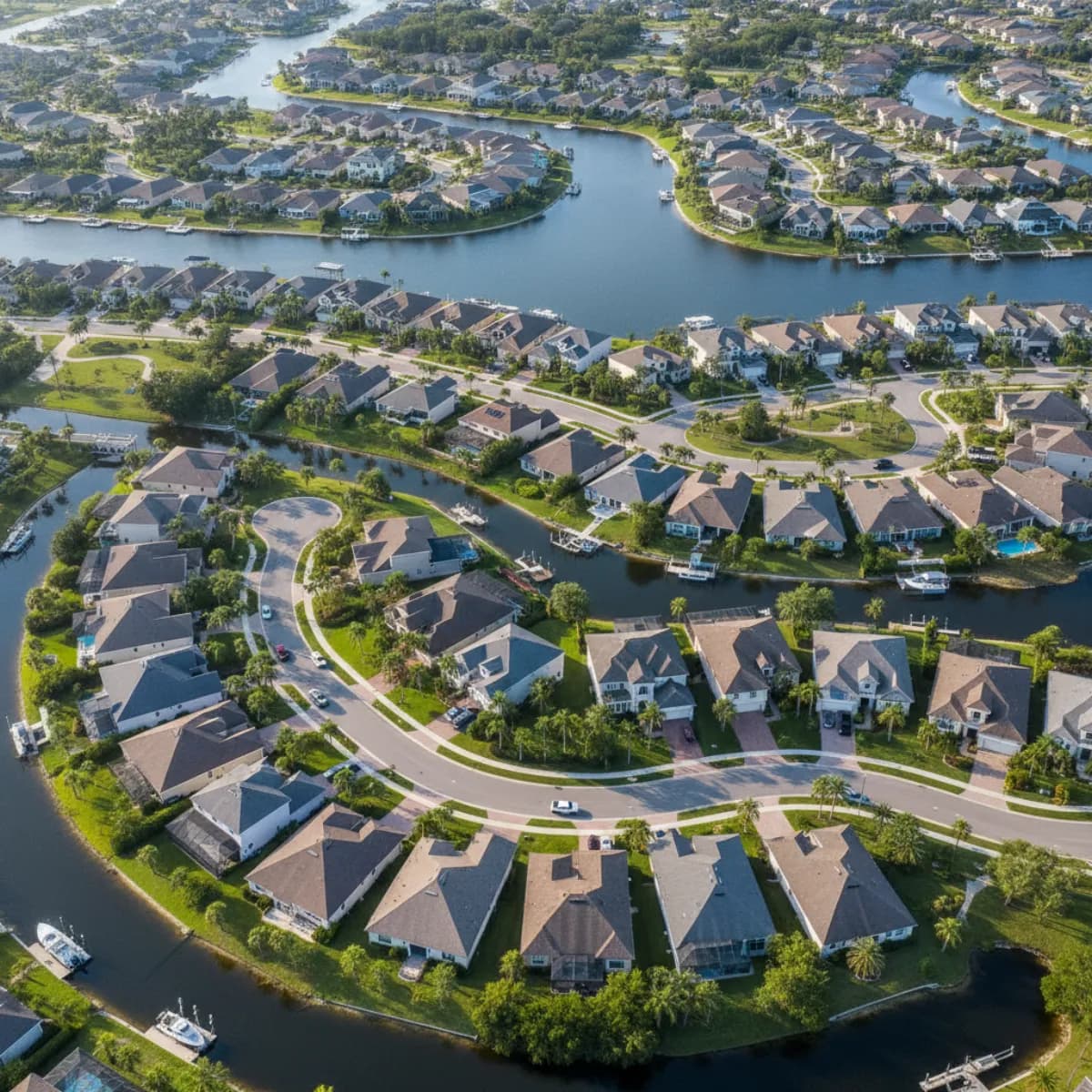
Flagler County's Master-Planned Community
Instant Roof Replacement Quotes in Palm Coast, FL
Palm Coast is one of Northeast Florida's fastest-growing cities, with thousands of homes built across its master-planned canal communities now reaching the age where roof replacement becomes essential. From canal-front properties along the Intracoastal Waterway to golf course neighborhoods in Grand Haven, get instant quotes from pre-vetted Florida CCC-licensed contractors who specialize in hurricane-rated roofing across all of Flagler County.
Free Quotes
no obligations ever
Contractor Bids
standardized scope comparison
Until You Choose
no spam, no lead resale
FL Contractors
CCC-licensed, insured, reviewed
Palm Coast at a Glance
Population
One of FL's fastest-growing cities
MPH Wind Rating
FBC high-wind design speed
Miles of Canals
Saltwater canal system
Avg Roof Cost
Material and size dependent
ITT Origins
Master-planned community
County
Between Jacksonville & Daytona
Why Palm Coast Homeowners Are Replacing Roofs Now
Palm Coast began as one of the most ambitious master-planned community developments in American history. In the late 1960s, ITT Community Development Corporation purchased 42,000 acres of Florida pine flatwoods and scrubland between Jacksonville and Daytona Beach and began carving out what would become a city of over 95,000 residents. The company dredged more than 70 miles of saltwater canals connected to the Intracoastal Waterway, platted nearly 100,000 residential lots across lettered sections (from Section A through Section Z and beyond), and installed the infrastructure for a massive retirement and family-oriented community along Florida's northeastern Atlantic coast.
The bulk of Palm Coast's residential construction occurred in two distinct waves. The first wave, from the late 1970s through the early 1990s, produced thousands of single-story concrete block homes with gable or hip roofs designed for architectural shingle installation. These original homes — many now 30 to 45 years old — are reaching the end of their second or even third roof lifecycle. The second wave of construction came during the Florida building boom of 2000-2007, producing newer homes built to modern FBC standards. Today, both waves of construction are generating tremendous demand for roof replacement: the older homes need upgraded roofing to meet current wind code requirements and insurance standards, while the 2000s-era homes are approaching their first shingle replacement cycle.
Palm Coast's geographic position along the NE Florida coast exposes it to the full force of Atlantic hurricanes. The devastating impacts of Hurricane Matthew in 2016, which brought sustained winds over 100 mph and catastrophic flooding through the city's canal system, proved that Palm Coast is not immune to major storm damage. Hurricane Irma in 2017 and Hurricane Ian's flooding in 2022 reinforced this reality. For homeowners in a community where many original roofs predate modern Florida Building Code standards, upgrading to current hurricane-rated materials and installation methods is not optional — it is the single most important investment for protecting your home and maintaining insurance eligibility. RoofVista's pre-vetted contractors in Flagler County understand the specific challenges of Palm Coast's housing stock, canal-front exposure, and wind zone requirements.
Roofing Challenges Unique to Palm Coast
Palm Coast's position on the northeast Florida coast, between the Atlantic Ocean and the Intracoastal Waterway, creates a distinct set of environmental stresses that roofing systems must withstand. The combination of hurricane-force wind potential, salt air from both ocean and canal exposure, subtropical heat and UV, and the ever-present flood risk from the city's low-lying canal neighborhoods defines what makes roofing in Palm Coast different from inland Florida communities.
! Hurricane Wind Exposure
Palm Coast sits in a 130+ mph wind zone under the Florida Building Code, reflecting its vulnerability to major Atlantic hurricanes. The city's position on the NE Florida coast places it directly in the path of storms tracking northward along the Atlantic seaboard. Hurricane Matthew in October 2016 was the defining modern storm event — its eye passed just offshore with sustained winds exceeding 100 mph, tearing shingles, lifting flashing, and causing widespread roof damage across every section of the city. The flat, low-lying terrain offers no topographic windbreak, meaning homes throughout Palm Coast face uniform wind exposure regardless of neighborhood.
- - 130+ mph FBC design wind speed
- - Hurricane Matthew (2016): 100+ mph sustained winds
- - Flat terrain provides no natural wind protection
- - Enhanced nail patterns and hurricane clips required
# Canal System Flooding & Moisture
Palm Coast's defining geographic feature is its extensive canal system — over 70 miles of man-made saltwater canals that connect to the Intracoastal Waterway and ultimately the Atlantic Ocean. While these canals provide desirable waterfront living, they also create serious flood risk. During Hurricane Matthew, storm surge pushed ocean water backward through the canal system, flooding hundreds of homes. Hurricane Ian in 2022 caused similar canal flooding. Homes along these canals face elevated humidity and moisture exposure year-round, which accelerates underlayment degradation, promotes algae and mold growth on roof surfaces, and can compromise wood decking if the roof system is not properly ventilated.
- - 70+ miles of saltwater canals
- - FEMA flood zone overlap on canal properties
- - Elevated humidity degrades underlayment
- - Proper attic ventilation is critical
~ Atlantic Salt Air Corrosion
With the Atlantic Ocean just miles east and the Intracoastal Waterway running through the city, Palm Coast homes are exposed to persistent salt-laden air that corrodes metal roofing components. Properties closest to the coast — in the Hammock area, along Flagler Beach, and on canal-front lots — experience the most severe corrosion. Standard galvanized steel fasteners, flashing, and vents can begin showing corrosion within 3-5 years. The salt air environment also accelerates the degradation of metal roof coatings and gutter systems. While Palm Coast is not as severely affected as South Florida's barrier islands, the salt air factor is still a significant consideration when selecting materials.
- - Proximity to Atlantic and Intracoastal Waterway
- - Galvanized fasteners corrode within 3-5 years
- - Stainless steel fasteners recommended for canal-front
- - Marine-grade coatings for metal roofing near coast
= Subtropical UV & Aging Housing Stock
Palm Coast's subtropical climate delivers intense UV radiation year-round, with summer surface temperatures on dark-colored shingle roofs reaching 150+ degrees F. This UV exposure accelerates granule loss on asphalt shingles, dries out sealant strips, and degrades polymer-based underlayment. The effect is compounded by Palm Coast's aging housing stock — thousands of homes built in the 1970s-1990s have roofs that have endured decades of UV bombardment on top of multiple hurricane events. Many of these older roofs were installed with 3-tab shingles and outdated underlayment that predates current FBC requirements, making them both structurally vulnerable and a liability for insurance eligibility.
- - 150+ degree F roof surface temperatures in summer
- - Accelerated granule loss on architectural shingles
- - Many homes 30-45 years old with outdated roofing
- - UV-resistant SBS-modified shingles recommended
Palm Coast Roof Replacement Cost by Material
Palm Coast roofing costs reflect Northeast Florida's moderate market — more affordable than South Florida's HVHZ zones but still influenced by the Florida Building Code's 130+ mph wind requirements and Flagler County's permitting process. The city's prevalence of larger single-story homes (1,400-2,200 sq ft of living space, translating to 1,600-2,800 sq ft of roof area) means that total project costs can vary significantly based on roof size. Labor rates in the Flagler County market average $40-$60 per hour, lower than the Jacksonville or Orlando metros.
Architectural Shingles
#1: Architectural Shingles (Dimensional)
Architectural shingles are the workhorse material of Palm Coast roofing, installed on the vast majority of homes across every section of the city. Their popularity reflects both the housing stock — concrete block homes with gable or hip roofs designed specifically for shingle installation — and the value proposition they offer in this market. Modern architectural shingles from manufacturers like GAF, CertainTeed, and Owens Corning carry Class 3 or Class 4 impact ratings, 130+ mph wind warranties when installed with the enhanced nail pattern required by the FBC, and 30-50 year manufacturer warranties. SBS-modified architectural shingles provide superior UV resistance and flexibility, lasting longer in Palm Coast's subtropical sun than standard oxidized asphalt formulations.
Best For:
Most Palm Coast homes, budget-friendly upgrades
Lifespan:
25-35 years (Palm Coast climate)
Cost Range:
$9,000 - $16,000
Wind Rating:
130+ mph (FBC-compliant)
Standing Seam Metal
#2: Standing Seam Metal
Standing seam metal roofing has become increasingly popular in Palm Coast as homeowners replacing aging shingle roofs opt for a material that may never need replacement again in their lifetime. A properly installed standing seam system with concealed clip fasteners and continuous interlocking panels creates outstanding hurricane resistance, routinely exceeding the 130+ mph FBC wind requirements. The key advantage for Palm Coast's canal-front homes is corrosion resistance — Galvalume steel with PVDF (Kynar 500) coatings or aluminum panels handle the salt air environment far better than shingles with exposed metal fasteners. Metal roofing also reflects solar heat, reducing cooling costs during Palm Coast's long, hot summers. The upfront premium over shingles is substantial, but the 40-70 year lifespan and near-zero maintenance make it cost-effective over time.
Best For:
Canal-front homes, long-term investment
Lifespan:
40-70 years
Cost Range:
$15,000 - $22,000
Corrosion Protection:
PVDF coating or aluminum panels
Concrete Tile
#3: Concrete Tile (Flat & Barrel Profile)
Concrete tile is less prevalent in Palm Coast than in South Florida markets, but it has a strong presence in the city's upscale neighborhoods and newer subdivisions. Grand Haven, Hammock Dunes, and European Village-area homes frequently feature barrel or flat tile roofs that complement Mediterranean and contemporary architectural styles. Concrete tile provides exceptional longevity (50-75 years), inherent wind resistance through tile weight (9-12 lbs each), and thermal mass that moderates attic temperatures. However, not all Palm Coast homes are structurally designed for tile — the original ITT-era concrete block homes were built for shingle-weight loads, so a tile conversion requires a structural engineering assessment to verify that the truss system can handle the additional dead load.
Best For:
Grand Haven, Hammock Dunes, Mediterranean styles
Lifespan:
50-75 years
Cost Range:
$14,000 - $20,000
Note:
Structural assessment required for older homes
Stone-Coated Steel
#4: Stone-Coated Steel
Stone-coated steel roofing has emerged as a popular middle-ground option in Palm Coast, offering the visual appeal of tile or shake with the lightweight performance of metal. These panels feature a steel core coated with stone granules that provide both aesthetics and impact resistance. Stone-coated steel is particularly appealing to Palm Coast homeowners who want the look of tile without the structural reinforcement costs, or who want metal's hurricane performance without the modern standing seam appearance. At roughly 1.5 lbs per square foot (compared to 9-12 lbs for concrete tile), stone-coated steel can be installed on any existing truss system without modification.
Best For:
Tile look without structural changes
Lifespan:
40-50 years
Cost Range:
$12,000 - $19,000
Weight:
~1.5 lbs/sqft (no structural changes needed)
Palm Coast Average Roof Cost: Architectural shingles $9,000-$16,000. Standing seam metal $15,000-$22,000. Concrete tile $14,000-$20,000. Stone-coated steel $12,000-$19,000. Costs vary based on roof size (Palm Coast homes average 1,600-2,800 sq ft of roof area), complexity, and canal-front location. Get your exact price with a free instant estimate.
Flagler County Building Requirements for Roofing
FBC & Flagler County Regulatory Requirements
Florida Building Code (FBC) Compliance
Palm Coast falls under the standard Florida Building Code — not the HVHZ that governs Miami-Dade and Broward counties — but the wind zone requirements are still significant. With a design wind speed of 130+ mph, all roofing products must carry a valid Florida Product Approval (FL number) and be installed according to the manufacturer's high-wind instructions. This includes enhanced nail patterns (typically 6 nails per shingle instead of 4), approved underlayment systems, and proper roof-to-wall connections using hurricane clips or straps at every truss connection point.
Flagler County Permitting
All roof replacements in Palm Coast require a permit from Flagler County Building Services. Permit applications must include the contractor's CCC license number, Florida Product Approval numbers for all materials, and proof of insurance. Permit fees typically range from $200-$500 depending on project scope. Flagler County requires inspections at two stages: dry-in (verifying underlayment installation and deck fastening) and final inspection (completed roof covering, flashing, and ventilation). Failing to obtain a permit is a code violation that can result in fines and complications when selling or insuring the home.
Wind Mitigation Standards
Florida Building Code Section 1609 establishes wind design criteria for Palm Coast's high-wind zone. All roof-to-wall connections must use approved hurricane straps or clips. Roof decking must be fastened with ring-shank nails or screws at code-specified spacing. Secondary water resistance (SWR) through self-adhering peel-and-stick underlayment is recommended and qualifies homeowners for substantial insurance premium reductions through the OIR-B1-1802 wind mitigation inspection process.
Flood Zone Considerations
Many Palm Coast properties — particularly those along the canal system and near the Intracoastal Waterway — fall within FEMA Special Flood Hazard Areas (zones AE and VE). While roofing is typically above base flood elevation, flood zone designation affects insurance underwriting. Insurers often apply stricter roof condition standards to properties in flood zones, recognizing the combined risk of flood and wind damage. A new, FBC-compliant roof can improve overall insurability for flood zone properties.
Florida CCC Licensing
Florida requires all roofing contractors to hold a Certified Roofing Contractor (CCC) license from the Department of Business and Professional Regulation (DBPR). The CCC is a statewide license valid in all 67 Florida counties, including Flagler. Contractors must additionally register with Flagler County before pulling permits. Verify any contractor's license at myfloridalicense.com. All RoofVista contractors in Palm Coast hold active CCC licenses, carry workers' compensation insurance, and maintain the required $10,000 surety bond.
Palm Coast Neighborhoods We Serve
From the original lettered sections of the ITT development to the gated luxury communities of Hammock Dunes and Grand Haven, our pre-vetted contractors serve every part of Palm Coast and greater Flagler County. Each area presents its own roofing considerations based on home age, construction style, canal proximity, and HOA requirements.
Sections B, E, F, R & L
- - Original ITT-era homes (1970s-1990s)
- - Single-story concrete block construction
- - Predominantly architectural shingles
- - Many homes on original or second roof
- - Canal-front lots in many sections
Canal-Front Properties
- - 70+ miles of saltwater canals
- - Elevated salt air corrosion risk
- - FEMA flood zone overlap
- - Stainless steel fasteners recommended
- - Marine-grade materials for longevity
Grand Haven
- - Gated golf course community
- - Newer construction (2000s-present)
- - Mix of tile and architectural shingles
- - HOA architectural review required
- - Higher-end material specifications
Hammock Dunes
- - Oceanfront gated community
- - Maximum coastal salt exposure
- - Tile and metal predominant
- - Strict HOA material requirements
- - Premium contractor specifications
Flagler Beach
- - Beachfront and near-beach homes
- - Severe salt air corrosion zone
- - Mix of older and renovated properties
- - Metal roofing increasingly popular
- - Municipal permitting (separate from county)
Matanzas Woods & Seminole Woods
- - Newer subdivisions (2000s-2020s)
- - Two-story and larger floor plans
- - Built to modern FBC standards
- - Approaching first shingle replacement
- - HOA color and material standards
Insurance Considerations for Palm Coast Homeowners
Roof Age, Flood Zones & Insurance Eligibility
Palm Coast homeowners face a double challenge when it comes to insurance: many properties sit in flood zones along the canal system AND have aging roofs that predate modern building codes. Florida's insurance market contraction has hit Flagler County hard — several private carriers have reduced coverage or withdrawn entirely since 2020, leaving homeowners with fewer options and higher premiums. Roof condition and age are now the most critical factors in obtaining and maintaining affordable coverage.
Roof Age & Insurance Eligibility
- - Many insurers refuse policies on roofs older than 15 years
- - Citizens requires inspection for roofs over 15 years
- - Coverage denied if roof has less than 5 years useful life
- - SB 4-D protects roofs under 15 years from age-based denial
- - New roof typically reduces premiums 20-40% immediately
Wind Mitigation Discounts
- - Florida law mandates insurance discounts for wind mitigation
- - OIR-B1-1802 inspection form documents wind-resistant features
- - Hurricane clips or straps: significant premium reduction
- - Secondary water resistance (SWR): major discount
- - Impact-resistant covering: additional 10-20% savings
- - Hip roof geometry: lower premium than gable roofs
Our pre-vetted Palm Coast contractors understand the critical connection between roofing and insurance eligibility in Flagler County. They can recommend installations specifically designed to maximize your wind mitigation credits and improve insurability, potentially saving thousands annually on premiums — especially important for homes in canal-adjacent flood zones.
Replacing the Roof on Your Original ITT-Era Palm Coast Home
If you own one of Palm Coast's original ITT Community Development homes built between the late 1970s and early 1990s, your roof replacement project has specific considerations that newer homes do not face. These homes were built to the building codes of their era — codes that have been significantly strengthened by the Florida Building Code updates following the devastating hurricane seasons of 2004-2005 and the lessons of Hurricane Andrew in 1992.
Key Considerations for ITT-Era Roof Replacements
Deck Condition Assessment
After removing the existing shingles, the plywood or OSB roof decking must be thoroughly inspected. Decking on 1970s-1980s homes may have moisture damage, delamination, or rot — especially around roof penetrations (vents, plumbing stacks) and in valleys where water has pooled. Any compromised decking must be replaced before the new roof system can be installed. Budget an additional $1,500-$3,500 for typical deck repairs on older Palm Coast homes.
Hurricane Strap Retrofitting
Many original ITT homes were built with toe-nailed roof-to-wall connections — the lowest tier on the wind mitigation scale. During a re-roof, this is the ideal time to add hurricane clips or straps at every truss-to-wall connection point. This relatively inexpensive upgrade ($500-$1,500 for a typical home) dramatically improves wind resistance and qualifies you for the highest wind mitigation insurance credits.
Ventilation Upgrades
Older Palm Coast homes often have inadequate attic ventilation — a significant problem in a subtropical climate where trapped heat and moisture accelerate roof degradation from the inside out. A modern re-roof should include proper ridge and soffit ventilation balanced to meet the 1:150 or 1:300 ventilation ratio required by code. This reduces attic temperatures, extends shingle life, and prevents moisture-related damage to the roof deck.
Code Upgrade Requirements
When you replace your roof, the new installation must meet the current Florida Building Code — not the code that was in effect when the home was originally built. This means enhanced nail patterns, approved underlayment systems, proper drip edge installation, and code-compliant ventilation regardless of what was there before. These upgrades are not optional and are verified during the Flagler County inspection process.
Frequently Asked Questions About Palm Coast Roofing
How much does a roof replacement cost in Palm Coast, FL?
Architectural shingle roofs cost $9,000-$16,000 in Palm Coast. Standing seam metal runs $15,000-$22,000. Concrete tile ranges $14,000-$20,000. Costs are influenced by Flagler County's 130+ mph wind zone requirements, larger single-story home footprints, and canal-front salt air exposure on waterfront properties.
What roofing materials are most common in Palm Coast?
Architectural shingles dominate at 70-80% of Palm Coast roofs, reflecting the city's master-planned origins with uniform single-story concrete block homes. Metal roofing is growing rapidly for its superior hurricane performance and 40-70 year lifespan. Concrete tile appears in newer subdivisions like Grand Haven and Hammock Dunes.
How do hurricanes affect roofing in Palm Coast?
Palm Coast has been hit by Hurricane Matthew (2016, major flooding and 100+ mph winds), Irma (2017, wind damage), and Ian (2022, severe canal flooding). These storms exposed weaknesses in older roofs built before current FBC standards, driving widespread replacements across the city's aging housing stock.
What building codes apply to roofing in Palm Coast?
Palm Coast falls under the Florida Building Code with 130+ mph design wind speed. All products need a Florida Product Approval. Permits go through Flagler County Building Services with inspections at dry-in and final stages. Enhanced nail patterns, underlayment, and roof-to-wall connections are required.
Do canal-front homes in Palm Coast need special roofing?
Yes. Palm Coast's 70+ miles of saltwater canals create elevated salt air corrosion. Canal-front homes need stainless steel or hot-dipped galvanized fasteners and should consider marine-grade metal roofing. These properties often fall in FEMA flood zones, making roof condition critical for insurance eligibility.
How does wind mitigation affect insurance costs in Palm Coast?
A new FBC-compliant roof with hurricane clips, ring-shank nails, peel-and-stick underlayment, and hip roof design can save 20-45% on the wind portion of insurance premiums. Since many Palm Coast homes were built in the 1970s-1990s, upgrading the roof is often the most impactful way to reduce insurance costs.
What contractor license is required for roofing in Palm Coast?
Florida requires a Certified Roofing Contractor (CCC) license from the DBPR. Contractors must also register with Flagler County. Verify licenses at myfloridalicense.com. All RoofVista contractors in Palm Coast hold active CCC licenses with verified insurance.
When is the best time to replace a roof in Palm Coast?
October through May is optimal, outside peak hurricane season. The dry season (November-April) offers the best weather. Scheduling in January through March provides the best combination of favorable conditions and contractor availability. Avoid the summer wet season when daily thunderstorms delay installations.
Florida Roofing Resources
Florida State Overview
All Florida roofing resources and city pages
Florida Roof Replacement Cost Guide
Detailed pricing for all FL regions and materials
Hurricane-Resistant Roofing in Florida
FBC requirements, wind ratings, and storm protection
Florida Roofing Building Codes
FBC 7th Edition and local requirements
Wind Mitigation Guide for Florida
Insurance discounts and inspection details
Florida Contractor Licensing
CCC license requirements and DBPR verification
Nearby Florida Cities
Get Your Palm Coast Roof Quote in Minutes
Enter your address to compare instant quotes from pre-vetted CCC-licensed Florida contractors who specialize in hurricane-rated roofing, wind mitigation, and canal-front home protection across Flagler County