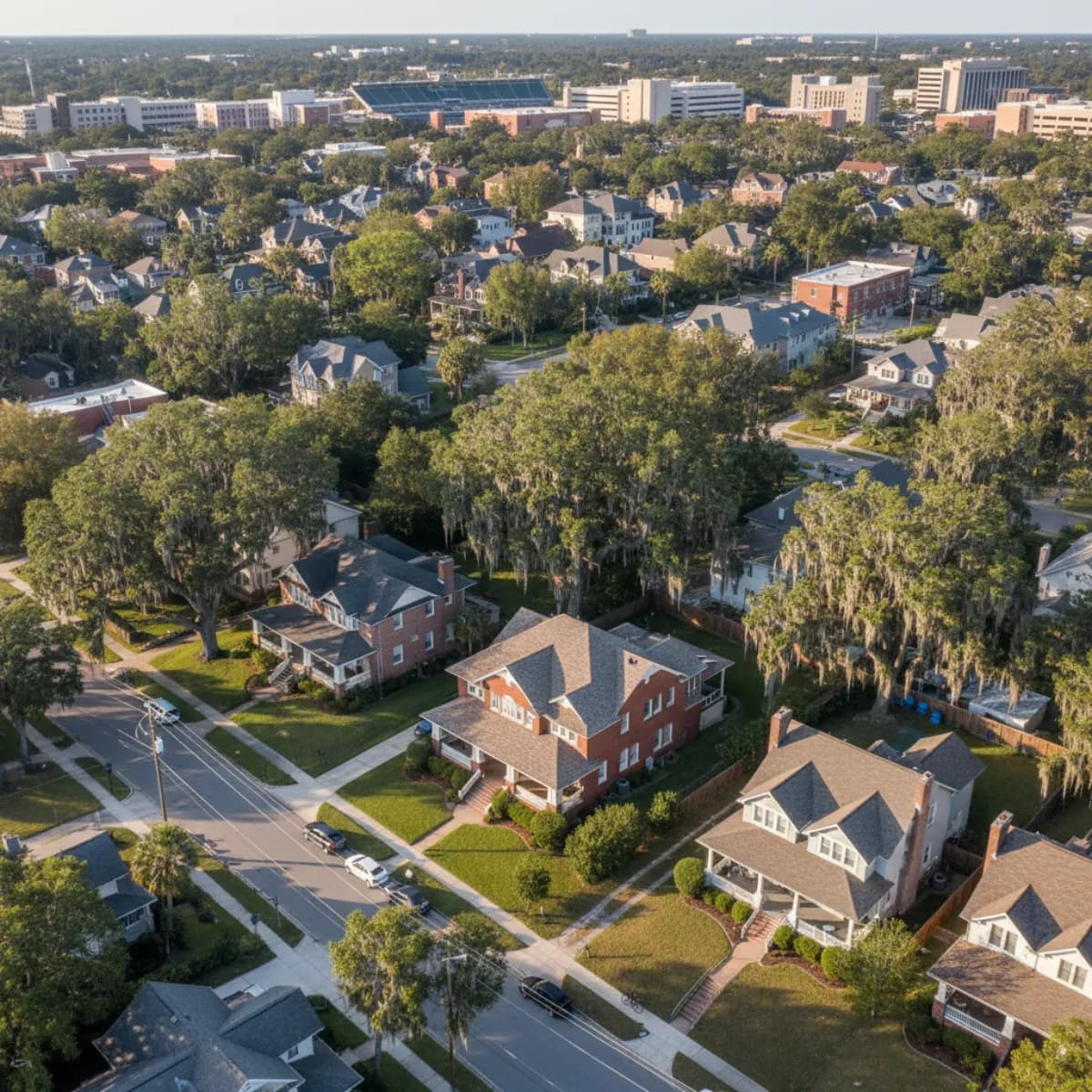
Alachua County • North Central Florida
Instant Roof Replacement Quotes in Gainesville, FL
Home to the University of Florida and a diverse mix of historic neighborhoods and modern developments, Gainesville's roofs face thunderstorm damage, humidity-driven algae growth, and occasional hurricane impacts. Get instant quotes from pre-vetted Florida CCC-licensed contractors who understand Alachua County's building codes, tree-heavy lots, and the unique demands of North Central Florida's subtropical climate.
Free Quotes
no obligations ever
Contractor Bids
standardized scope comparison
Until You Choose
no spam, no lead resale
FL Contractors
CCC-licensed, insured, reviewed
Gainesville at a Glance
Population
Alachua County seat
MPH Wind Zone
Standard FBC (not HVHZ)
Annual Rainfall
Concentrated May-October
Avg Roof Cost
Lower than coastal FL cities
Thunderstorm Days/Year
Hail, wind, and lightning
University of Florida
Large student rental market
Why Gainesville Roofing Is Different from Coastal Florida
Gainesville sits in the heart of North Central Florida, roughly 70 miles from both the Atlantic and Gulf coasts. This inland position means the city avoids the worst of the direct hurricane landfalls and the extreme salt air corrosion that define coastal Florida roofing. However, Gainesville's location in the thunderstorm capital of the United States — the corridor stretching from Tampa to Jacksonville experiences more lightning strikes per square mile than anywhere else in the country — creates its own set of roofing challenges that are distinct from anything homeowners in Miami, Tampa, or Jacksonville face.
The city's lush tree canopy, dominated by massive live oaks, Southern magnolias, and pine trees, is one of Gainesville's most cherished features. But those trees are a constant source of roof stress. Falling branches during storms cause puncture damage, accumulated leaf and pine needle debris traps moisture and promotes algae and moss growth, and overhanging limbs create shade zones where moisture lingers for days. Combined with Gainesville's high humidity — often exceeding 90% during summer mornings — these conditions accelerate the deterioration of asphalt shingles and make algae-resistant materials an essential investment rather than an optional upgrade.
Gainesville also experiences something most of South Florida does not: hard freezes. While average winter temperatures are mild, North Central Florida regularly sees overnight lows in the upper 20s and low 30s during December through February, with occasional deep freezes dropping into the teens. These freeze-thaw cycles can crack tile roofing, damage improperly sealed flashings, and cause ice formation in gutters and valleys. This temperature range means Gainesville roofing materials must perform across a wider thermal spectrum than those installed in perpetually warm South Florida — an important consideration when selecting materials and underlayment systems.
Roofing Challenges Unique to Gainesville
Gainesville's subtropical inland climate produces a distinctive set of roofing stresses. Unlike coastal cities where salt air and extreme wind codes dominate, Gainesville homeowners must contend with thunderstorm severity, biological growth, tree debris, and a wider temperature range than most Florida markets.
! Severe Thunderstorms & Hail
Gainesville averages over 80 thunderstorm days per year, making it one of the most lightning- and storm-active cities in the United States. These intense afternoon and evening storms regularly produce hail — ranging from pea-sized to golf-ball dimensions — that pits asphalt shingles, cracks tile, and dents metal roofing. Wind gusts of 60-80 mph during severe thunderstorms cause shingle lift, tree branch impact damage, and uplift stress on flashing and ridge caps. Unlike hurricanes that provide days of warning, severe thunderstorms develop in hours and can catch homeowners off guard.
- - 80+ thunderstorm days annually
- - Hail damage to shingles and tile
- - 60-80 mph wind gusts from microbursts
- - Sudden onset with minimal warning
~ Algae, Moss & Biological Growth
The combination of high humidity, warm temperatures, frequent rainfall, and dense tree canopy shade makes Gainesville one of the worst cities in Florida for roof algae and moss. Gloeocapsa magma, a blue-green algae, creates the dark streaks and stains visible on thousands of Gainesville roofs. In heavily shaded areas — particularly under live oak canopies in neighborhoods like Duckpond and the historic districts — moss growth can become thick enough to hold moisture against shingle surfaces for extended periods, accelerating granule loss and dramatically shortening roof lifespan.
- - Gloeocapsa magma algae causes dark streaks
- - Moss traps moisture, accelerates deterioration
- - Algae-resistant shingles strongly recommended
- - Trim branches 6-10 feet from roof surface
= Tree Debris & Branch Impact
Gainesville's urban forest is one of the most extensive in the Southeast, with massive live oaks, Southern magnolias, sweetgums, and slash pines providing canopy coverage across much of the city. While beautiful, this tree coverage is the single largest source of roof damage in the Gainesville area. During storms, falling branches cause puncture holes and structural damage. Between storms, accumulated leaves, pine needles, acorns, and seed pods block gutters, trap moisture in valleys, and create a composting layer that holds water against the roof surface. This organic debris is the primary food source for the algae and moss that plague Gainesville roofs.
- - Dense live oak and pine canopy citywide
- - Branch impact damage during storms
- - Leaf and needle buildup clogs gutters
- - Metal roofs shed debris more effectively than shingles
# Humidity & Freeze-Thaw Cycles
Gainesville's climate occupies a unique position in Florida: subtropical heat and humidity in summer, but with genuine winter cold snaps that South Florida never experiences. Summer humidity regularly exceeds 90% during morning hours, driving moisture into every gap and seam of the roofing system. Then in winter, overnight temperatures can plunge into the upper 20s or low 30s, with occasional deep freezes into the teens. This freeze-thaw cycle — rare in South Florida — can crack clay and concrete tile, compromise sealant strips on shingles, and cause ice formation in gutters and roof valleys that leads to water intrusion.
- - Summer humidity regularly exceeds 90%
- - Winter lows in upper 20s to low 30s
- - Freeze-thaw cracks tile and degrades sealant
- - Materials must handle wide temperature range
Gainesville Roof Replacement Cost by Material
Gainesville's roofing costs are among the most affordable in Florida, reflecting the city's inland location, standard FBC wind zone (120 mph rather than 185+ mph HVHZ), and competitive labor market. Materials do not require the expensive Miami-Dade NOA certification, and installation methods, while still code-compliant, are less labor-intensive than coastal HVHZ requirements. Labor rates in Alachua County average $35-$55/hour for experienced roofers, roughly 30-40% below Miami-Dade rates.
Architectural Shingles
#1: Architectural (Dimensional) Shingles
The dominant roofing material in Gainesville and across Alachua County, architectural shingles account for the vast majority of residential roof replacements. These multi-layered asphalt shingles provide a three-dimensional appearance, strong wind resistance (most rated to 130 mph, meeting FBC requirements), and a 25-30 year manufacturer warranty. For Gainesville specifically, specifying algae-resistant (AR) shingles with copper or zinc granules is virtually mandatory — the modest upfront premium pays for itself many times over by preventing the dark algae stains that plague standard shingles within 3-5 years in this humid, shaded environment. Top choices include GAF Timberline HDZ, Owens Corning Duration, and CertainTeed Landmark, all available with algae-resistant options.
Best For:
Most Gainesville homes, best value
Lifespan:
25-30 years
Cost Range:
$9,000 - $18,000
Wind Rating:
130 mph (FBC-compliant)
Standing Seam Metal
#2: Standing Seam Metal
Standing seam metal is the premium choice for Gainesville homeowners who want maximum durability and minimal maintenance. In a city defined by its tree canopy, metal roofing offers a critical advantage: leaves, pine needles, and small branches slide off the smooth, continuous panels rather than accumulating and trapping moisture the way they do on textured shingle surfaces. Metal is inherently resistant to algae and moss growth — a major selling point in Gainesville's humid environment. The reflective surface reduces solar heat gain, lowering cooling costs by an estimated 10-25% during Gainesville's long, hot summers. Without the salt air corrosion concerns of coastal Florida, Gainesville metal roofs can achieve their full 40-60 year lifespan with standard Galvalume coatings rather than the expensive marine-grade finishes required on the coast.
Best For:
Tree-heavy lots, long-term homeowners
Lifespan:
40-60 years
Cost Range:
$15,000 - $30,000
Maintenance:
Minimal — resists algae and debris
Impact-Resistant
#3: Impact-Resistant Shingles (Class 4)
Given Gainesville's frequent hailstorms and tree debris impact, Class 4 impact-resistant shingles are an increasingly popular upgrade. These shingles use SBS (Styrene-Butadiene-Styrene) polymer-modified asphalt that makes them more flexible and resistant to cracking from hail impact, falling branches, and temperature extremes. They pass the UL 2218 Class 4 impact test, where a 2-inch steel ball is dropped from 20 feet without cracking the shingle. Beyond the physical protection, many Florida insurers offer premium discounts of 5-15% for homes with verified Class 4 impact-resistant roofing — a meaningful savings over the 25-30 year life of the roof. The SBS modification also provides superior performance across Gainesville's wide temperature range, maintaining flexibility during winter freezes and resisting softening during summer heat.
Best For:
Hail-prone areas, insurance savings
Lifespan:
25-30 years
Cost Range:
$11,000 - $22,000
Impact Rating:
Class 4 (UL 2218)
Gainesville Average Roof Cost: Architectural shingles $9,000-$18,000. Impact-resistant shingles $11,000-$22,000. Standing seam metal $15,000-$30,000. Gainesville's inland location and standard FBC wind zone keep costs 20-35% below coastal Florida markets. Get your exact price with a free instant estimate.
Alachua County Building Requirements for Roofing
Florida Building Code Requirements
Wind Zone & Design Speed
Gainesville is classified in the 120 mph wind zone under the Florida Building Code — the standard tier, not the High Velocity Hurricane Zone (HVHZ) that applies to Miami-Dade and Broward counties. This means roofing products need a Florida Product Approval (FPA) but not the more expensive Miami-Dade NOA certification. While the requirements are less stringent than coastal zones, the FBC still mandates wind-rated underlayment, specific nail patterns based on roof zone (field, perimeter, and corner), and proper roof-to-wall hurricane strap connections on all new installations.
Permit Requirements
All roof replacements within Alachua County require a building permit. For properties within the City of Gainesville, permits are obtained through the City of Gainesville Development Services Department. For properties in unincorporated Alachua County, permits are issued by the Alachua County Building Department. Permit applications require the contractor's active CCC or RC license number, proof of insurance, a description of materials to be used with Florida Product Approval numbers, and a Notice of Commencement. Permit fees typically range from $150-$400 depending on project scope.
Inspection Process
Alachua County requires inspections at two key stages: dry-in (after underlayment is installed but before the finish roofing material) and final inspection (completed installation). Inspectors verify proper fastener spacing, underlayment installation, flashing details, and compliance with the approved permit documentation. While less intensive than HVHZ multi-stage inspections, these checkpoints ensure code compliance and protect the homeowner's investment.
Florida CCC Licensing
All roofing contractors working in Gainesville must hold a valid Certified Roofing Contractor (CCC) license from the Florida DBPR or a Registered Roofing Contractor (RC) license for Alachua County. Unlicensed contracting is a third-degree felony in Florida. Verify any contractor's license status, disciplinary history, and insurance at myfloridalicense.com before signing a contract. Every RoofVista contractor in Gainesville holds an active CCC license with verified insurance coverage.
Gainesville Neighborhoods We Serve
From the tree-lined streets of the historic Duckpond to newer developments in the western suburbs, our pre-vetted contractors serve every neighborhood in Gainesville and throughout Alachua County. Each area has distinct roofing considerations based on housing age, tree coverage, and architectural style.
Duckpond Historic District
- - Victorian and Craftsman homes (1880s-1930s)
- - Historic preservation guidelines
- - Heavy oak canopy, significant shade
- - Steep-slope roofs, complex valleys
- - Algae and moss growth very common
University Area & Midtown
- - Mix of single-family and rental properties
- - Many 1950s-1970s ranch-style homes
- - Cost-effective shingle replacements
- - Rental property ROI considerations
- - High tenant turnover affects maintenance
Haile Plantation
- - Master-planned community (1990s+)
- - HOA architectural guidelines
- - Larger homes, higher roof areas
- - Mix of shingle and some metal
- - Well-maintained with regular upkeep
Northwest & I-75 Corridor
- - Newer construction (2000s-present)
- - Suburban developments and townhomes
- - Builder-grade shingles often due for upgrade
- - Fewer trees, less algae concern
- - Standard FBC-compliant construction
Southeast & Hawthorne Road
- - Paynes Prairie proximity (humidity)
- - Rural and suburban mix
- - Older homes with original roofing
- - Pine tree canopy, needle debris
- - Budget-conscious material choices
Newberry & Archer Area
- - Rapidly growing suburbs west of Gainesville
- - New construction and established neighborhoods
- - Metal roofing popular on rural properties
- - Alachua County permitting (not city)
- - More open lots, less tree coverage
Roofing Considerations for Gainesville Rental Properties
University of Florida & the Rental Market
Gainesville's identity as a college town — with over 55,000 students at the University of Florida alone — means a significant portion of the city's housing stock consists of rental properties. Landlords and property investors face unique roofing decisions that differ from owner-occupied homes. The calculus is simple: maximize durability per dollar spent while meeting code requirements and maintaining tenant satisfaction.
Rental Property Roofing Strategy
- - Architectural shingles offer the best cost-to-lifespan ratio
- - AR (algae-resistant) upgrade is essential to avoid costly cleaning
- - 25-year shingles are the standard for rental properties
- - Insurance compliance is critical — many carriers won't cover roofs over 15 years
- - Deferred maintenance by tenants makes durable materials more important
ROI Considerations
- - New roof immediately improves property insurability
- - Wind mitigation credits reduce annual insurance costs
- - Algae-free appearance maintains rental value and attracts tenants
- - Metal roofing eliminates repeat replacements for long-term hold properties
- - Compare quotes from multiple contractors to optimize your investment
Insurance Considerations for Gainesville Homeowners
Florida Insurance & Wind Mitigation
Florida's homeowner insurance market remains one of the most challenging in the nation, and even inland cities like Gainesville are affected. Multiple carriers have left the state since 2020, and those remaining have implemented strict roof age requirements. While Gainesville homeowners pay lower wind premiums than coastal residents, the same roof-age rules apply statewide — making a new roof one of the most effective ways to secure affordable coverage.
Roof Age & Insurance Eligibility
- - Many insurers refuse policies on roofs older than 15 years
- - Citizens Insurance requires roof inspection for roofs over 15 years
- - SB 4-D (2022) protects roofs under 15 years from age-based denial
- - New roof typically reduces premiums 15-30% in Gainesville
- - Expanded carrier options with a new, code-compliant roof
Wind Mitigation Discounts
- - OIR-B1-1802 inspection form documents wind-resistant features
- - Hurricane clips/straps at roof-to-wall connections
- - Ring-shank nails at 6-inch spacing for deck attachment
- - Optional secondary water resistance for additional credit
- - Impact-resistant covering provides extra 5-15% savings
- - Hip roof geometry receives higher credit than gable
Our pre-vetted Gainesville contractors understand the connection between roofing and insurance. They can recommend installations designed to maximize your wind mitigation credits and improve your insurability, helping offset the cost of your new roof through annual premium savings.
Hurricane Preparedness for Gainesville Roofs
Gainesville's inland location provides more protection from direct hurricane landfalls than coastal Florida, but the city is far from immune. Hurricane Irma in September 2017 brought sustained tropical storm force winds and damaging gusts to Alachua County, causing widespread roof damage, downed trees, and extended power outages. Tropical Storm Debby (2012) dumped over 10 inches of rain on the area, causing flooding and water intrusion damage. And when hurricanes track up the Gulf Coast, Gainesville can experience the most dangerous quadrant of the storm — the northeast sector — where tornado-spawning rain bands are most active.
The Florida Building Code's 120 mph design wind speed for Gainesville is calibrated to this risk profile. While lower than the HVHZ's 185+ mph requirement, it still demands properly installed roofing systems with hurricane straps, wind-rated underlayment, and correct fastener patterns. Homeowners who invest in upgrades beyond the minimum code — such as secondary water resistance, impact-resistant shingles, and enhanced roof deck attachment — gain both better storm performance and meaningful insurance premium reductions through the wind mitigation credit system.
Gainesville Storm History & Risk
Recent Notable Storm Events
- - Hurricane Irma (2017): TS-force winds, widespread roof damage
- - Tropical Storm Debby (2012): 10+ inches of rain, flooding
- - Hurricane Matthew (2016): Outer bands brought damaging gusts
- - Annual severe thunderstorms: 80+ storm days per year
Code-Exceeding Upgrades
- - Secondary water resistance (peel-and-stick underlayment)
- - Impact-resistant shingles (Class 4, UL 2218)
- - Enhanced deck attachment (ring-shank nails, 6" spacing)
- - Hurricane clips at every truss-to-wall connection
Nearby Florida City Pages
Comparing quotes across North Central Florida? Explore roofing costs and contractor options in these nearby cities.
Florida Roofing Resources
Florida State Overview
All Florida roofing resources and city pages
Florida Roof Replacement Cost Guide
Detailed pricing for all FL regions and materials
Hurricane-Resistant Roofing in Florida
Wind ratings, product approvals, and storm preparation
Florida Roofing Building Codes
FBC, HVHZ, and local requirements
Wind Mitigation Guide for Florida
Insurance discounts and inspection details
Florida Contractor Licensing
CCC license requirements and DBPR verification
Get Your Gainesville Roof Quote in Minutes
Enter your address to compare instant quotes from pre-vetted CCC-licensed Florida contractors who serve Alachua County with architectural shingles, metal roofing, and storm damage repair
Frequently Asked Questions About Gainesville Roofing
How much does a roof replacement cost in Gainesville, FL?
Roof replacement in Gainesville typically costs between $9,000 and $22,000 for a standard single-family home. Architectural shingles range from $9,000 to $18,000. Standing seam metal runs $15,000 to $30,000. Gainesville's costs are significantly lower than coastal Florida cities due to standard FBC wind zone requirements (120 mph vs. 185+ mph in the HVHZ) and a more competitive labor market.
What roofing materials are most popular in Gainesville?
Architectural asphalt shingles dominate the Gainesville market at roughly 70-80% of homes. Standing seam metal is the second most popular choice, valued for its durability under Gainesville's heavy tree canopy. Tile roofing is uncommon compared to South Florida. Impact-resistant shingles are growing in popularity for insurance discount eligibility.
Does Gainesville get hurricanes that damage roofs?
While 70 miles inland, Gainesville is not immune to hurricane damage. Hurricane Irma (2017) caused significant roof damage across Alachua County. The greater day-to-day threat comes from severe afternoon thunderstorms producing hail, high winds, and lightning damage during the May through October storm season.
Why does algae and moss grow on Gainesville roofs?
Gainesville's high humidity, warm temperatures, dense tree canopy, and frequent rain create ideal conditions for algae and moss growth. This traps moisture against shingles, accelerating granule loss and shortening roof life by 3-5 years. Algae-resistant shingles with copper or zinc granules are strongly recommended for Gainesville homes.
What building codes apply to roofing in Gainesville?
Gainesville falls under the standard Florida Building Code with a 120 mph design wind speed — not the HVHZ zone. Products need a Florida Product Approval but not the more expensive Miami-Dade NOA. Permits are required through Alachua County Building Department or City of Gainesville Development Services.
How do I save on insurance with a new Gainesville roof?
Florida law requires insurers to offer premium discounts for wind mitigation features. A new roof qualifies for credits including FBC-compliant covering, upgraded deck attachment, hurricane clips, and optional secondary water resistance. These can reduce the wind portion of your premium by 20-45%.
What contractor license is required for roofing in Gainesville?
Florida requires a Certified Roofing Contractor (CCC) license from the DBPR. Licensed contractors must carry workers' compensation and a $10,000 surety bond. Verify licenses at myfloridalicense.com. Unlicensed roofing is a felony in Florida.
Should I choose metal or shingle roofing for my Gainesville home?
Architectural shingles cost $9,000-$18,000 and last 25-30 years. Standing seam metal costs $15,000-$30,000 but lasts 40-60 years, sheds tree debris better, reflects heat, and resists algae. For rental properties near UF, shingles offer the best ROI. For long-term homeowners, metal's durability often justifies the higher cost.