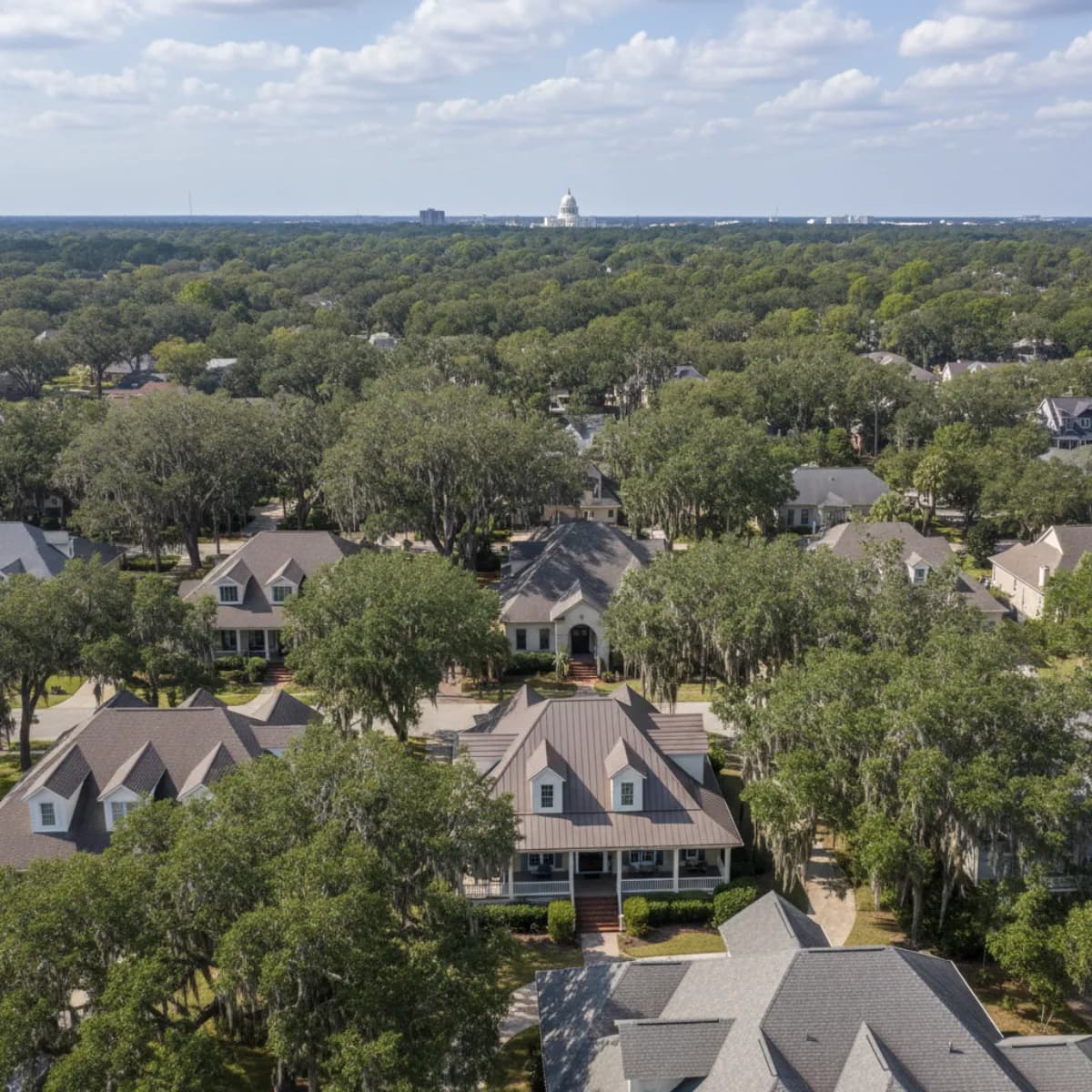
Florida's Capital City
Instant Roof Replacement Quotes in Tallahassee, FL
Nearly 200,000 residents across Leon County need roofing built for North Florida's unique climate — hurricane winds, seasonal freezes, dense tree canopy, and rolling hills unlike anywhere else in the state. Get instant quotes from pre-vetted Florida contractors for Midtown bungalows, Betton Hills colonials, Killearn estates, and homes across every Tallahassee neighborhood.
Free Quotes
no obligations ever
Contractor Bids
standardized scope comparison
Until You Choose
no spam, no lead resale
FL Contractors
licensed, insured, reviewed
Tallahassee at a Glance
Population
Florida's capital city
Hurricane Michael
90 miles west, October 2018
Freezing Nights / Year
Unique for Florida
Permit Cost
Leon County permits
University Town
85,000+ students
Hilly Terrain
Unlike flat coastal Florida
Roofing Challenges Unique to Tallahassee
Tallahassee occupies a unique position in Florida's roofing landscape. As the state's capital city nestled in the rolling red clay hills of North Florida, Tallahassee faces a combination of challenges that no other major Florida market experiences. The city endures hurricane-force winds from Gulf storms, genuine winter freezing that South Florida never sees, one of the densest urban tree canopies in the Southeast, and hilly terrain that creates complex drainage patterns on residential roofs. Understanding these overlapping factors is essential for choosing the right materials and contractor for your Tallahassee home.
! Hurricane & Tropical Storm Exposure
Tallahassee sits just 25 miles from the Gulf of Mexico, placing it directly in the path of storms that track through the eastern Gulf. Hurricane Michael in October 2018 provided a devastating reminder of this vulnerability. The Category 5 storm made landfall at Mexico Beach, just 90 miles west, delivering sustained tropical storm-force winds of 60-75 mph to Tallahassee with gusts exceeding 85 mph. Thousands of roofs across Leon County suffered damage, and the storm toppled massive trees onto homes throughout the city's canopy-covered neighborhoods. While Tallahassee is not in the Wind-Borne Debris Region like coastal cities, the Florida Building Code still requires wind resistance ratings that account for inland hurricane exposure.
- - FBC wind resistance requirements for inland Leon County
- - Enhanced nail patterns recommended despite inland location
- - Tree fall risk during storms compounds wind damage
- - Post-Michael awareness has driven material upgrades
# Seasonal Freezing & Thermal Cycling
Tallahassee is the only major Florida city where freeze-thaw cycles are a genuine roofing concern. The city averages 15-25 nights per year below 32 degrees F, with occasional hard freezes plunging into the mid-20s F. These freezing events, combined with summer highs regularly exceeding 95 degrees F, create an annual temperature range of over 70 degrees that stresses roofing materials through thermal expansion and contraction. This freeze-thaw cycling can crack improperly installed metal flashing, break brittle tile, cause sealant failure along penetrations, and contribute to premature granule loss on shingles. No other major Florida market contends with this temperature extremity.
- - Thermal expansion stress on all roofing materials
- - Flashing and sealant failure from freeze-thaw
- - Ice accumulation in gutters during hard freezes
- - Materials must handle 25F to 95F+ annual range
* Dense Urban Tree Canopy
Tallahassee is recognized as one of the most heavily canopied cities in the United States. Massive live oaks, towering longleaf pines, sweetgums, and magnolias form a near-continuous canopy over most residential neighborhoods, especially in established areas like Betton Hills, Midtown, and the university-adjacent neighborhoods. While this canopy gives Tallahassee its distinctive Southern character and provides welcome shade from summer heat, it creates significant roofing challenges. Hurricane Michael demonstrated the canopy's destructive potential when thousands of trees fell onto homes across Leon County, causing more roof damage from fallen limbs than from wind alone in many neighborhoods.
- - Falling limbs and trees during storms (primary damage source)
- - Moss, lichen, and algae accelerate shingle degradation
- - Leaf and pine needle debris traps moisture in valleys
- - Reduced sunlight keeps roofs damp, promoting rot
~ Rolling Hills & Drainage Complexity
Unlike the flat topography that defines most of Florida, Tallahassee sits atop rolling red clay hills at an elevation of 150-200 feet above sea level. This terrain creates steeper lot grades, varied roof pitches, and complex water drainage patterns that flat-terrain contractors may not be experienced with. Homes built on hillsides in areas like Betton Hills, the Meridian Road corridor, and parts of Killearn often have multi-level rooflines with complex valleys where water concentrates during Tallahassee's heavy summer downpours. Proper valley construction, step flashing at dormers, and adequate gutter sizing are critical on hillside properties to prevent water intrusion.
- - Complex roof geometries from hillside construction
- - Concentrated water flow in valleys requires attention
- - Step flashing critical at multi-level transitions
- - Gutter sizing must handle concentrated runoff
Hurricane Michael's Lasting Impact on Tallahassee Roofing
Hurricane Michael made landfall on October 10, 2018, near Mexico Beach and Tyndall Air Force Base as the first Category 5 hurricane to strike the Florida Panhandle in recorded history. With maximum sustained winds of 160 mph at landfall, the storm devastated the immediate coastal impact zone. Tallahassee, located approximately 90 miles to the east, experienced sustained tropical storm-force winds of 60-75 mph with gusts exceeding 85 mph, accompanied by torrential rain and over 100,000 power outages across Leon County.
The storm's impact on Tallahassee's roofing stock was severe but distinct from coastal damage patterns. Rather than the widespread wind-driven destruction seen along the Panhandle coast, Tallahassee's primary damage mechanism was tree fall. The city's dense canopy, already weakened by previous drought stress, proved catastrophically vulnerable to Michael's sustained winds. Thousands of trees fell across the city, punching through roofs, tearing off shingles, destroying gutters, and crushing entire sections of homes in Midtown, Betton Hills, Killearn, and neighborhoods throughout the city. Leon County processed over 8,000 residential roofing claims following the storm.
The Michael experience changed Tallahassee homeowners' approach to roofing in several lasting ways. Impact-resistant shingles, once rare in the Tallahassee market, now account for a growing share of replacements as homeowners seek materials that can withstand falling limb impacts. Metal roofing has surged in popularity for its ability to shed debris and resist puncture. And perhaps most importantly, many homeowners now proactively address tree clearance around their rooflines before storm season rather than waiting for damage to occur.
Homes in Tallahassee that still carry roofs that predated Hurricane Michael — now more than seven years ago — are approaching or exceeding the typical insurance eligibility threshold. Insurers in the Tallahassee market increasingly scrutinize roofs older than 15-20 years, and a pre-Michael roof may complicate policy renewal or home sale transactions. If your roof survived Michael but has not been replaced since, a professional inspection to assess accumulated wear is a prudent investment.
Tallahassee Roof Replacement Cost by Material
Tallahassee is consistently the most affordable major metro in Florida for roof replacement. Lower labor rates ($45-$65/hour compared to $65-$90 in Miami and Tampa), reduced wind code requirements versus coastal markets, and strong contractor competition in the capital city market all contribute to pricing that runs 20-35% below South Florida. While Tallahassee still requires full Florida Building Code compliance, the city's inland location exempts it from the most stringent Wind-Borne Debris Region requirements that drive costs higher on the coast.
Architectural Shingles
#1: Architectural Shingles
The dominant roofing material in Tallahassee, covering approximately 75% of residential roofs across the city. Architectural shingles (also called dimensional or laminate shingles) provide a strong balance of affordability, aesthetics, and performance for North Florida's climate. The multi-layered construction handles freeze-thaw cycling better than single-layer 3-tab shingles, while offering wind ratings of 110-130 mph that meet FBC requirements for inland Leon County. Algae-resistant formulations (look for AR-rated shingles) are particularly important in Tallahassee's humid, shaded environment where moss and algae growth can rapidly degrade standard shingles under the tree canopy. Leading manufacturers like GAF, Owens Corning, and CertainTeed all offer algae-resistant architectural lines specifically suited to Tallahassee's climate zone.
Best For:
Most Tallahassee homes, best value
Lifespan:
25-30 years
Cost Range:
$7,000 - $16,000
Wind Rating:
110-130 mph
Standing Seam Metal
#2: Standing Seam Metal
Rapidly gaining market share in Tallahassee, particularly in the Killearn, Bradfordville, and SouthWood communities where homeowners are investing in long-term solutions. Standing seam metal is uniquely well-suited to Tallahassee's climate: the interlocking panels handle thermal expansion from freeze-thaw cycles without stress, the smooth surface sheds fallen leaves and pine needles that would trap moisture on shingles, and the 40-60 year lifespan means most homeowners will never need another roof. Metal is naturally resistant to the moss and algae growth that plagues shingle roofs under Tallahassee's dense canopy. During Hurricane Michael, metal roofs across Tallahassee fared significantly better than shingle roofs, with their smooth profiles allowing falling branches to slide off rather than puncture the surface. The higher upfront cost is offset by insurance discounts, zero moss/algae maintenance, and an effective per-year cost that beats shingles over time.
Best For:
Long-term investment, tree-heavy lots
Lifespan:
40-60 years
Cost Range:
$12,000 - $28,000
Wind Rating:
140-160 mph (concealed fasteners)
Impact-Resistant Shingles
#3: Impact-Resistant Shingles
A growing segment in the Tallahassee market since Hurricane Michael exposed the vulnerability of standard shingles to falling debris. Class 4 impact-resistant shingles (UL 2218 rated) use polymer-modified asphalt and reinforced fiberglass mats to withstand impacts from 2-inch diameter steel balls dropped from 20 feet — a standard that simulates the force of large hail or falling tree branches. For Tallahassee homeowners living under the canopy, this impact resistance provides genuine peace of mind during storm season. Florida law mandates insurance premium discounts for impact-resistant roofing, and Tallahassee homeowners typically see 10-20% reductions on their annual premiums. The incremental cost over standard architectural shingles is $2,000-$4,000 on a typical home, which the insurance savings recoup within 5-8 years even at Tallahassee's lower premium levels.
Best For:
Canopy-covered homes, insurance savings
Lifespan:
25-35 years
Cost Range:
$9,000 - $20,000
Insurance Savings:
10-20% premium reduction
3-Tab Shingles
#4: 3-Tab Shingles (Budget Option)
While declining in market share nationwide, 3-tab shingles remain a viable budget option in Tallahassee's more affordable housing market. They are commonly found on rental properties near the FSU and FAMU campuses, investment properties, and starter homes where budget constraints outweigh longevity considerations. The single-layer construction is more vulnerable to freeze-thaw cycling and wind uplift than architectural shingles, and the thinner profile provides less impact resistance against falling branches. However, for Tallahassee homeowners on a strict budget, a properly installed 3-tab roof still meets FBC requirements and provides 15-20 years of service. The most cost-effective approach for budget-conscious Tallahassee homeowners is often a mid-grade architectural shingle, which costs only $1,500-$3,000 more than 3-tab but lasts 8-12 years longer.
Best For:
Budget-focused, rental properties
Lifespan:
15-20 years
Cost Range:
$5,500 - $11,000
Note:
Architectural shingles recommended instead
Tallahassee Average Roof Cost: Architectural shingles $7,000-$16,000. Impact-resistant shingles $9,000-$20,000. Standing seam metal $12,000-$28,000. 3-tab shingles $5,500-$11,000. Tallahassee costs run 20-35% below South Florida markets. Get your exact price with a free instant estimate.
Tallahassee as a University Town: Roofing for Homeowners & Investors
Tallahassee is defined by its universities. Florida State University (enrollment 45,000+) and Florida A&M University (enrollment 10,000+), along with Tallahassee Community College, bring over 85,000 students to the city each year. This university population creates a significant rental housing market concentrated in neighborhoods surrounding the campuses, including the Frenchtown area, the Gaines Street corridor, portions of Midtown, and the student housing zones along Tennessee Street and Pensacola Street.
For rental property investors, roofing decisions in Tallahassee are driven by different priorities than owner-occupied homes. Student rental properties prioritize cost-effectiveness and durability over premium aesthetics. Architectural shingles in the $7,000-$12,000 range provide the best balance of longevity and return on investment for rental properties. The key is selecting algae-resistant formulations that minimize the moss and mildew growth common under Tallahassee's tree canopy, reducing both maintenance costs and tenant complaints.
For owner-occupied homes in established neighborhoods like Betton Hills, Killearn, and SouthWood, the calculus shifts toward premium materials and long-term value. A standing seam metal roof that lasts 50+ years can be a compelling investment for homeowners who plan to remain in Tallahassee long-term, especially given the insurance premium savings and zero-maintenance profile. The city's relatively affordable home prices mean that a premium roof investment represents a larger percentage of total home value, making it an effective way to differentiate a property in the resale market.
Tallahassee Building Requirements & Leon County Permits
Important Local Regulations
Leon County Building Permits
All roof replacements in Tallahassee and unincorporated Leon County require building permits. City of Tallahassee permits are obtained through the Growth Management Department; unincorporated Leon County permits through the Building Inspection Division. Permit fees range from $150 to $400 based on project valuation. Online applications are available through the Leon County eTRAKiT portal. Most residential re-roof permits are processed within 2-4 business days, significantly faster than major metro areas. Inspections are required at multiple stages: existing deck condition assessment and final completion inspection. Failing to pull a permit can complicate home sales and insurance claims.
Florida Building Code (Inland Requirements)
While Tallahassee is not in the coastal Wind-Borne Debris Region, all re-roofs must comply with the Florida Building Code. Wind resistance requirements for Leon County are based on the applicable wind speed map, which specifies lower design wind speeds than coastal cities but still mandates proper fastener patterns, underlayment requirements, and material ratings. Tallahassee contractors must follow FBC Chapter 15 for roof assemblies. Roof sheathing attachment, underlayment type, and fastener schedules are all specified by the code. While Tallahassee does not require the sealed roof deck (secondary water barrier) mandatory in coastal Wind-Borne Debris Regions, many contractors recommend it as a best practice given the city's hurricane exposure.
Tree Canopy & Setback Considerations
Tallahassee has a tree protection ordinance that restricts removal of certain heritage and specimen trees. When roof replacement requires tree trimming for access or to clear overhanging branches, homeowners must ensure compliance with the City of Tallahassee's tree ordinance (Land Development Code Section 5-118). Trees with a diameter at breast height (DBH) of 24 inches or more are classified as heritage trees and require a permit for removal. Most roofing-related trimming (clearing branches from the roofline) does not require a permit, but full removal of protected trees near the work area does. Our pre-vetted contractors coordinate with arborists when necessary.
Florida Contractor Licensing
Florida requires all roofing contractors to hold either a Certified Roofing Contractor (CCC) license (valid statewide) or a Registered Roofing Contractor (RC) license (valid in the issuing jurisdiction). Verify any contractor at myfloridalicense.com through the DBPR (Department of Business and Professional Regulation). Licensed contractors must carry workers' compensation insurance and a minimum $300,000 general liability policy. All of RoofVista's pre-vetted Tallahassee contractors hold active CCC or RC licenses with verified insurance coverage.
Wind Mitigation Inspections
Even though Tallahassee is inland, Florida law mandates that all property insurers offer wind mitigation discounts statewide. After roof replacement, homeowners should obtain a wind mitigation inspection (OIR-B1-1802 form) documenting the new roof's features. The inspection evaluates roof covering compliance, deck attachment, roof-to-wall connections, roof geometry (hip vs. gable), secondary water barrier, and opening protection. Tallahassee homeowners typically save 10-30% on insurance premiums with a favorable wind mitigation report. The inspection costs $75-$150 and remains valid until the next re-roofing.
Tallahassee Neighborhoods We Serve
From the canopy-covered streets of Midtown to the master-planned communities of SouthWood and the sprawling estates of Bradfordville, our pre-vetted contractors serve every corner of Tallahassee and greater Leon County. Each neighborhood has distinct roofing considerations shaped by its tree coverage, elevation, housing stock age, and proximity to the Gulf.
Midtown
- - Tallahassee's walkable urban core
- - 1940s-1970s homes with mature canopy
- - Heavy tree coverage creates debris and shade
- - Mix of original and updated roofs
- - Algae-resistant materials essential here
Betton Hills
- - Tallahassee's premier established neighborhood
- - Rolling terrain with complex rooflines
- - Massive live oaks over most properties
- - Premium homes justify quality materials
- - Metal roofing increasingly popular
Killearn Estates & Killearn Lakes
- - Tallahassee's largest planned community
- - 1970s-2000s construction, many aging roofs
- - Pine-dominated canopy with needle debris
- - HOA restrictions on some sections
- - Strong demand for roof replacements
SouthWood
- - Newer master-planned community (2000s+)
- - Mix of traditional and cottage styles
- - HOA architectural guidelines apply
- - First-generation roofs approaching replacement
- - Well-maintained lots with controlled canopy
Bradfordville
- - North Leon County's rural-suburban corridor
- - Larger lots with estate-style homes
- - Heavy pine and hardwood canopy
- - Metal roofing popular for acreage properties
- - Unincorporated Leon County permitting
Campus-Adjacent & Frenchtown
- - FSU and FAMU surrounding neighborhoods
- - High percentage of rental/investment properties
- - Budget-conscious material selections
- - Older housing stock needing updates
- - Quick turnaround between tenants preferred
Why Tallahassee Roofing Is Different from South Florida
Many Florida roofing guides treat the state as a monolith, but Tallahassee's roofing reality has far more in common with southern Georgia and Alabama than with Miami or Fort Lauderdale. Understanding these differences is critical for Tallahassee homeowners who may receive advice or quotes calibrated for coastal South Florida conditions that don't apply 500 miles north.
Tallahassee (North FL)
- Climate: Humid subtropical with genuine winter (15-25 freezing nights/year)
- Dominant Material: Architectural shingles (75% market share)
- Wind Zone: Inland FBC, NOT Wind-Borne Debris Region
- Top Concern: Tree fall damage and canopy-related degradation
- Avg. Cost: $7,000-$16,000 (shingles)
- Insurance Premiums: $1,800-$3,000/year (lower than coastal FL)
- Terrain: Rolling hills, 150-200 ft elevation
Miami / Tampa (South FL)
- Climate: Tropical, no freezing ever
- Dominant Material: Concrete tile (40-50% market share)
- Wind Zone: Wind-Borne Debris Region (130+ mph rated)
- Top Concern: Hurricane wind uplift and storm surge
- Avg. Cost: $10,000-$22,000 (shingles)
- Insurance Premiums: $4,000-$8,000/year
- Terrain: Flat, near sea level
The bottom line for Tallahassee homeowners: you benefit from significantly lower roofing costs than coastal Florida, but you face freeze-thaw challenges, tree canopy hazards, and terrain complexity that coastal markets do not. Work with contractors who understand North Florida's specific conditions rather than applying South Florida standards to your Tallahassee home.
Insurance Considerations for Tallahassee Homeowners
Navigating Florida's Insurance Market from the Capital
Tallahassee homeowners face a more favorable insurance environment than their coastal Florida counterparts, but they are not immune to the statewide insurance challenges. Average homeowners insurance premiums in Leon County run $1,800-$3,000 per year — significantly below Tampa ($4,000+) and Miami ($5,000+) — but still well above the national average of approximately $1,700. The state's ongoing insurance restructuring, carrier exits, and Citizens Property Insurance growth affect Tallahassee even if the impact is less acute than on the coast.
Tallahassee Advantages
- - Inland location means lower base premiums
- - Not in Wind-Borne Debris Region (reduced requirements)
- - Lower storm surge risk than coastal cities
- - More carrier options available vs. coastal FL
- - Competitive contractor market keeps replacement affordable
How Your Roof Can Help
- - New FBC-compliant roof keeps you insurable
- - Impact-resistant materials save 10-20% on premiums
- - Wind mitigation inspection documents savings features
- - Hip roof shape earns additional credits over gable
- - Roof under 10 years old avoids age-related surcharges
Our pre-vetted contractors understand Tallahassee's insurance landscape and install roofing systems that maximize your wind mitigation credits and maintain policy eligibility in Florida's evolving market.
Frequently Asked Questions About Tallahassee Roofing
How much does a roof replacement cost in Tallahassee, FL?
Roof replacement in Tallahassee typically costs between $7,000 and $16,000 for architectural shingles on a standard 1,500-2,000 sq ft home, making it the most affordable major metro in Florida for roofing. Impact-resistant shingles run $9,000-$20,000 but qualify for insurance premium discounts that offset the additional cost over time. Standing seam metal, growing rapidly in popularity across Killearn, Bradfordville, and SouthWood, ranges from $12,000 to $28,000 and delivers a 40-60 year lifespan. Budget-minded 3-tab shingles remain available at $5,500-$11,000 but are increasingly replaced by architectural shingles for their superior wind and freeze-thaw performance. Tallahassee's lower costs are driven by labor rates of $45-$65/hour (versus $65-$90 in South Florida), inland wind code requirements that are less stringent than coastal markets, and strong contractor competition in the capital city. Homes with steep pitches, complex rooflines typical of hillside properties, or extensive tree-related damage repair will fall toward the higher end of these ranges.
How did Hurricane Michael affect Tallahassee roofing?
Hurricane Michael made landfall as a Category 5 storm on October 10, 2018, at Mexico Beach, approximately 90 miles west of Tallahassee. Despite the distance, Tallahassee experienced sustained tropical storm-force winds of 60-75 mph with gusts exceeding 85 mph. The city's dense tree canopy proved catastrophically vulnerable: thousands of massive live oaks, pines, and hardwoods toppled across the city, punching through roofs, tearing off shingles, and crushing sections of homes in every major neighborhood. Leon County processed over 8,000 residential roofing claims following the storm. The experience fundamentally changed the Tallahassee roofing market: impact-resistant shingles gained significant market share, metal roofing surged in popularity for its debris-shedding properties, and homeowners became far more proactive about tree clearance around rooflines. Homes still carrying pre-Michael roofs (now 7+ years old) should be professionally inspected for accumulated wear.
Does Tallahassee get freezing weather that affects roofs?
Yes, and this is what makes Tallahassee roofing fundamentally different from the rest of Florida. The city averages 15-25 nights per year below 32 degrees F, with occasional hard freezes dropping into the mid-20s F. These freezing events, combined with summer highs regularly exceeding 95 degrees F, subject roofing materials to an annual temperature range of over 70 degrees. This freeze-thaw cycling causes thermal expansion and contraction that can crack improperly installed metal flashing, break brittle tile, cause sealant failure along pipe boots and other penetrations, and accelerate granule loss on shingles. Ice can accumulate in gutters and downspouts during hard freezes, causing water backup under shingle edges. While Tallahassee does not experience the ice damming common in northern states, the freeze-thaw effect on materials is a genuine concern that South Florida roofers may not adequately address. Always ensure your Tallahassee contractor uses flexible sealants rated for freeze-thaw cycling and installs drip edge designed for thermal movement.
What roofing materials work best in Tallahassee's climate?
Tallahassee's unique North Florida climate demands materials that handle a broader range of conditions than anywhere else in the state. Architectural shingles (25-30 years) remain the most popular choice, covering approximately 75% of Tallahassee's residential roofs. Their multi-layered construction handles freeze-thaw cycling well, and algae-resistant formulations combat the moss and mildew growth that Tallahassee's dense tree canopy promotes. Standing seam metal (40-60 years) is the fastest-growing segment, prized for its ability to shed fallen pine needles and leaves, resist canopy-related moisture damage, and perform through extreme thermal cycling. Impact-resistant shingles (Class 4, UL 2218, 25-35 years) have gained significant ground since Hurricane Michael, offering debris impact protection and insurance premium savings. For budget properties and campus-area rentals, 3-tab shingles remain functional but are being phased out in favor of architectural shingles for their modest price premium and substantially longer service life.
What is the permit process for roof replacement in Tallahassee?
All roof replacements within the City of Tallahassee and unincorporated Leon County require building permits. City of Tallahassee permits are obtained through the Growth Management Department, while unincorporated Leon County permits go through the Building Inspection Division. Permit fees range from $150 to $400 based on project valuation — substantially less than major coastal cities. Both jurisdictions offer online applications through the Leon County eTRAKiT portal for faster processing. Most residential re-roof permits are approved within 2-4 business days, significantly faster than the 1-4 week processing times common in South Florida metros. Inspections are required at key stages: initial deck condition assessment and final completion. Unlike the Wind-Borne Debris Region, Tallahassee does not require a mandatory mid-process sealed roof deck inspection, though contractors should still document all work stages. Pulling a proper permit is essential for insurance claims, home sales, and code compliance. All of our pre-vetted Tallahassee contractors handle the full permit process from application through final inspection sign-off.
How does Tallahassee's tree canopy affect roofing?
Tallahassee's dense urban canopy is one of its greatest assets and one of its most significant roofing challenges. The city is recognized as one of the most heavily canopied in the United States, with massive live oaks, towering longleaf pines, sweetgums, and magnolias creating a near-continuous canopy over most residential neighborhoods. This canopy affects roofing in four primary ways. First, falling limbs and trees during storms represent the single greatest roof damage risk in Tallahassee — Hurricane Michael proved this decisively. Second, the shade and moisture retention from the canopy promote aggressive moss, lichen, and algae growth that degrades shingle surfaces and retains moisture against the roof. Third, accumulated leaf litter and pine needles clog gutters and collect in roof valleys, trapping moisture and causing premature deterioration of underlayment and decking. Fourth, reduced sunlight keeps roofs damp for extended periods, accelerating organic growth and potentially contributing to wood rot in sheathing. Homeowners should trim branches to maintain at least 6-10 feet of clearance from the roofline and clean gutters 2-4 times per year.
How long does a roof replacement take in Tallahassee?
Most Tallahassee roof replacements take 2-3 days for architectural or impact-resistant shingles and 3-5 days for standing seam metal on a standard residential home. Tallahassee's moderate year-round climate allows roofing work in every season, making scheduling more flexible than in many other markets. The summer rainy season from June through September brings daily afternoon thunderstorms that typically halt work for 1-2 hours, potentially adding a half-day to the timeline but rarely causing multi-day delays. Winter is the ideal roofing season in Tallahassee, with dry conditions, comfortable working temperatures, and minimal weather interruptions. Properties with heavy tree canopy may require pre-roofing limb trimming that adds a half-day to the project timeline. Complex hillside rooflines with multiple valleys, dormers, or steep sections take longer than simple gable configurations. Scheduling in Tallahassee is typically 2-4 weeks out, significantly shorter than South Florida's 4-8 week backlogs, giving Tallahassee homeowners more flexibility in timing their projects.
Are there insurance benefits to upgrading my Tallahassee roof?
Yes, and while Tallahassee's insurance premiums are lower than coastal Florida, the savings from a roof upgrade are still meaningful. Florida Statute 627.0629 requires all property insurers to offer wind mitigation discounts statewide, including inland markets like Tallahassee. A wind mitigation inspection (OIR-B1-1802 form) evaluates six key features of your roof: roof covering (FBC compliance year), roof deck attachment (nail pattern and type), roof-to-wall connections (clips, wraps, or toe-nails), roof geometry (hip vs. gable), secondary water barrier, and opening protection. Each qualifying feature reduces your premium incrementally. Tallahassee homeowners typically pay $1,800-$3,000 annually for homeowners insurance, and a favorable wind mitigation report following roof replacement can reduce premiums by 10-30%, translating to savings of $200-$900 per year. Impact-resistant Class 4 shingles trigger additional mandatory discounts under Florida law. Over a 25-30 year roof lifespan, cumulative insurance savings of $5,000-$20,000 can offset a significant portion of the roof investment. The wind mitigation inspection itself costs $75-$150 and remains valid until the next re-roofing.
Florida Roofing Resources
Florida State Overview
All Florida roofing resources and city pages
Florida Roof Replacement Cost Guide
Detailed pricing for all FL regions and materials
Hurricane-Resistant Roofing in Florida
FBC requirements and wind mitigation guide
Florida Contractor Licensing
CCC and RC license requirements and DBPR verification
Get Your Tallahassee Roof Quote in Minutes
Enter your address to compare instant quotes from pre-vetted Florida contractors who understand North Florida's freeze-thaw cycles, hurricane exposure, and dense canopy challenges