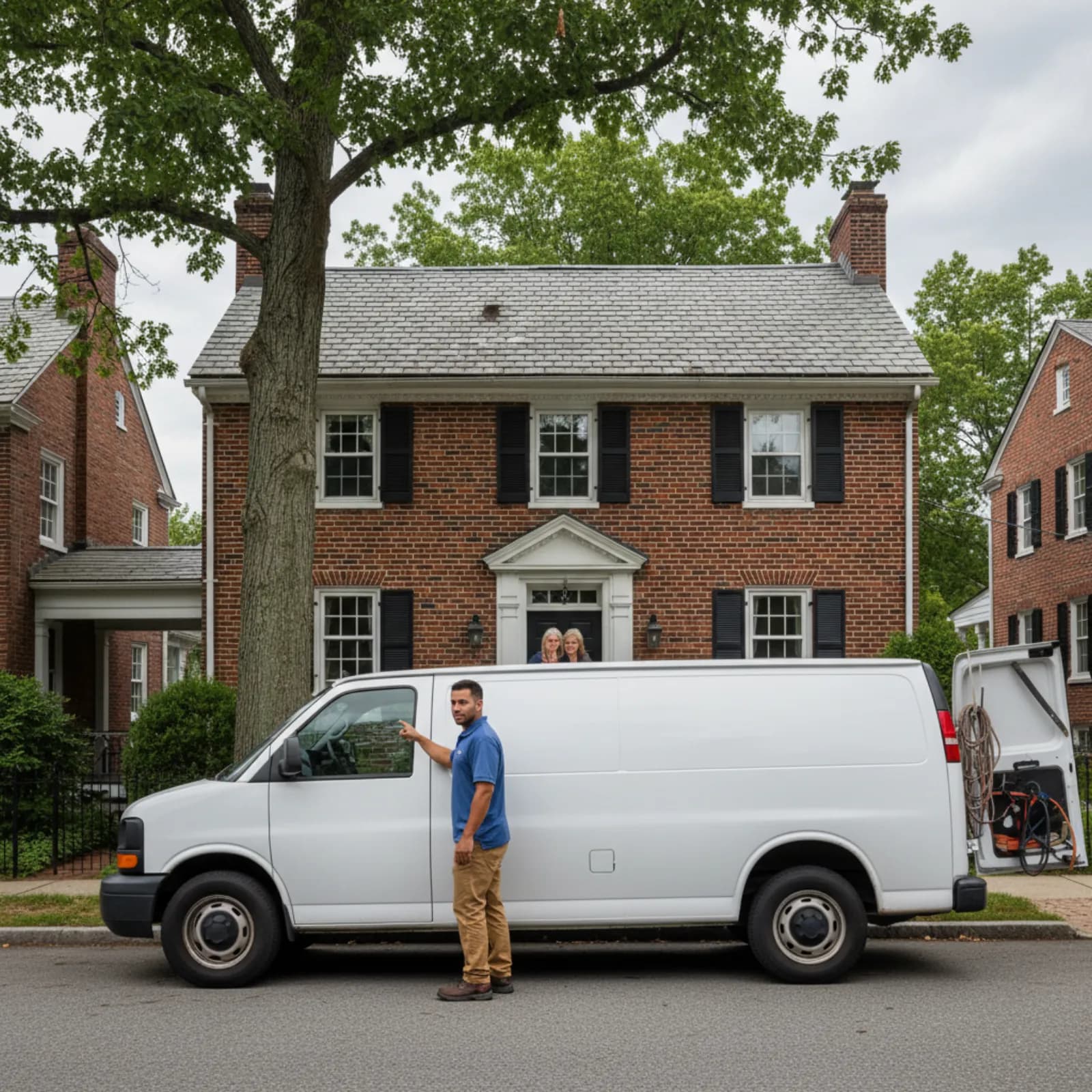
Connecticut's Roofing Scam Problem
Roofing fraud is one of the most persistent consumer protection challenges in Connecticut. The state's Department of Consumer Protection (DCP) has made it a priority, issuing a formal consumer warning in 2025 specifically about roofing scammers targeting homeowners across the state. The warning highlighted a surge of unlicensed contractors — many from out of state — taking advantage of homeowners dealing with storm damage, aging roofs, and the pressure of rising material costs.
Connecticut's geographic position makes it particularly vulnerable. Situated between New York and Massachusetts, the state sits in a corridor that sees intense nor'easters, coastal storms, heavy snow loads, and increasingly severe summer thunderstorms. Each weather event creates a wave of legitimate repair demand — and a corresponding wave of scammers looking to exploit that urgency. Storm chasers from as far as the Southeast and Midwest converge on Connecticut neighborhoods within days of a major weather event, armed with pressure tactics and glossy sales materials but lacking the proper CT Home Improvement Contractor (HIC) registration.
CT DCP 2025 Consumer Warning
The Connecticut Department of Consumer Protection issued a formal warning in 2025 about a rise in roofing scam activity across the state. The DCP specifically cautioned homeowners about unlicensed operators, door-to-door solicitation following storms, and contractors who pressure homeowners into signing contracts without providing written estimates or proper documentation. The DCP urged all homeowners to verify HIC registration before hiring any roofing contractor.
The good news is that Connecticut has robust consumer protection laws specifically designed to protect homeowners from fraudulent contractors. The Connecticut Home Improvement Act (CGS 20-418 through 20-432) establishes strict requirements for contractor registration, written contracts, surety bonds, and homeowner rights. The challenge is understanding these protections and knowing how to use them before you sign a contract — not after something goes wrong.
This guide covers every major roofing scam operating in Connecticut, walks you through the exact steps to verify a contractor's credentials using official state resources, explains your legal rights under Connecticut law, and provides actionable checklists to protect yourself and your investment. Whether you are replacing an aging roof, dealing with storm damage, or simply getting estimates, this information can save you thousands of dollars and months of frustration.
6 Common Roofing Scams in Connecticut
These are the most common schemes targeting Connecticut homeowners, based on DCP complaint patterns and consumer reports. For each scam, we explain how it works, how to recognize it, and what to do if you encounter it.
Storm Chasers Offering "Free Inspections"
How It Works
After a nor'easter, hailstorm, or severe thunderstorm, out-of-state contractors flood Connecticut neighborhoods within hours. They knock on doors, claim they can see damage from the street, and offer a "free roof inspection." Once on your roof, they "discover" damage that may not exist, then pressure you to sign a contract immediately. Their trucks carry out-of-state plates, their business cards list P.O. boxes or out-of-state addresses, and they have no long-term presence in Connecticut. By the time warranty issues arise, they are gone.
How to Spot It
Unsolicited visit within days of a storm, out-of-state plates or phone number, no local CT business address, pressure to sign immediately, and they claim damage is "urgent" or your insurance will "expire."
What to Do
Do not let them on your roof. Ask for their CT HIC registration number and verify it at portal.ct.gov/DCP. Get at least three quotes from established local contractors. Report suspicious activity to your local police and the CT DCP.
"We're Working in Your Neighborhood" Pitch
How It Works
A salesperson knocks on your door claiming their crew is "already working on your neighbor's roof" and they can offer you a special deal because they are already in the area. This creates artificial urgency and a false sense of legitimacy. In reality, there may be no neighbor project, or the "crew" is another subcontracted team with no accountability. This tactic is designed to bypass your natural caution by leveraging your trust in your neighbors.
How to Spot It
Unsolicited door-knock, vague about which neighbor they are working for, offers a "special deal" for signing today, cannot provide a written estimate on the spot, and becomes evasive when you ask for their CT HIC number.
What to Do
Ask which neighbor they are working for and verify it yourself. Request their CT HIC registration number and look it up before continuing any conversation. Never sign anything at the door. A legitimate contractor will not pressure you for an immediate decision.
Insurance Fraud — Inflated Damage Claims
How It Works
The contractor offers to handle your entire insurance claim, then inflates the damage assessment to collect a larger payout. They may fabricate damage that does not exist, bill for premium materials while installing cheap alternatives, or offer to waive your deductible (which is illegal). You become an unwitting participant in insurance fraud. If discovered, you face claim denial, policy cancellation, or criminal charges. The contractor pockets the difference and moves to the next town.
How to Spot It
Promises of a "free" roof, offers to waive your deductible, insists on handling insurance communication exclusively, reluctant to provide a written estimate before filing the claim, and asks you to sign an Assignment of Benefits (AOB) form.
What to Do
File your own insurance claim directly. Never sign an AOB form. Work with your adjuster independently. Get your own estimate before the insurance adjuster visits. Report suspected insurance fraud to the CT Insurance Department at (860) 297-3900.
Lowball Bids That Escalate with "Unexpected" Issues
How It Works
The contractor submits a bid dramatically lower than competitors to win the job. Once your old roof is torn off and your home is exposed, they "discover" hidden damage — rotted decking, compromised framing, mold — that conveniently doubles the price. With your roof open to the elements, you have zero leverage. The original low bid was bait; the change orders are the real price. The "discoveries" were predictable issues any experienced roofer would have accounted for.
How to Spot It
A bid 30% or more below other quotes, vague scope of work with language like "repair as needed," no line-item breakdown, and a contract with loose change-order terms that do not require your written approval.
What to Do
Get at least three detailed, itemized quotes. Be suspicious of any bid dramatically lower than others. Insist on a written change-order process requiring your signed approval before any additional work begins. Ask each contractor what they would do if they find deck damage.
Cash-Only Demands with No Written Contract
How It Works
The contractor offers a discount for paying in cash and skipping the written contract. This eliminates your paper trail, removes chargeback rights, allows the contractor to avoid taxes, and leaves you with zero legal documentation. Under CT law, any home improvement work over $200 requires a written contract. Without one, you have no recourse through the DCP, no bond to claim against, and no evidence to present in court. The "discount" costs you your consumer protections.
How to Spot It
Offers a significant "cash discount," refuses to provide a written contract, says a handshake is good enough, no invoice or receipt, and pays their crew in cash.
What to Do
Connecticut law requires a written contract for jobs over $200. Refuse cash-only arrangements. Pay by credit card or check for a paper trail. Report contractors who refuse to provide written contracts to the CT DCP at (860) 713-6110.
Out-of-State Operators Without CT HIC Registration
How It Works
Contractors from neighboring states (often New York, New Jersey, or Pennsylvania) operate in Connecticut without bothering to register as Home Improvement Contractors with the DCP. They skip the registration to avoid the $20,000 surety bond requirement, insurance costs, and regulatory accountability. When something goes wrong — and it often does — you have virtually no recourse. There is no bond to claim against, no licensing board to file complaints with, and the contractor may be impossible to locate across state lines.
How to Spot It
Out-of-state plates on work vehicles, out-of-state phone number, unable or unwilling to provide a CT HIC registration number, no local business address, suspiciously low prices, and their company name does not appear in the DCP registry.
What to Do
Search the DCP HIC registry at portal.ct.gov/DCP before signing anything. If the contractor is not registered, do not hire them regardless of price. Report unregistered contractors to the DCP. Check for a local physical address in Connecticut.
Red Flags to Watch For
Any one of these red flags warrants caution. Two or more should end the conversation immediately. Print this list and refer to it when evaluating any roofing contractor.
No written contract or refuses to provide one
Immediate disqualifierCannot provide a CT HIC registration number
Immediate disqualifierPressures you to sign today with "limited time" pricing
Immediate disqualifierAsks for more than one-third of the contract price upfront
Immediate disqualifierNo physical Connecticut business address
Immediate disqualifierOut-of-state plates on work vehicles
Warning signWill not pull building permits or claims permits are unnecessary
Immediate disqualifierOffers to waive your insurance deductible
Immediate disqualifierOnly accepts cash, cashier's check, or wire transfer
Immediate disqualifierCannot provide verifiable local references
Warning signCompany was incorporated within the last few months
Warning signCannot produce proof of workers' compensation insurance
Immediate disqualifierWants you to sign an Assignment of Benefits (AOB) form
Immediate disqualifierOffers an unrealistically low price compared to other quotes
Warning signNo visible $20,000 surety bond as required by CT law
Immediate disqualifierHow to Verify a Connecticut Roofing Contractor
Before you sign a contract or pay a deposit, complete every step on this verification checklist. Each step takes only a few minutes and can save you thousands of dollars and months of frustration. Connecticut's DCP provides free public lookup tools for all of these verifications.
Check CT DCP HIC Registration
Every Connecticut home improvement contractor must be registered with the Department of Consumer Protection (DCP). Visit portal.ct.gov/DCP and use the license lookup tool to search by contractor name or HIC registration number. The listing should show an active status, the contractor's name, business address, and registration expiration date. If they are not registered, do not hire them — you will have no bond protection and no regulatory recourse.
Verify now on official siteVerify $20,000 Surety Bond
Connecticut requires all HIC-registered contractors to maintain a $20,000 surety bond or its equivalent. This bond protects you financially if the contractor fails to perform, abandons the project, or does defective work. Ask the contractor for their bond information and verify it is active. If they cannot provide bond details, they may not be properly registered. The bond is your financial safety net.
Confirm General Liability Insurance ($500K+)
General liability insurance covers damage to your property caused by the contractor's work. While Connecticut does not mandate a specific dollar minimum for roofing contractors, industry best practice is at least $500,000 in coverage. Ask for a Certificate of Insurance naming you as an additional insured for the duration of the project, and call the insurance carrier directly to verify the policy is active and not expired.
Confirm Workers' Compensation Insurance
Connecticut law requires employers with one or more employees to carry workers' compensation insurance. If a roofing crew member is injured on your property and the contractor lacks workers' comp coverage, you could be held personally liable for medical bills and lost wages. Ask for a Certificate of Insurance, verify the policy number, and call the insurer directly to confirm the coverage is current.
Check BBB Rating and Complaint History
Search the contractor on the Better Business Bureau at bbb.org. Pay attention to complaint history, resolution patterns, and how long the company has been in business. A newly incorporated company with dozens of glowing reviews should raise suspicion. Look for a pattern of complaints rather than just the letter grade. Cross-reference with Google Reviews and Yelp for consistency.
Verify now on official siteSearch CT DCP Complaint Records
The Connecticut Department of Consumer Protection maintains records of complaints filed against contractors. Call the DCP at (860) 713-6110 or visit portal.ct.gov/DCP to check whether the contractor has any unresolved complaints or disciplinary actions. Previous complaints about the same contractor are a strong indicator of ongoing problems.
Verify now on official siteVerify a Physical Connecticut Address
Confirm the contractor has a real, physical business address in Connecticut — not a P.O. box, a UPS Store mailbox, or an out-of-state address. Drive by the address if possible. A local contractor with a physical presence has a reputation to protect and cannot disappear overnight. If the only address listed is out-of-state or a mail drop, that is a significant red flag.
Your Rights Under Connecticut Law
CT Home Improvement Act (CGS 20-418 to 20-432)
The Connecticut Home Improvement Act is the primary statute protecting homeowners from fraudulent and incompetent contractors. It establishes requirements that every roofing contractor must follow:
Mandatory HIC registration: All contractors performing home improvement work must register with the Department of Consumer Protection (DCP). Registration requires passing a background check, providing proof of insurance, and posting a $20,000 surety bond. Working without registration is a criminal offense.
Written contract required for work over $200: Connecticut has one of the lowest thresholds in the nation for requiring a written contract. Any home improvement work exceeding $200 must be documented in a written agreement. This is significantly stricter than many other states which set the threshold at $1,000 or more.
3-day right of rescission: If a contractor solicits you at your home (door-to-door sales), you have three business days to cancel the contract without penalty. The contractor is legally required to include this notice in writing in the contract. Failure to include it extends the cancellation period indefinitely.
$20,000 surety bond: Every registered HIC must maintain a $20,000 surety bond or its equivalent. This bond protects homeowners if the contractor fails to perform, does defective work, or abandons a project. You can file a claim against the bond through the DCP.
Payment schedule limits: A contractor cannot demand more than one-third of the total contract price as a deposit before work begins. Subsequent payments should be tied to work milestones, with the final payment due only upon satisfactory completion.
CT Unfair Trade Practices Act (CUTPA — CGS 42-110a)
Connecticut's Unfair Trade Practices Act (CUTPA) provides additional legal protection against deceptive business practices, including roofing scams. It is Connecticut's version of a consumer protection statute and offers significant remedies:
Actual damages plus costs: A court can award your actual damages, court costs, and reasonable attorney fees. This makes pursuing a claim financially viable even for smaller losses.
Punitive damages: In cases of willful or egregious conduct, the court can award punitive damages in addition to actual damages. This is designed to punish particularly bad actors and deter future misconduct.
Broad coverage: CUTPA covers misrepresentation, fraud, failure to perform, use of substandard materials, operating without proper licensing, and any other practice that is unfair, deceptive, or unconscionable.
No demand letter required: Unlike some states, Connecticut does not require a pre-suit demand letter before filing a CUTPA claim. However, it is still good practice to send one, as it may prompt a faster resolution.
What a Legitimate Roofing Contract Should Include
Connecticut law requires a written contract for home improvement work exceeding $200 — one of the strictest thresholds in the nation. But legal compliance and genuine protection are not the same thing. Demand every item on this list before you sign.
Contractor's full legal name, CT business address, phone, and email
CT HIC registration number (required by law)
Complete scope of work describing every element of the project
Materials specified by manufacturer, product line, and model (e.g., "GAF Timberline HDZ Charcoal")
Project start date and estimated completion date
Total contract price with line-item breakdown of labor and materials
Payment schedule (no more than 1/3 deposit — CT law)
Warranty terms: manufacturer warranty period and workmanship warranty period
Who is responsible for pulling building permits and scheduling inspections
Cleanup and debris removal obligations
Written change-order process requiring your signed approval
Dispute resolution method (mediation, arbitration, or court)
Notice of your 3-day right of rescission (required for door-to-door sales)
Lien waiver requirements tied to each payment milestone
Insurance documentation (general liability and workers' compensation)
Surety bond information ($20,000 CT requirement)
Pro Tip: Compare Scope of Work, Not Just Price
When comparing multiple quotes, make sure each contractor is bidding on the same scope of work. A $14,000 quote that includes complete tear-off, synthetic underlayment, ice-and-water shield on all eaves and valleys, new step flashing, and ridge vent replacement is a better deal than a $10,000 quote that only covers shingles over the existing layer. RoofVista standardizes every quote so you can compare on equal terms.
Payment Schedule Best Practices
How you structure payments is your single most powerful lever for keeping a contractor accountable. Connecticut law caps the deposit at one-third of the total contract price. Here is the payment schedule that best protects your interests:
At Contract Signing
The CT legal maximum deposit. This covers the contractor's material procurement costs. Pay by credit card for chargeback protection. Never exceed this amount regardless of what the contractor requests.
At Materials Delivery
Pay the second third only after materials have been delivered to your property and you have verified they match the contract specifications. Check brands, product lines, and quantities against the written scope of work.
At Completion & Inspection
The final payment is due only after the work is complete, the job site is cleaned up, the building inspection has passed, and you are satisfied with the result. Never release final payment under pressure.
Never Do These
- • Never pay the full contract amount before work begins
- • Never pay in cash without a receipt and written contract
- • Never wire money to a contractor (no chargeback protection)
- • Never make payments ahead of schedule because the contractor asks
- • Never release final payment before the building inspection passes
What to Do If You've Been Scammed
If you believe you have been the victim of a roofing scam in Connecticut, act quickly. The sooner you take these steps, the better your chances of recovering your money and preventing the contractor from victimizing others.
Document Everything Immediately
Take photos and videos of all work performed (or not performed), save all contracts, receipts, text messages, emails, and voicemails. Create a written timeline of events including dates, amounts paid, and promises made. Screenshot any social media profiles or ads from the contractor. This documentation is critical for every subsequent step.
File a Complaint with CT Department of Consumer Protection
Contact the DCP at (860) 713-6110 or file online at portal.ct.gov/DCP. The DCP investigates complaints against registered and unregistered contractors, can take disciplinary action, and may be able to help you access the contractor's surety bond for compensation.
Contact the CT Attorney General's Office
The Connecticut Attorney General's office handles consumer protection enforcement. File a complaint at portal.ct.gov/AG or call (860) 808-5318. The AG's office can pursue legal action against contractors engaged in unfair trade practices under CUTPA and may join your complaint with others to build a stronger case.
File a Police Report
If the contractor collected money and disappeared, performed no work, or engaged in outright fraud, file a police report with your local department. This creates an official record, may trigger a criminal investigation, and is often required by your bank for chargeback claims or your insurance company for claim processing.
File a Surety Bond Claim
If the contractor was registered with the DCP and carried the required $20,000 surety bond, you can file a claim against the bond to recover your financial losses. Contact the DCP to obtain the bond company information and file a claim directly with the surety company. This is one of the most direct paths to financial recovery in Connecticut.
Initiate a Credit Card Chargeback
If you paid by credit card, contact your card issuer immediately to dispute the charge. The Fair Credit Billing Act gives you the right to dispute charges for services not rendered or goods not delivered. Provide your documentation, police report, and DCP complaint as supporting evidence. Most credit card companies have a 60-day window for disputes, but contact them as soon as possible.
Consider Small Claims Court or CUTPA Action
For claims up to $5,000, Connecticut small claims court provides a fast, affordable path to resolution without an attorney. For larger claims, consult a consumer protection attorney about filing a CUTPA claim, which can award actual damages, punitive damages, and attorney fees. Many consumer protection attorneys offer free initial consultations.
Key CT Contact Numbers
How RoofVista Protects Connecticut Homeowners
RoofVista was built specifically to solve the problems described in this guide. Instead of spending hours verifying contractors yourself, you get instant access to a marketplace where every contractor has already been vetted. Here is what that means in practice:
CT HIC Verification
Every contractor on our platform has their CT DCP Home Improvement Contractor registration verified before they can receive a single lead. We confirm active status, bond compliance, and registration details directly through official DCP records.
Insurance Verified
We verify general liability insurance ($500K+ minimum), workers' compensation coverage, and the $20,000 surety bond for every CT contractor. You never have to worry about being liable for an uninsured crew on your property.
Standardized Quotes
Every quote uses the same scope-of-work format, so you can compare apples to apples. No more wondering why one bid is $5,000 less than another — you can see exactly what is included and what is not, item by item.
Complaint History Checked
We review DCP complaint records, BBB history, and online review patterns before approving any contractor. Contractors with unresolved complaints, patterns of negative reviews, or disciplinary actions are not accepted into the marketplace.
No Pressure, No Spam
When you use RoofVista, you enter your address and get an instant satellite-based estimate. You then receive standardized quotes from pre-vetted Connecticut contractors. You compare on your own terms, on your own timeline. No one is knocking on your door. No one is pressuring you to sign today. No one is calling you 15 times. That is how it should work. See how we vet contractors for the full process.
Contractor Verification Checklist
Use this checklist before hiring any roofing contractor in Connecticut. Items marked as REQUIRED are non-negotiable — if a contractor fails any of these, walk away immediately.
All items checked? You are working with a legitimate Connecticut roofing contractor. Missing any REQUIRED items? Get quotes from pre-vetted contractors on RoofVista who have already passed every item on this list.
Related Resources
Consumer Protection Hub
Your rights and protections as a homeowner.
How We Vet Contractors
Our contractor screening and verification process.
CT Contractor Licensing Guide
Complete guide to Connecticut licensing requirements.
Connecticut Roofing Hub
Roof replacement quotes across Connecticut.
National Roofing Scams Guide
General guide to roofing scams across the US.
Get a Free Estimate
Instant satellite-based roof estimate in 30 seconds.