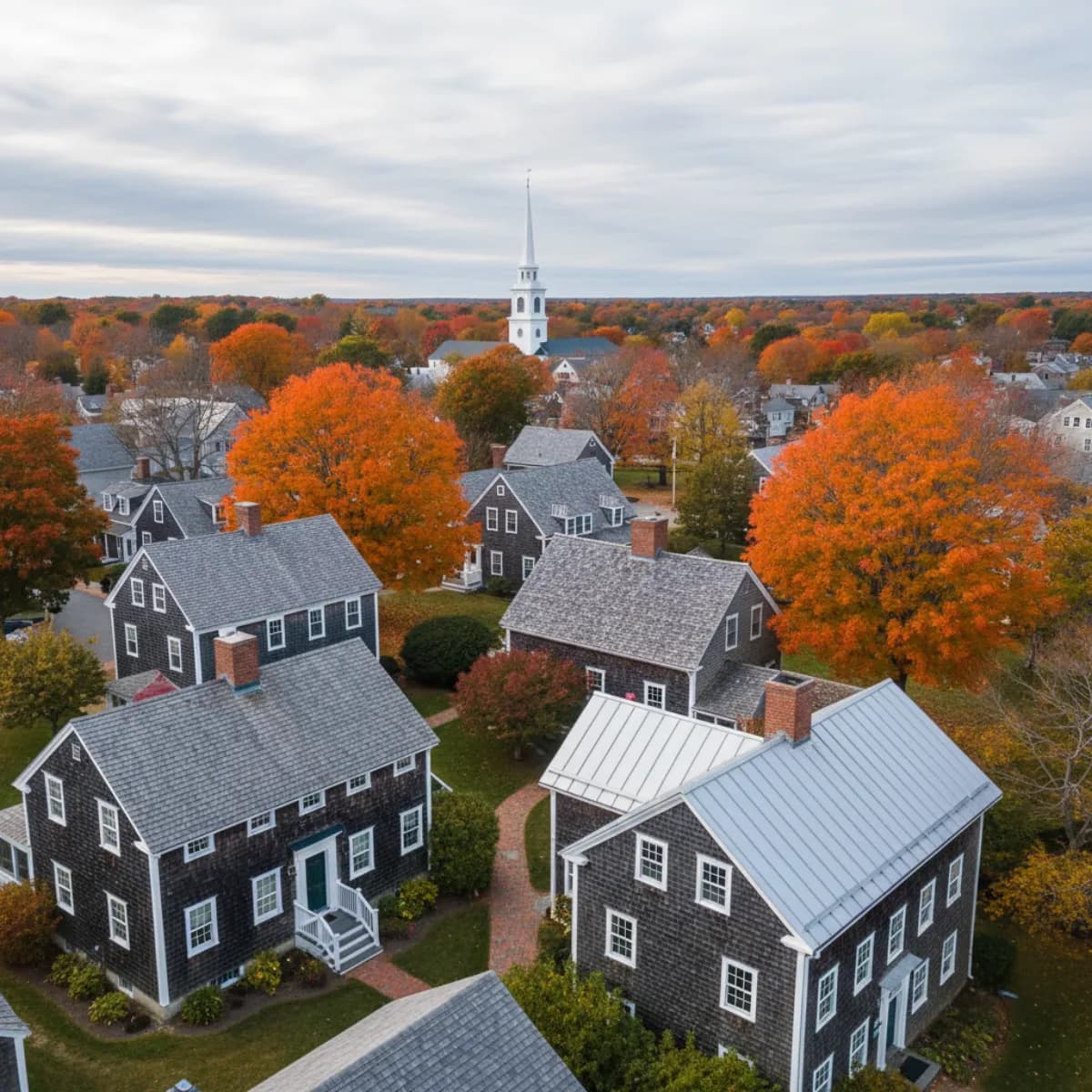
How Much Does a New Roof Cost in New England?
The average roof replacement in New England costs $8,500 to $18,000 for a standard 2,000 sqft home with architectural shingles, varying significantly by state, material, and local climate factors. Massachusetts homeowners in Boston typically pay the highest rates in the region ($10,500 to $18,400), while Vermont and Maine homeowners benefit from lower labor costs, with average projects running $8,000 to $15,000. These ranges reflect real 2026 contractor pricing from RoofVista's marketplace data, not outdated national averages.
New England's unique climate creates roofing challenges that don't exist in most of the United States. The region experiences severe freeze-thaw cycling, ice dam formation, nor'easter winds exceeding 80 mph, heavy snow loads ranging from 30 to 100+ pounds per square foot, coastal salt spray corrosion, and summer humidity that promotes algae growth. Each of these factors influences which roofing material performs best and how much a quality installation costs. A roof that works perfectly in Virginia or North Carolina may fail within 10 years on a New England home.
RoofVista's instant estimator uses satellite imagery to measure your exact roof dimensions, pitch, and complexity, then provides instant roof replacement quotes from pre-vetted local contractors in under 60 seconds. Unlike traditional estimates that require scheduling 3 to 5 in-home visits over multiple weeks, our roof replacement cost estimator gives you standardized, comparable quotes immediately. Every contractor in our marketplace is verified for state licensing, insurance coverage, and local references specific to your New England community.
This guide breaks down roof replacement costs across all six New England states — Massachusetts, Connecticut, Rhode Island, New Hampshire, Vermont, and Maine — with real pricing data for 8 roofing materials, city-level cost breakdowns for 14 major cities, and climate-specific recommendations that help you choose the right material for your property. Whether you're replacing an aging asphalt shingle roof on a Cape Cod cottage, upgrading to metal on a Vermont farmhouse, or restoring slate on a historic Boston brownstone, this is the most comprehensive New England roofing cost resource available.
Get Your Personalized Estimate
The costs in this guide are regional averages. Your actual roof replacement cost depends on your exact roof size, pitch, complexity, and location. Enter your address below for a satellite-measured estimate tailored to your home.
State-by-State Roof Replacement Cost Comparison
Roof replacement costs vary significantly across New England's six states, driven by differences in labor rates, building code requirements, climate severity, and contractor availability. The table below shows real 2026 pricing pulled directly from RoofVista's contractor marketplace for the two most popular materials: architectural shingles and metal standing seam roofing.
| State | Architectural Shingles ($/sqft) | Metal Roofing ($/sqft) | Avg Project Cost (2,000 sqft) | Key Cost Driver |
|---|---|---|---|---|
| Massachusetts | $6.10 – $8.53 | — – — | $12,200 – $17,060 | High labor costs and ice dam requirements |
| Connecticut | $5.94 – $8.31 | — – — | $11,880 – $16,620 | Coastal wind codes and steep-pitch colonials |
| Rhode Island | — – — | — – — | — – — | Coastal wind exposure and salt spray corrosion |
| New Hampshire | — – — | — – — | — – — | Heavy snow loads (50-80 psf) and rural access |
| Vermont | — – — | — – — | — – — | Extreme snow loads and limited contractor supply |
| Maine | — – — | — – — | — – — | Harsh coastal/inland climate and material transport costs |
Pricing data sourced from RoofVista's contractor marketplace. Costs reflect installed prices including materials, labor, underlayment, and standard waste factor. Updated daily. Individual project costs vary based on roof size, pitch, complexity, and access.
City-Level Roof Replacement Costs Across New England
Roofing costs vary dramatically even within the same state. Boston homeowners pay 15 to 20% more than the Massachusetts state average, while rural Vermont and Maine communities benefit from lower overhead but may face material delivery surcharges. Here are the top 14 New England cities where homeowners most frequently compare roofing contractor prices through our marketplace.
| City | State | Avg Project Cost | Top Material | Climate Factor |
|---|---|---|---|---|
| Boston | Massachusetts | $10,500 – $18,400 | Architectural Shingles | Urban heat island, coastal nor'easters |
| Worcester | Massachusetts | $9,200 – $16,000 | Architectural Shingles | Heavy snow loads (45-55 psf), inland freeze-thaw |
| Springfield | Massachusetts | $8,800 – $15,500 | Architectural Shingles | Western MA snow belt, tornado-enhanced wind codes |
| Hartford | Connecticut | $9,000 – $16,200 | Architectural Shingles | River valley humidity, heavy winter precipitation |
| New Haven | Connecticut | $9,400 – $16,800 | Architectural Shingles | Coastal wind exposure, Long Island Sound storms |
| Bridgeport | Connecticut | $9,600 – $17,000 | Impact-Resistant Shingles | Coastal wind zone, salt spray corrosion |
| Providence | Rhode Island | $9,200 – $16,500 | Architectural Shingles | Narragansett Bay wind exposure, coastal humidity |
| Warwick | Rhode Island | $9,000 – $16,000 | Architectural Shingles | Coastal proximity, moderate snow loads |
| Manchester | New Hampshire | $8,500 – $15,200 | Architectural Shingles | Heavy snow loads (50-60 psf), freeze-thaw cycling |
| Nashua | New Hampshire | $8,800 – $15,500 | Architectural Shingles | Southern NH snow loads, Boston metro labor spillover |
| Burlington | Vermont | $8,400 – $15,000 | Metal Standing Seam | Extreme snow loads (60-80 psf), Lake Champlain moisture |
| Montpelier | Vermont | $8,200 – $14,800 | Metal Standing Seam | Highest VT snow loads, limited contractor availability |
| Portland | Maine | $8,600 – $15,400 | Architectural Shingles | Coastal nor'easters, salt spray, freeze-thaw |
| Bangor | Maine | $8,000 – $14,500 | Metal Standing Seam | Interior snow belt (55-70 psf), remote material transport |
Project costs are for a standard 2,000 sqft architectural shingle roof unless the city's top material differs. Actual costs depend on your roof's exact dimensions — enter your address above for a personalized satellite-measured estimate.
Roofing Material Cost Comparison for New England
New England's climate demands more from roofing materials than almost any other region in the United States. The combination of ice, snow, wind, humidity, and salt spray means that material selection is not just about aesthetics or price — it's about survival. Below is a comprehensive comparison of all 8 roofing materials available through RoofVista's marketplace, with NE-specific pricing from our contractor database, climate performance ratings, and honest pros and cons for the region.
| Material | NE Price Range ($/sqft) | Best For in NE | Lifespan in NE | Wind Resistance | Snow Load Rating |
|---|---|---|---|---|---|
| 3-Tab Shingles | — – — | Budget-conscious projects in sheltered inland areas | 15 to 20 years | 60-70 mph | Standard |
| Architectural Shingles | $5.94 – $8.53 | Most New England homes — best balance of cost and performance | 25 to 30 years | 110-130 mph | Good |
| Metal Standing Seam | — – — | Heavy snow areas (VT, NH, inland ME) and coastal wind zones | 40 to 70 years | 140+ mph | Excellent |
| Tile Roofing | $11.76 – $21.74 | Mediterranean and Spanish-style architecture in southern NE | 50 to 75 years | 100-150 mph | Good (with structural support) |
| Flat/TPO Roofing | $6.61 – $11.21 | Low-slope and flat-roof sections common on commercial buildings and row houses | 20 to 30 years | 80-120 mph | Good (with proper drainage) |
| Natural Slate | $17.64 – $30.19 | Historic New England homes and properties in historic districts | 75 to 150+ years | 110-150+ mph | Excellent |
| Wood Shake | $8.10 – $14.58 | Rustic New England aesthetics in dry inland areas | 20 to 30 years (with maintenance) | 80-100 mph | Fair |
| Impact-Resistant Shingles | $5.67 – $8.91 | Coastal NE properties exposed to nor'easters and hail | 25 to 35 years | 130+ mph | Very Good |
3-Tab Shingles
Budget-conscious projects in sheltered inland areas
NE lifespan: 15 to 20 years
Pros for New England
- +Lowest upfront cost
- +Easy to repair and source
Cons for New England
- -Limited wind resistance (60-70 mph) — vulnerable in nor'easters
- -Shorter lifespan means more frequent replacement in harsh NE climate
- -No ice dam protection advantage
Architectural Shingles
Most New England homes — best balance of cost and performance
NE lifespan: 25 to 30 years
Pros for New England
- +Wind rating: 110-130 mph handles most nor'easters
- +Works well with ice and water shield
- +Wide aesthetic range for colonial and Cape Cod styles
- +Best cost-per-year value for NE homeowners
Cons for New England
- -Still vulnerable to extreme ice dam conditions without proper underlayment
- -Algae growth in humid coastal areas (choose algae-resistant variants)
Metal Standing Seam
Heavy snow areas (VT, NH, inland ME) and coastal wind zones
NE lifespan: 40 to 70 years
Pros for New England
- +Snow sheds naturally — virtually eliminates ice dams
- +Wind rating: 140+ mph — exceeds worst nor'easter conditions
- +Lasts 2 to 3 times longer than shingles
- +Energy savings of 10 to 25% through solar reflectance
Cons for New England
- -Highest upfront cost among common materials
- -Requires snow guards over walkways and entries
- -Can be noisy during heavy rain without proper underlayment
Tile Roofing
Mediterranean and Spanish-style architecture in southern NE
NE lifespan: 50 to 75 years
Pros for New England
- +Extremely durable and fire-resistant
- +Heavy weight handles moderate wind loads well
- +Very long lifespan reduces total cost of ownership
Cons for New England
- -Weight requires structural reinforcement (12-15 lbs/sqft)
- -Vulnerable to cracking during freeze-thaw cycling
- -Limited installer availability in northern NE states
- -Not ideal for steep-pitch colonials
Flat/TPO Roofing
Low-slope and flat-roof sections common on commercial buildings and row houses
NE lifespan: 20 to 30 years
Pros for New England
- +Excellent waterproofing for low-slope applications
- +Energy Star rated white membrane reflects heat
- +Cost-effective for commercial and multi-family buildings
Cons for New England
- -Not suitable for steep residential roofs
- -Ponding water risk requires proper drainage in NE rain/snowmelt
- -Seam integrity critical in freeze-thaw conditions
Natural Slate
Historic New England homes and properties in historic districts
NE lifespan: 75 to 150+ years
Pros for New England
- +Heritage material — many NE historic districts require it
- +Naturally freeze-thaw, fire, and wind resistant
- +VT and ME quarry slate is 20 to 30% cheaper than imported alternatives
- +Some NE slate roofs have survived 200+ years
Cons for New England
- -Very heavy — requires structural verification (15-20 lbs/sqft)
- -Highest upfront cost
- -Requires specialized installers (limited in NE)
- -Individual slate tiles can crack under heavy ice loads
Wood Shake
Rustic New England aesthetics in dry inland areas
NE lifespan: 20 to 30 years (with maintenance)
Pros for New England
- +Classic New England look for colonial and farmhouse styles
- +Natural insulation value
- +Can be sourced locally from NE cedar mills
Cons for New England
- -High maintenance in NE humidity — moss, algae, and rot risk
- -Not fire-resistant without chemical treatment
- -Prohibited in many NE fire districts
- -Requires regular treatment every 3 to 5 years
Impact-Resistant Shingles
Coastal NE properties exposed to nor'easters and hail
NE lifespan: 25 to 35 years
Pros for New England
- +Wind rating: 130+ mph with enhanced fastening
- +Class 4 UL 2218 impact rating — survives 2-inch steel ball impact
- +Insurance discounts: 10 to 20% premium savings
- +Enhanced ice dam resistance compared to standard shingles
Cons for New England
- -15 to 25% more expensive than standard architectural shingles
- -Fewer style options than standard shingles
How New England's Climate Impacts Roofing Costs and Material Selection
New England's climate is among the most demanding for roofing systems in the entire United States. The region experiences the full spectrum of weather extremes — from sub-zero winter temperatures with heavy snowfall to humid summers exceeding 90 degrees F — creating a punishing cycle that accelerates roof degradation and drives up installation costs compared to more temperate regions. Understanding these climate factors is essential for choosing a material that will perform reliably and deliver long-term value.
Ice Dams and Freeze-Thaw Cycling
Ice dams are the single most destructive climate factor for New England roofs. They form when heat escaping from the attic melts snow on the upper roof surface, and the resulting meltwater refreezes at the colder eave edge, creating a dam of ice that forces water back under shingles and into the home. All six New England states require ice and water shield membrane for at least the first 24 inches past the interior wall line, but best practice in areas with heavy snowfall (northern NH, VT, and interior ME) extends this protection 3 to 6 feet from the eave.
Freeze-thaw cycling — the repeated expansion and contraction of water in microscopic cracks — degrades asphalt shingles, concrete tiles, and even natural stone over decades. New England experiences 80 to 120+ freeze-thaw cycles per winter depending on elevation and latitude. This is why material lifespan in New England is typically 15 to 25% shorter than manufacturer ratings based on national averages. Standing seam metal roofing largely avoids this issue because its smooth, continuous surface prevents water from accumulating in cracks and seams.
Nor'easters and Coastal Wind Exposure
New England experiences 5 to 10 significant nor'easters per winter, with sustained winds of 40 to 60 mph and coastal gusts exceeding 80 mph. These storms are the primary driver of acute roof damage across the region, especially along the coastlines of Massachusetts, Rhode Island, Connecticut, and southern Maine. Architectural shingles rated for 110+ mph winds handle most nor'easters when installed with a 6-nail fastening pattern, but coastal properties benefit from impact-resistant shingles rated at 130+ mph or standing seam metal at 140+ mph. The additional cost for wind-rated materials — typically $500 to $2,000 — is a fraction of the cost of wind damage repair, which averages $5,000 to $12,000 per incident.
Heavy Snow Loads
Ground snow loads across New England range from 30 psf along the southern Connecticut coast to 100+ psf in Vermont's Green Mountains and New Hampshire's White Mountains. Roof structural design must account for these loads, and heavy roofing materials like slate (15 to 20 lbs/sqft) and tile (12 to 15 lbs/sqft) require engineering verification to ensure the structure can support both the material weight and peak snow accumulation. Metal roofing has a significant advantage in snow country because snow slides off the smooth panels, reducing accumulated load and eliminating the primary cause of ice dams.
Salt Spray Corrosion on Coastal Properties
Properties within 1 to 3 miles of the Atlantic coast — from Maine's Downeast region through Massachusetts' South Shore and Cape Cod, Rhode Island's Narragansett Bay, and Connecticut's Long Island Sound — face accelerated corrosion from salt-laden air. This is particularly destructive for metal roofing components: flashing, fasteners, drip edges, and (on budget metal roofs) the panels themselves. Coastal properties should specify marine-grade stainless steel fasteners and Galvalume or aluminum panels rather than bare galvanized steel. The corrosion premium adds $1,000 to $3,000 to a metal roof project but prevents premature failure.
Humidity and Algae Growth
New England's humid summers promote algae (Gloeocapsa magma) growth on north-facing roof slopes, creating dark streaks that are cosmetically unattractive and can accelerate shingle degradation by retaining moisture against the surface. Most major shingle manufacturers now offer algae-resistant variants with copper or zinc granules (AR shingles) at minimal cost premium. For New England installations, specifying algae-resistant shingles is strongly recommended, especially on shaded lots surrounded by mature trees.
How Climate Drives Material Selection by Sub-Region
| Sub-Region | Primary Climate Risk | Recommended Material | Cost Premium |
|---|---|---|---|
| Southern Coast (CT, RI, South Shore MA) | Wind + salt spray | Impact-resistant or metal | +10 to 25% |
| Northern Coast (ME, North Shore MA) | Wind + ice + salt | Metal standing seam | +15 to 30% |
| Interior Snow Belt (VT, NH, western ME) | Heavy snow + ice dams | Metal standing seam | +15 to 25% |
| Urban Metro (Boston, Hartford, Providence) | Mixed + high labor costs | Architectural shingles | Baseline (labor premium built in) |
| Historic Districts (NE-wide) | Regulatory + aesthetic | Slate or period-appropriate | +20 to 50% |
How RoofVista's Instant Roof Cost Estimator Works
RoofVista's roof replacement cost estimator eliminates the guesswork from roofing projects by combining satellite technology with real contractor pricing. Here's how New England homeowners get instant roof replacement quotes in four simple steps.
Enter Your Address
Type your New England home address into the search bar. Our system identifies your property and locates it on high-resolution satellite imagery covering all six New England states.
AI Measures Your Roof
Our AI analyzes satellite imagery to calculate your exact roof dimensions, pitch, number of slopes, complexity factors, and total square footage. No climbing on your roof required.
Get Instant Quotes from Pre-Vetted Contractors
Within 60 seconds, you receive instant roof replacement quotes from contractors in our marketplace who serve your area. Every contractor is verified for state licensing, insurance, and local references.
Compare and Choose
Compare roofing contractor prices side by side with standardized scopes of work. See material options, warranties, timelines, and total costs — then choose the contractor that fits your project.
Try It Now — Free for New England Homeowners
No phone calls, no salespeople, no obligation. Enter your address below and compare quotes from pre-vetted contractors in your area.
Cost Factors That Drive New England Roof Replacement Pricing
Beyond material and labor, several New England-specific factors add significant cost to roof replacement projects. Understanding these factors helps homeowners budget accurately and avoid surprises when they compare roofing contractor prices.
Ice and Water Shield Requirements
All six New England states require ice and water shield membrane extending at least 24 inches past the interior wall line at eaves. This self-adhering waterproof barrier is the primary defense against ice dam leaks. In heavy snow areas (northern NH, VT, and interior ME), best practice extends coverage 3 to 6 feet from the eave and around all penetrations, valleys, and roof-to-wall transitions. The cost of enhanced ice and water shield adds $800 to $2,500 to a standard project, but this investment prevents interior water damage that can cost $5,000 to $20,000 to repair.
Steep Pitch Premiums on New England Colonials
New England's architectural heritage features steep-pitch roofs — Colonials, Capes, Saltboxes, and Gambrels — with pitches commonly ranging from 8:12 to 12:12. Roofs with pitches steeper than 7:12 require additional safety equipment (roof jacks, harnesses, scaffolding) and slower installation speeds, adding 10 to 25% to labor costs. A 10:12 pitch Colonial — extremely common across Massachusetts and Connecticut — may add $1,500 to $4,000 in steep-pitch premiums compared to a standard 4:12 to 6:12 roof. This factor is often overlooked in generic online calculators that assume moderate pitches.
Historic District Material Requirements
New England has more registered historic districts than any other region in the country. Properties in these districts — including Boston's Back Bay, Beacon Hill, and South End; Cambridge's Harvard Square; Providence's College Hill; Portland's Old Port; and dozens of New England town centers — may be required to use specific roofing materials (typically slate or architecturally appropriate alternatives) approved by a local Historic Commission. These requirements add 20 to 50% to project costs and 2 to 6 weeks to the timeline for commission review and approval.
Seasonal Pricing Dynamics
New England's compressed roofing season (April through November) creates pronounced seasonal pricing patterns. Peak demand from August through October — when homeowners rush to complete projects before winter — adds 5 to 10% above off-season rates. The best pricing windows are late April through May (before peak season) and mid-October through mid-November (as demand drops). Winter installation is generally not recommended in New England: temperatures below 40 degrees F prevent proper shingle adhesive activation, and snow and ice create safety hazards that slow work and increase risk.
Labor Shortage in NE Metro Areas
New England's roofing labor market is among the tightest in the nation. The combination of high cost of living, strict licensing requirements (Massachusetts requires a Construction Supervisor License and Home Improvement Contractor registration), and a limited pool of skilled tradespeople drives labor rates 15 to 30% above the national average. Boston metro rates of $85 to $95 per hour are among the highest in the country. Even in lower- cost areas like Vermont and Maine, contractor availability can be limited, especially during peak season. This is why early scheduling — ideally 4 to 8 weeks before your preferred start date — is critical in New England.
Frequently Asked Questions: New England Roof Replacement Costs
How much does a roof replacement cost in Massachusetts?
What's the cheapest roofing material in New England?
How much does a metal roof cost in New England?
Is it cheaper to replace a roof in Vermont vs Massachusetts?
How long does a roof replacement take in New England?
What roofing material lasts longest in New England winters?
Do I need a permit to replace my roof in New England?
How can I compare roofing contractor prices in New England?
What is the best time to replace a roof in New England?
How does RoofVista's roof cost estimator work?
Get Your Free Instant Estimate
New England Homeowners
Enter your address below and get instant roof replacement quotes from pre-vetted local contractors. No phone calls, no salespeople, no obligation. Compare quotes side by side with standardized scopes of work.
Covers all 6 New England states: MA, CT, RI, NH, VT, ME