Insurance Cancelled Because of Your Roof? Here’s What to Do
Across the country, insurers are dropping homeowners whose roofs are over 15-20 years old. If you’ve received a non-renewal notice — or you’re worried one is coming — this guide walks you through your rights, your options, and how replacing your roof can restore coverage and cut your premiums by hundreds per year.
Updated March 2026 · Covers all 12 RoofVista service states
Get an instant roof replacement quote — see what a new roof would cost
Why Insurers Are Dropping Homeowners in 2026
The insurance industry is undergoing its most aggressive underwriting tightening in decades. After years of escalating weather-related claims — driven by more frequent hailstorms, stronger nor’easters, and rising material costs — carriers are cutting risk by shedding policies on homes with aging roofs. This is not a temporary blip; it is a structural shift in how insurers evaluate residential risk.
Three forces driving non-renewals:
1. The ACV Shift on 10-15 Year Roofs
Insurers are aggressively switching policies from Replacement Cost Value (RCV) to Actual Cash Value (ACV) once a roof reaches 10-15 years old. Under ACV, depreciation is deducted from any claim payout. A 15-year-old architectural shingle roof depreciated at 4% per year retains only 40% of its replacement value. On a $15,000 roof replacement, an ACV policy might pay out only $6,000 minus your deductible — leaving you responsible for $10,000 or more out-of-pocket. Many homeowners discover this only after filing a claim.
2. Outright Non-Renewal for 20+ Year Roofs
Once a roof crosses the 20-year threshold, many carriers simply refuse to renew the policy at all. This is especially common with standard 3-tab and architectural asphalt shingles, whose manufacturer warranties typically expire at 20-30 years. Insurers view these roofs as statistically likely to fail in the next major storm, and the math no longer works for them at standard premium levels.
3. Drone and Satellite Roof Inspections
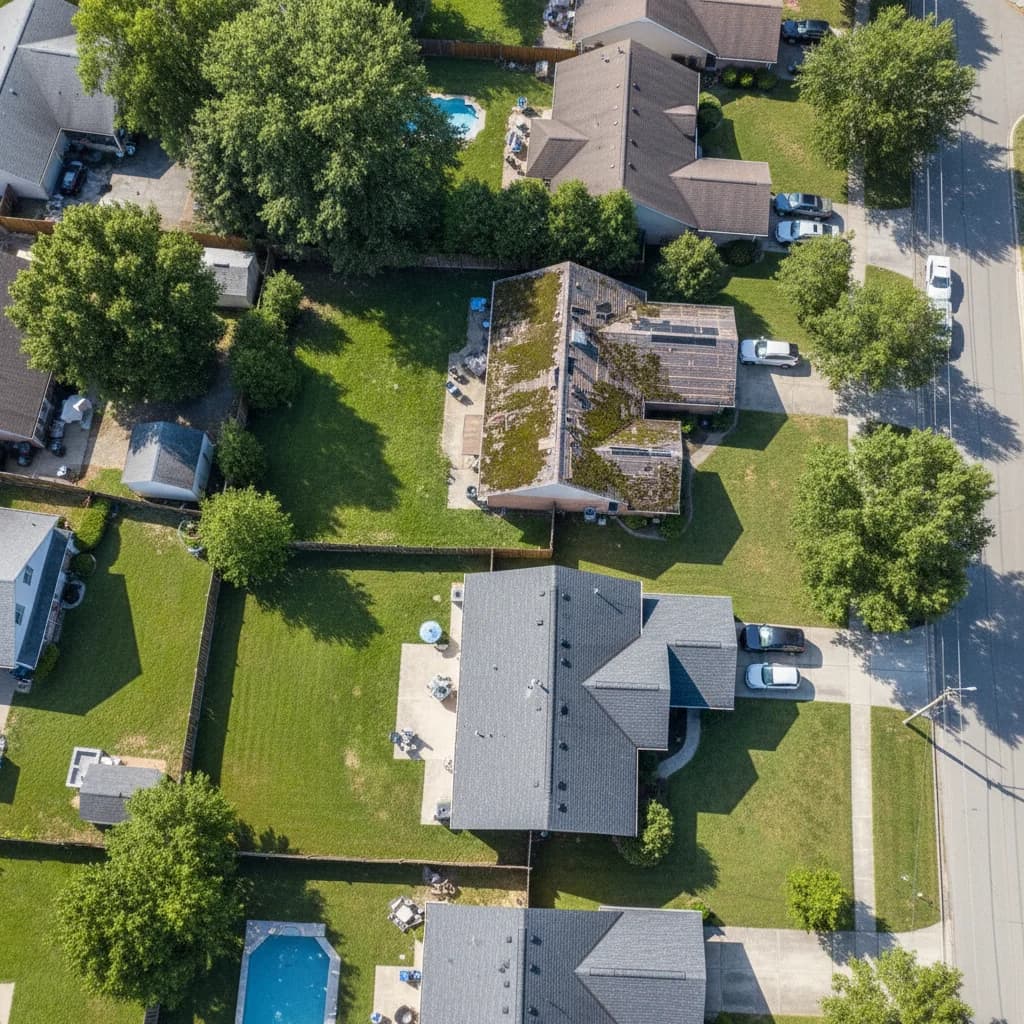
Insurers no longer need to send a person to your house to assess your roof. Aerial imagery from satellites and drones allows carriers to evaluate roof condition remotely at scale. Algorithms flag moss growth, missing shingles, granule loss, ponding water, and sagging ridgelines — often triggering non-renewal letters before the homeowner is even aware of the issue. If your insurer has an aerial photo of your roof, they already know its condition.
Key insight: Insurers are not just looking at age — they are looking at condition. A well-maintained 18-year-old roof in documented good condition may survive underwriting review, while a neglected 12-year-old roof may trigger ACV conversion. Documentation and proactive maintenance matter.
Your Rights When You Get a Non-Renewal Notice
A non-renewal notice is not an eviction from insurance. You have legal protections, and the process is regulated at the state level. Understanding your rights is the first step to fighting back.
State-by-State Notice Requirements
| State | Minimum Notice | Notes |
|---|---|---|
| Massachusetts | 45-90 days | 90 days for policies held 3+ years |
| Connecticut | 60 days | Written reason required |
| New York | 60-90 days | 90 days for policies held 3+ years |
| New Jersey | 60 days | Cannot non-renew for single weather claim |
| Pennsylvania | 60 days | Competitive market; alternatives available |
| Texas | 30 days | TWIA for coastal wind coverage |
| Maine | 30-75 days | 75 days for policies in effect 3+ years |
| New Hampshire | 60 days | No state FAIR Plan; limited fallback options |
| Vermont | 45 days | Small market; fewer carrier options |
| Rhode Island | 60-90 days | 90 days for policies held 3+ years |
Right to a Written Explanation
Every state requires insurers to provide a written reason for non-renewal. If you received a vague notice, contact your insurer and demand specifics. Was it roof age? Condition? Claims history? The reason matters because it determines your appeal strategy.
Right to Appeal
You can appeal a non-renewal with new documentation. A professional roof inspection showing your roof is in serviceable condition is the strongest evidence. Some states require insurers to reconsider their decision when presented with contradicting evidence from a licensed inspector.
Right to File a Complaint
If you believe the non-renewal is unfair or violates state regulations, you can file a complaint with your state’s Department of Insurance. This triggers a formal review of the insurer’s decision. While it does not guarantee reversal, it creates a regulatory record and can sometimes prompt the insurer to reconsider.
5 Steps to Take Immediately After a Non-Renewal Notice
Time is your most important asset after receiving a non-renewal notice. Do not wait until the last week of your coverage period. Start this process immediately.
Do Not Panic — You Have Time
Your current policy remains in effect through the end of the current term. The non-renewal notice means the insurer will not issue a new term, but your existing coverage is intact until expiration. You typically have 30-90 days depending on your state. Use every day of that window strategically.
Get a Professional Roof Inspection
Hire a licensed roofing contractor to perform a detailed inspection. This serves two purposes: it gives you documentation to support an appeal (if the roof is in better condition than the insurer believes), and it tells you honestly whether replacement is the better path. A good inspection report includes photos, measurements, an assessment of remaining useful life, and a written professional opinion.
Get Instant Roof Replacement Quotes
Whether or not you decide to replace immediately, knowing your replacement cost is essential. It helps you make an informed decision about whether to appeal or replace, and gives you leverage in conversations with insurers and agents. Use RoofVista to get an instant satellite-based estimate and compare quotes from pre-vetted contractors in your area.
Appeal With Documentation
If your inspection shows the roof is in serviceable condition, submit a formal appeal to your insurer. Include the inspection report, maintenance records, and any documentation of repairs or improvements. Address the specific reason for non-renewal cited in their notice. Send via certified mail to create a paper trail. If the insurer denies your appeal, file a complaint with your state’s insurance department.
Shop for New Coverage Immediately
Do not wait for the appeal outcome. Start shopping for alternative coverage in parallel. Work with an independent insurance agent who represents multiple carriers — they can often find coverage that a single-carrier agent cannot. If no private market option exists, explore your state’s FAIR Plan or insurer of last resort (detailed below). The worst outcome is a lapse in coverage, which makes future insurance even harder and more expensive to obtain.
How a New Roof Changes Everything
Replacing your roof is the single most effective action you can take to solve an insurance non-renewal. It addresses the insurer’s core concern (risk of near-term failure) and unlocks financial benefits that extend far beyond insurability.
Average savings per year after replacing a 20+ year old roof. Over a 25-year roof lifespan, this adds up to $7,500-$20,000 in insurance savings alone.
A new roof qualifies you for Replacement Cost Value coverage instead of depreciated ACV. If disaster strikes, your insurer pays the full replacement cost minus only your deductible.
Homes with new roofs are eligible for coverage from virtually every private market insurer. More competition means better rates, better coverage, and more negotiating leverage.
The Financial Case for Replacement
Consider a homeowner in Massachusetts paying $2,800/year for insurance on a home with a 22-year-old roof. After non-renewal, their only option is a FAIR Plan at $5,200/year — a $2,400/year increase. A roof replacement through RoofVista averages $12,000-$18,000. After replacement, they qualify for private market coverage at $2,200/year (saving $600/year vs. their old premium, or $3,000/year vs. the FAIR Plan).
Even at the higher replacement cost, the insurance savings pay back a significant portion of the investment within 5-7 years. Factor in increased home value (a new roof adds 60-70% of its cost to resale value) and the financial case becomes overwhelming.
Impact-Resistant Shingles: The Insurance Hack
If you are going to replace your roof anyway, choosing Class 4 impact-resistant shingles is one of the smartest financial decisions you can make. These shingles are engineered to withstand hail impacts that would destroy standard shingles, and insurers reward you accordingly.
What Makes a Shingle “Class 4”?
The UL 2218 impact resistance test drops a 2-inch steel ball from 20 feet onto the shingle twice in the same spot. To earn a Class 4 rating, the shingle must show no cracking, splitting, or fracturing after both impacts. Standard architectural shingles fail this test consistently. Class 4 shingles use modified asphalt formulations, rubberized polymers, or heavier mat construction to absorb the energy.
Popular Class 4 options include Owens Corning Duration FLEX, CertainTeed Landmark IR, GAF Timberline HDZ (with StainGuard Plus), and TAMKO Heritage IR. They look identical to standard architectural shingles but provide dramatically better protection.
The ROI Math
| Factor | Standard | Class 4 IR |
|---|---|---|
| Material cost (2,000 sq ft roof) | $3,800 | $4,750 |
| Additional cost for IR | — | +$950 |
| Annual insurance discount (10-35%) | $0 | $250-$700/yr |
| Breakeven period | — | 1.5-4 years |
| 25-year savings | $0 | $5,300-$16,550 |
The premium upcharge for Class 4 shingles is typically 15-25% over standard architectural shingles. At $950 extra on a $14,000-$16,000 total job, the insurance discount alone pays back the premium in 1.5-4 years. Every year after that is pure savings. In hail-prone areas of Texas, the math is even more compelling, with some insurers offering 28-35% premium discounts.
When you get an instant quote through RoofVista, you can compare pricing for standard and impact-resistant shingles side by side. Our pre-vetted contractors can walk you through the specific insurance discount available in your area and help you choose the material that maximizes your return.
State-by-State Insurance Landscape
Insurance regulations, market conditions, and risk profiles vary significantly by state. Here is how the non-renewal landscape looks in each of our 10 service states, with links to our detailed state insurance guides.
Massachusetts
Full MA insurance guideMassachusetts has the FAIR Plan (the oldest in the nation, established 1968) for homeowners who cannot get private coverage. Coastal properties from the Cape to the North Shore face the highest non-renewal rates. The state Division of Insurance requires 45-day non-renewal notice for policies in effect less than 3 years, and 90 days for longer-term policies.
Connecticut
Full CT insurance guideConnecticut requires 60-day non-renewal notice. The CT FAIR Plan provides wind and hail coverage for properties near the coast. Insurers have been aggressively non-renewing policies on homes with roofs over 20 years old, particularly in Fairfield and New Haven counties. Impact-resistant shingles are gaining traction due to increased hail events.
New York
Full NY insurance guideNew York mandates 60-day non-renewal notice (90 days for policies held 3+ years). The NY Property Insurance Underwriting Association (NYPIUA) serves as the insurer of last resort. Long Island and NYC coastal zones face the tightest underwriting. The state Department of Financial Services actively investigates unfair non-renewal practices.
New Jersey
Full NJ insurance guideNew Jersey requires 60-day non-renewal notice. The NJ FAIR Plan covers coastal and high-risk properties. Shore communities in Ocean, Atlantic, and Cape May counties see the most non-renewals. New Jersey law prohibits insurers from non-renewing solely based on a single weather-related claim, but roof age alone is a valid reason.
Pennsylvania
Full PA insurance guidePennsylvania requires 60-day non-renewal notice. The state has a FAIR Plan for high-risk properties. Western PA faces hail risk while eastern PA deals with nor'easters. Pennsylvania's insurance market is relatively competitive, so homeowners often can find private coverage even with older roofs if condition is documented as serviceable.
Texas is the epicenter of roof-related insurance disputes. Percentage-based wind/hail deductibles (typically 1-2% of dwelling value) mean a $300,000 home could have a $3,000-$6,000 deductible for hail damage alone. The Texas Windstorm Insurance Association (TWIA) covers coastal properties. Class 4 impact-resistant shingles can reduce premiums by 10-35% and are nearly essential in north Texas and the Dallas-Fort Worth corridor.
Maine requires 30-day non-renewal notice (75 days for policies in effect 3+ years). The state prohibits non-renewal after a single weather-related claim. Maine's older housing stock means many roofs exceed insurer age thresholds. The FAIR Plan provides basic coverage, though premiums are significantly higher than private market rates.
New Hampshire
Full NH insurance guideNew Hampshire requires 60-day non-renewal notice. The state has no FAIR Plan, which means homeowners denied private coverage have fewer options. This makes proactive roof replacement even more critical in New Hampshire. The state insurance department will review complaints about unfair non-renewals.
Vermont
Full VT insurance guideVermont requires 45-day non-renewal notice. The state has a small insurance market with limited carrier options. Vermont's cold climate accelerates roof aging, making 20-year-old asphalt shingles a common non-renewal trigger. Slate and metal roofs, which are common on older Vermont homes, face less age-based scrutiny due to their longer expected lifespan.
Rhode Island
Full RI insurance guideRhode Island requires 60-day non-renewal notice (90 days for policies held 3+ years). The RI FAIR Plan covers coastal properties in Narragansett Bay and south coast communities. Rhode Island's small size means coastal wind risk affects a large proportion of homes. The state Insurance Division actively monitors non-renewal trends.
FAIR Plans and Insurers of Last Resort
If no private market insurer will cover your home, every state has a fallback option — though the coverage is more limited and significantly more expensive. Understanding these programs helps you make a realistic plan.
What Are FAIR Plans?
FAIR Plans (Fair Access to Insurance Requirements) are state-mandated insurance pools created to provide basic property coverage to homeowners who cannot obtain insurance through the voluntary (private) market. About 30 states operate FAIR Plans. They are funded by assessments on all insurers operating in the state, not by taxpayer dollars.
FAIR Plan coverage is typically more limited than standard homeowners policies. Most FAIR Plans provide fire and basic peril coverage but may exclude or limit coverage for wind, hail, theft, and liability. You may need to purchase separate wind coverage or a companion policy for full protection.
To qualify, you generally must demonstrate that you have been unable to obtain coverage in the private market. This usually means providing written declination letters from at least two private insurers. An independent insurance agent can help you document this requirement efficiently.
FAIR Plans in RoofVista Service States
| State | Program | Cost vs. Private Market |
|---|---|---|
| MA | Massachusetts FAIR Plan (est. 1968) | 2-3x higher |
| CT | CT FAIR Plan | 1.5-2.5x higher |
| NY | NYPIUA (Property Insurance Underwriting Assoc.) | 2-3x higher |
| NJ | NJ FAIR Plan | 2-2.5x higher |
| PA | PA FAIR Plan | 1.5-2x higher |
| TX | TWIA (Texas Windstorm Insurance Assoc.) | 2-4x higher (coastal wind) |
| ME | Maine FAIR Plan | 1.5-2.5x higher |
| NH | No FAIR Plan | Surplus lines only; 3-5x higher |
| VT | Limited FAIR Plan | 2-3x higher |
| RI | RI FAIR Plan | 2-2.5x higher |
Important: FAIR Plan coverage should be considered a temporary bridge, not a long-term solution. The premiums are dramatically higher, the coverage is more limited, and you lose access to the bundling discounts, loyalty credits, and competitive pricing of the private market. The fastest way to get back to affordable private market coverage is to replace your roof and re-enter the standard underwriting pool.
Frequently Asked Questions
Can my insurance company cancel my policy just because my roof is old?
What is the difference between ACV and RCV roof coverage?
How much can a new roof lower my insurance premium?
What are impact-resistant shingles and do they really lower premiums?
What is a FAIR Plan and how do I get coverage through one?
Can I appeal a non-renewal decision from my insurer?
How long do I have after receiving a non-renewal notice to find new coverage?
Will replacing my roof guarantee I can get insurance again?
Related Resources
Insurance Claims Guides
State-by-state guides to filing roof insurance claims, ACV vs RCV, and maximizing your payout.
Roof Replacement Cost Guide
Detailed pricing breakdowns by state, material, and roof size to help you budget your replacement.
Roofing Materials Guide
Compare shingle types, metal, slate, and more — including lifespan, cost, and insurance implications.
Contractor Licensing Guide
Verify your contractor is properly licensed and insured before starting a roof replacement.
Financing Options
Explore payment plans, home equity loans, and financing programs for roof replacement.
Roof Lifespan Guide
How long each roofing material lasts and when to plan for replacement based on your roof’s age.
Do Not Wait for the Non-Renewal Deadline
Every day you wait is a day closer to a coverage gap. Get an instant roof replacement quote now — compare prices from pre-vetted contractors in your area and take control of your insurance situation before it takes control of you.
Enter your address for a free instant estimate
Instant satellite-based estimates · Pre-vetted local contractors · No spam, no obligation
Frequently Asked Questions
Can my insurance company cancel my policy just because my roof is old?
Yes. In most states, insurers can non-renew your policy at the end of a term due to roof age or condition. This is not the same as mid-term cancellation, which requires specific cause like non-payment or fraud. Non-renewal simply means the insurer declines to offer you a new policy period. They must provide advance notice (typically 30-90 days depending on your state), but they are generally within their rights to decline coverage on homes with roofs over 15-20 years old.
What is the difference between ACV and RCV roof coverage?
Replacement Cost Value (RCV) pays the full cost to replace your roof with similar materials, minus your deductible. Actual Cash Value (ACV) deducts depreciation based on your roof's age, meaning a 15-year-old roof might only receive 25-50% of replacement cost. Many insurers automatically switch from RCV to ACV when a roof reaches 10-15 years old. ACV policies can leave you tens of thousands of dollars short of what you actually need to replace your roof.
How much can a new roof lower my insurance premium?
Homeowners who replace an aging roof typically see premium reductions of $300 to $800 per year. The exact savings depend on your location, the roofing material, and your insurer. Impact-resistant (Class 4) shingles can unlock additional discounts of 10-35% in many states. Over a 25-year roof lifespan, insurance savings alone can offset $7,500 to $20,000 of the replacement cost.
What are impact-resistant shingles and do they really lower premiums?
Impact-resistant shingles are rated Class 1 through Class 4 under UL 2218 testing, with Class 4 offering the highest hail resistance. They withstand impacts from 2-inch steel balls dropped from 20 feet. Insurers in hail-prone states like Texas offer premium discounts of 10-35% for Class 4 shingles. The shingles cost roughly 15-25% more than standard architectural shingles, but the insurance savings typically pay back the premium within 3-5 years.
What is a FAIR Plan and how do I get coverage through one?
FAIR Plans (Fair Access to Insurance Requirements) are state-mandated insurance pools that provide basic property coverage to homeowners who cannot obtain insurance in the private market. They exist in about 30 states. FAIR Plan premiums are typically 2-3 times higher than private market rates, and coverage is more limited. To qualify, you generally must provide written proof of at least two denials from private insurers. Contact your state's FAIR Plan directly or work with an independent insurance agent.
Can I appeal a non-renewal decision from my insurer?
Yes. Start by requesting a written explanation for the non-renewal. If the reason is roof condition, you can get a professional roof inspection documenting that your roof is in serviceable condition. Submit this documentation to your insurer along with a formal appeal letter. If the insurer still declines, file a complaint with your state's Department of Insurance. Some states require insurers to reconsider with new evidence.
How long do I have after receiving a non-renewal notice to find new coverage?
Notice periods vary by state: most require 30-60 days, though some states mandate 90 days for long-term policyholders. Your current policy remains in effect through the end of the current term, giving you time to shop for alternatives. Do not let your coverage lapse, as this creates gaps that future insurers will penalize. Start shopping immediately upon receiving the notice.
Will replacing my roof guarantee I can get insurance again?
A new roof dramatically improves your insurability. Most private market insurers will write a policy on a home with a new roof, and you will qualify for RCV coverage rather than ACV. While a new roof does not guarantee the lowest rates (other factors like claims history, location, and home age matter), it removes the single biggest objection insurers have. Getting instant quotes through RoofVista before and after replacement lets you quantify the exact financial benefit.