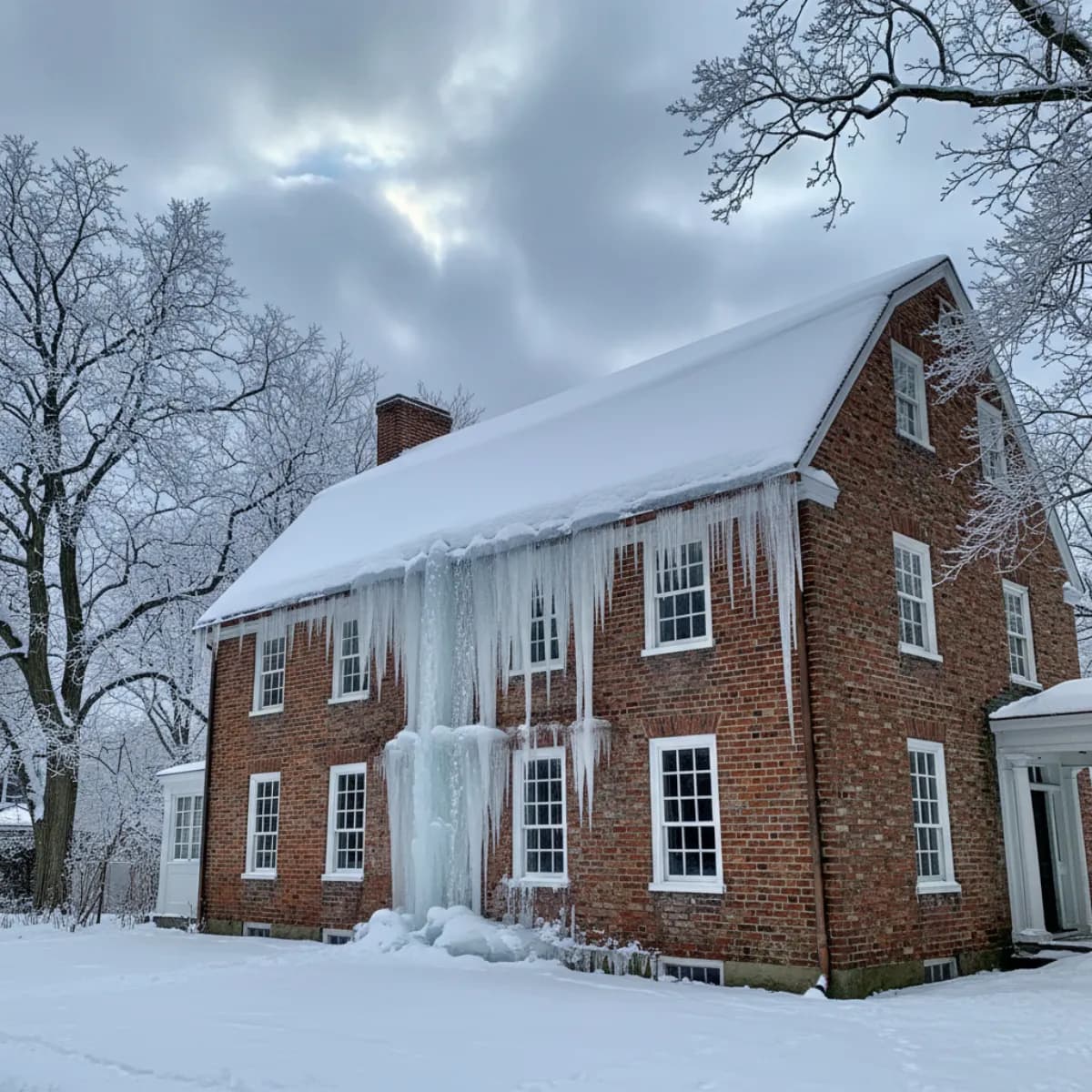
Is This an Ice Dam? How to Identify the Problem
Before you take action, you need to confirm what you are dealing with. Ice dams form when heat escaping through your attic melts snow on the upper roof. The meltwater flows down to the colder eaves, where it refreezes into a ridge of ice. This ridge traps water behind it, which backs up under your shingles and into your home. Here are the telltale signs:
Large Icicles at the Eaves
Icicles hanging from your gutters or eaves are the most visible sign. While small icicles are normal, thick clusters of long icicles (12+ inches) indicate water is pooling and refreezing at the roof edge. The bigger the icicles, the larger the dam behind them.
Water Stains on Ceilings or Walls
Brown or yellowish stains appearing on ceilings or walls near exterior walls are a critical warning. This means water has already penetrated your roof and is actively causing damage. Check areas near the eaves, around skylights, and where roof planes meet walls.
Active Dripping or Leaking
If water is actively dripping from your ceiling, running down walls, or pooling in your attic, you have an active ice dam leak. This is an emergency. Water can travel along rafters and sheathing before dripping far from the original entry point, so the leak source may not be directly above the drip.
Other Signs to Watch For
- -Ice in the soffit area: Ice visible in or around the soffit vents indicates water is backing up behind the fascia and into the overhang cavity.
- -Peeling paint or blistering near the roofline: Moisture trapped behind exterior paint causes bubbling and peeling, often the first exterior sign of ice dam damage.
- -Uneven snow melt pattern: If the upper half of your roof is clear but the lower 3-4 feet are still snow-covered with ice, heat is escaping from the attic and an ice dam is forming or has formed.
- -Sagging or bulging drywall: In severe cases, water-saturated drywall will sag or bulge. If you see this, place a bucket underneath and carefully poke a small drain hole to relieve pressure and prevent a ceiling collapse.
5 Things to Do RIGHT NOW
If you have confirmed an ice dam, time is critical. Every hour of delay increases the risk of structural damage, mold growth, and higher repair costs. Follow these five steps immediately, in this order.
Document Everything Immediately
Before you touch anything, document the damage thoroughly. Your insurance company will need evidence of the damage and its timeline. Use your phone to take date-stamped photos and video of:
- - Exterior ice dam formation from multiple angles
- - Icicle size and location along the eaves
- - Interior water stains, drips, and pooling water
- - Damaged walls, ceilings, flooring, and personal property
- - Your attic, showing any visible moisture, frost, or daylight
Pro tip: Take a video walkthrough narrating the damage. Adjusters find video evidence compelling. Save photos to cloud storage immediately in case your phone is damaged.
Call Your Insurance Company Within 48 Hours
File your claim as soon as possible. Most policies require "prompt notice" of damage, and waiting too long can jeopardize your claim. When you call:
- - Have your policy number ready
- - Describe the damage clearly and factually
- - Ask about your deductible and coverage limits
- - Request a claim number and write it down
- - Ask about emergency mitigation coverage (most policies cover reasonable emergency repairs)
Important: Your insurer may authorize emergency mitigation (tarping, water extraction) before an adjuster arrives. Ask specifically about this, and save every receipt.
Do NOT Hack at the Ice
This is the most common and most expensive mistake homeowners make. Chipping, hammering, or prying at an ice dam with tools will:
- - Crack and break shingles, creating new leak points
- - Dent or puncture metal flashing and gutters
- - Void your roofing manufacturer warranty
- - Send heavy chunks of ice falling unpredictably (serious injury risk)
- - Give your insurance company grounds to deny part of your claim for "homeowner-caused damage"
Your instinct will be to grab a hammer or shovel. Resist that instinct. The ice dam removal methods in the next section are safer and far less likely to cause additional damage.
Create Drainage Channels with Calcium Chloride
While you wait for professional removal, you can safely create drainage channels through the ice dam using calcium chloride. This is the one DIY method that actually works without risking roof damage:
- Fill a leg from old pantyhose or a thin tube sock with calcium chloride ice melt pellets
- Lay the filled tube vertically across the ice dam, perpendicular to the gutter
- The calcium chloride will slowly melt a channel through the ice, allowing trapped water to drain
- Place multiple tubes every 3-4 feet along the ice dam for best results
NEVER use rock salt (sodium chloride) or table salt. These will corrode metal gutters and flashing, stain your siding, and kill plants below the roofline. Use only calcium chloride (CaCl2), available at any hardware store.
Manage Interior Water and Emergency Tarp
While addressing the exterior, protect your interior from further damage:
- - Place buckets and towels under all active drips. Empty frequently.
- - Move furniture and valuables away from affected areas.
- - If ceiling is bulging, carefully poke a small hole at the lowest point with a screwdriver to drain water into a bucket. This prevents a sudden ceiling collapse.
- - Run dehumidifiers and fans to dry affected areas and slow mold growth (mold can begin within 24-48 hours).
- - If safe to access the roof, a heavy-duty tarp secured with 2x4 boards (not nails through shingles) over the affected area can slow water entry until professionals arrive.
Do not attempt to access a snow-covered or icy roof without proper safety equipment. Falls from roofs are the leading cause of winter home injury deaths.
Filing Your Ice Dam Insurance Claim
The 2025-2026 winter has produced a surge in ice dam claims across New England. State Farm reported processing over 200 ice dam claims from a single January 2026 storm in Connecticut alone, with an average payout of $30,000 per claim. Understanding what is covered, and what is not, will help you navigate the process.
Typically Covered
- Water damage to interior walls, ceilings, and floors
- Mold remediation resulting from the water intrusion
- Damaged insulation that needs replacement
- Emergency mitigation costs (tarping, water extraction)
- Damaged personal property (furniture, electronics, clothing)
- Roof repair to the areas damaged by the ice dam
Typically NOT Covered
- Ice dam removal costs (considered maintenance)
- Pre-existing roof wear or deferred maintenance
- Preventive upgrades (insulation, ventilation improvements)
- Cosmetic damage that does not affect function
- Damage caused by your own removal attempts (chipping, hammering)
- Gutter replacement due to ice weight (sometimes excluded)
Step-by-Step Claim Process
- 1Notify your insurer within 48 hours. Call the claims line, not your agent's personal number. The claims line is staffed 24/7 and will assign a claim number immediately.
- 2Submit your photo and video documentation. Most insurers have apps for uploading directly. Include dates, descriptions, and weather reports from the day of the storm.
- 3Authorize emergency mitigation. Ask your insurer to approve emergency mitigation (water extraction, tarping, dehumidification). Get verbal confirmation and note the name of the representative.
- 4Meet the adjuster. Be present for the adjuster's inspection. Walk them through every area of damage. Show your photos documenting the timeline. Point out hidden damage in the attic.
- 5Get independent repair estimates. Do not rely solely on the adjuster's estimate. Get quotes from licensed local contractors to compare. If there is a significant gap, your contractor's detailed scope of work can be used to supplement your claim.
- 6Save every receipt. All emergency supplies, temporary repairs, hotel stays (if displaced), and professional services are potentially reimbursable. Keep originals and digital copies.
Safe Ice Dam Removal Methods
There are only two safe ways to remove an ice dam: the calcium chloride method (DIY) and professional steam removal. Everything else risks damaging your roof, voiding your warranty, or injuring yourself.
Calcium Chloride Sock Method (DIY)
Cost: $15-30 for materials · Effectiveness: Moderate · Roof damage risk: Very low
Fill a tube sock or pantyhose leg with calcium chloride pellets (not rock salt). Lay it perpendicular across the ice dam so it extends over the gutter. The calcium chloride melts a channel through the ice, allowing trapped water to drain. Place tubes every 3-4 feet. Results appear within 2-6 hours depending on temperature. Reapply after heavy snowfall.
Best for: Small to medium ice dams, accessible rooflines, temporary relief while waiting for professional service.
Professional Steam Removal
Cost: $300-800 per session · Effectiveness: High · Roof damage risk: None
Professional steam removal uses low-pressure steam (not pressure washers or hot water) to melt ice dams completely without any mechanical contact with your roof. A trained technician works from a ladder or platform, directing steam at the ice dam until it is fully removed. This is the gold standard method recommended by roofing manufacturers and insurance companies alike.
Best for: Large ice dams, active leaks, multi-story homes, steep roofs, and any situation where the ice dam must be completely removed.
What NOT to Do: Dangerous Removal Methods
- Hammers, chisels, or axes: Destroys shingles and flashing. Voids warranty. Creates new leak points.
- Rock salt or table salt: Corrodes aluminum gutters, stains siding and masonry, kills landscaping beneath the drip line.
- Pressure washers or hot water: Forces water under shingles, worsening the leak. High-pressure can strip granules.
- Heat cables installed after ice forms: Too late to help. Cannot be safely installed on an icy roof. Does not address the root cause.
- Blowtorches or open flame: Extreme fire risk. Melts asphalt shingles. Can ignite underlayment or sheathing.
- Pulling icicles off: Icicles are attached to the ice dam. Pulling them can rip off gutters and trigger ice falls weighing hundreds of pounds.
Why 2026 Is the Worst Year for Ice Dams in a Decade
The 2025-2026 winter has been a perfect storm for ice dam formation across New England. After several years of relatively mild winters, this season has brought a combination of factors that have overwhelmed homes across the region.
The "First Real Winter in Years"
As GBH News reported, the 2025-2026 winter is New England's first "real winter in years," with sustained cold and heavy snowfall after a stretch of mild seasons. Homeowners who skipped attic insulation upgrades and roof maintenance during the warm years are now paying the price. Roofs that performed adequately during light-snow winters are failing under the snow loads and temperature differentials of a traditional New England winter.
Record Call Volumes Across the Region
The Hartford Courant reported that Connecticut roofing and restoration companies are seeing 65% more ice dam calls in January-February 2026 compared to the same period in 2025. Massachusetts contractors report similar surges, with some companies booked 2-3 weeks out for steam removal services. Boston.com coverage highlighted multiple neighborhoods in greater Boston where entire blocks experienced simultaneous ice dam leaks after a heavy snowfall followed by a thaw-refreeze cycle.
Insurance Industry Impact
The scale of the 2026 ice dam season is staggering. State Farm alone reported processing over 200 ice dam claims from a single January storm in Connecticut, with the average claim reaching $30,000. Across New England, insurers are projecting ice-dam-related payouts to exceed $500 million for the 2025-2026 winter, the highest figure since the winter of 2014-2015. Deductibles are not changing mid-season, but industry analysts expect premium increases of 5-10% at renewal for properties that filed ice dam claims this winter.
The Bottom Line
If your home made it through the 2025-2026 winter without an ice dam, consider yourself fortunate and take the prevention steps below before next winter. If you are currently dealing with an ice dam, the combination of high demand and limited contractor availability means you should act immediately: every day of delay extends your wait time for professional service and increases the damage to your home.
Preventing Future Ice Dams: The Permanent Fix
Ice dams are a symptom, not the disease. The root cause is heat escaping from your living space into the attic, warming the roof deck unevenly. Here are the four investments that eliminate ice dams permanently, listed in order of priority.
Attic Insulation (R-49 or Higher)
The single most impactful upgrade. Current building codes across all New England states require R-49 attic insulation for new construction, but most older homes have R-19 or less. Blown-in cellulose or fiberglass insulation can be added without removing existing insulation. Cost: $1,500-$3,500 for an average home. Many utility companies offer rebates covering 50-75% of the cost through Mass Save (MA), Energize CT (CT), and similar programs in NH, VT, ME, and RI.
Critical areas: seal all air leaks first, especially around recessed lights, bathroom exhaust fans, attic hatches, plumbing penetrations, and chimney chases. Air sealing alone can reduce heat loss by 30-40%.
Proper Roof Ventilation
Your attic needs a balanced ventilation system: intake vents at the soffits and exhaust vents at or near the ridge. The goal is to keep the attic temperature as close to the outside temperature as possible. Without adequate ventilation, even well-insulated attics can trap enough heat to melt snow on the roof deck.
The standard is 1 square foot of net free ventilation area per 150 square feet of attic floor (or 1:300 with a vapor barrier). Common fixes include adding continuous soffit vents, ridge vents, or gable vents. Cost: $500-$2,000 depending on what exists currently.
Ice and Water Shield Underlayment
When your roof is due for replacement, this is your best defense. Ice and water shield is a self-adhering waterproof membrane installed directly on the roof deck beneath the shingles. It seals around nail penetrations and prevents water from entering even if it backs up under the shingles. All New England building codes require it at the eaves, but best practice is to extend it 3-6 feet past the interior wall line, in all valleys, and around all penetrations.
Cost: adds $500-$1,500 to a typical roof replacement. This is the single best insurance policy against ice dam water damage and is worth every penny in the New England climate. Compare roof replacement quotes that include ice and water shield coverage using Massachusetts cost guides or Connecticut cost guides.
Proper Roof Design and Snow Management
If you are building new or doing a major renovation, roof design choices can eliminate ice dams entirely. Metal roofing sheds snow before it can accumulate and form dams. Steeper roof pitches (8:12 or higher) reduce snow buildup. Wide overhangs with proper ventilation keep the entire roof surface at a uniform temperature.
For existing homes, a roof rake (used from the ground) to remove snow from the first 3-4 feet of the roof after each storm is an effective interim measure. Cost: $30-50 for a telescoping roof rake. Use it after every snowfall of 4+ inches to prevent ice dam formation. See our New Hampshire and Vermont cost guides for metal roofing pricing in snow country.
State-by-State Resources and Building Code Requirements
Each New England state has specific building code requirements relevant to ice dam prevention. When replacing your roof or adding insulation, your contractor must comply with these codes. Knowing the requirements helps you verify that the work is done correctly.
Massachusetts (MA)
780 CMR (9th Edition, based on 2021 IRC)
- - Ice barrier (ice and water shield) required at eaves in areas where average January temperature is 25°F or less
- - Must extend from eave edge to at least 24 inches inside the exterior wall line
- - Attic insulation: R-49 minimum for new construction
- - Ventilation: 1:150 ratio (or 1:300 with approved vapor retarder)
Connecticut (CT)
CT State Building Code (2018 IRC with amendments)
- - Ice barrier required at eaves for all new roof installations statewide
- - Must extend at least 24 inches past interior wall line
- - Attic insulation: R-49 minimum
- - Contractor licensing required through DCP (Dept. of Consumer Protection)
New Hampshire (NH)
NH Building Code (RSA 155-A, based on 2018 IRC)
- - Ice barrier required at eaves, valleys, and around penetrations
- - Snow load design: 60-100 PSF depending on elevation and location
- - Attic insulation: R-49 minimum for Climate Zone 6
- - Enhanced ventilation requirements for high-snow-load areas
Vermont (VT)
VT Residential Building Energy Standards (RBES)
- - Ice barrier required on all eaves per RBES
- - Snow load design: 50-90 PSF depending on elevation
- - Attic insulation: R-49 to R-60 depending on municipality
- - Blower door testing required for new construction to verify air sealing
Rhode Island (RI)
RI State Building Code (SBC-1 through SBC-8)
- - Ice barrier required at eaves per IRC adoption
- - Attic insulation: R-49 minimum for new construction
- - Contractor registration required through RI Contractors Registration Board
- - Coastal areas may have additional wind and moisture requirements
Maine (ME)
Maine Uniform Building and Energy Code (MUBEC)
- - Ice barrier required at eaves in all municipalities that enforce MUBEC
- - Snow load design: 60-100+ PSF, varies significantly by region
- - Attic insulation: R-49 to R-60 for Climate Zone 6-7
- - Some rural municipalities do not enforce state code; verify locally
Frequently Asked Questions About Ice Dams
Does homeowners insurance cover ice dam damage?
Can I remove an ice dam myself?
How do I know if I have an ice dam?
What causes ice dams to form?
How much does professional ice dam removal cost?
Will heat cables prevent ice dams?
Should I get a new roof after ice dam damage?
What is ice and water shield and do I need it?
Ice Dam Damage? Get Instant Roof Replacement Quotes
Enter your address below to get instant satellite-based roof replacement estimates from pre-vetted New England contractors. Compare quotes with standardized scopes of work, and choose the right contractor for your repair or replacement.
Serving Massachusetts, Connecticut, Rhode Island, New Hampshire, Vermont, and Maine. RoofVista also serves NY, NJ, PA, TX, FL, and CA.
Free estimates. No spam. No selling your info.