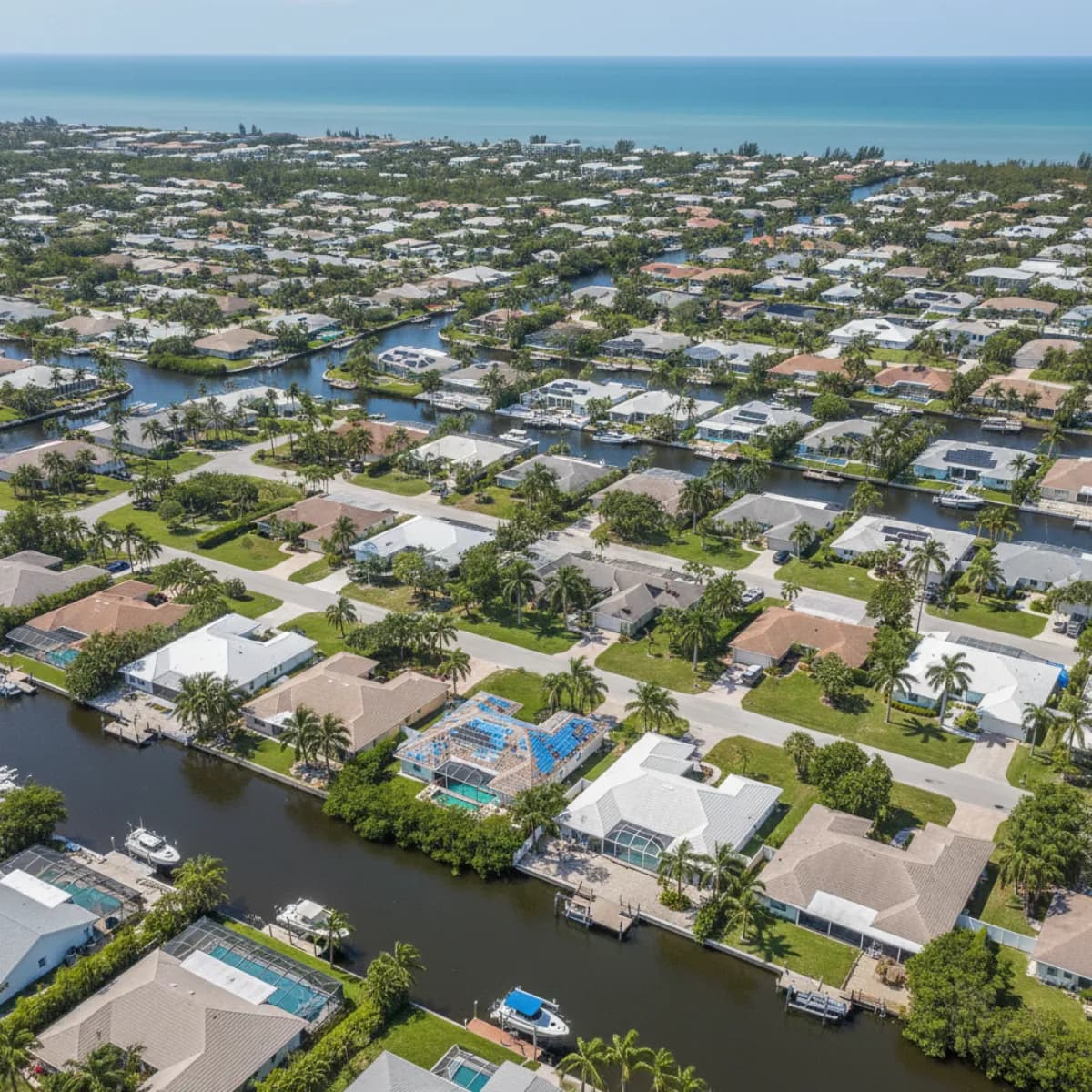
Rebuilding Stronger After Hurricane Ian
Instant Roof Replacement Quotes in Cape Coral, FL
Hurricane Ian delivered a direct Category 4 hit to Cape Coral in September 2022, damaging an estimated 90% of homes. The city's 200,000+ residents are rebuilding stronger with impact-rated materials and modern wind-resistant systems. Get instant quotes from pre-vetted Florida CCC-licensed contractors who specialize in hurricane-hardened roofing across Cape Harbour, Burnt Store, South Cape, Pelican, and every Cape Coral neighborhood.
Free Quotes
no obligations ever
Contractor Bids
standardized scope comparison
Until You Choose
no spam, no lead resale
FL Contractors
CCC-licensed, insured, reviewed
Cape Coral at a Glance
Population
Largest city between Tampa and Miami
Miles of Canals
Most canal-front city in the world
Hurricane Ian (2022)
Direct hit, 150 mph sustained winds
Permit Cost
Lee County re-roof permits
MPH Design Wind Speed
FBC requirement for Lee County
Homes Damaged by Ian
Massive ongoing rebuild market
Hurricane Ian and the Cape Coral Rebuild
On September 28, 2022, Hurricane Ian made landfall near Cayo Costa as a Category 4 storm with sustained winds of 150 mph and gusts exceeding 160 mph. Cape Coral sat directly in the storm's path. The combination of catastrophic winds and storm surge of 12 to 18 feet along the Caloosahatchee River and Gulf-access canals caused destruction on a scale the city had never experienced. An estimated 90% of Cape Coral's roughly 80,000 residential structures sustained some degree of roof damage — from torn shingles and broken tiles to complete roof system failures where decking was ripped from trusses.
The damage revealed a hard truth about Cape Coral's housing stock. Many homes had been built during the city's rapid growth in the 1980s and 1990s, before the Florida Building Code was significantly strengthened following Hurricane Andrew in 1992 and further tightened after the devastating 2004-2005 hurricane seasons (Charley, Frances, Ivan, Jeanne, Wilma). Roofs constructed under the older South Florida Building Code lacked the enhanced nail patterns, hurricane straps, sealed underlayment, and impact-resistant materials that current code demands. Hurricane Ian exposed these deficiencies at massive scale, with pre-2002 roofs failing at dramatically higher rates than those built or replaced under the modern Florida Building Code.
More than three years later, the Cape Coral rebuild remains one of the largest residential reconstruction efforts in Florida history. Thousands of homeowners have replaced their roofs with modern, hurricane-hardened systems designed to meet or exceed current FBC requirements. The shift in material preference has been striking: standing seam metal roofing has surged from a niche option to one of the most requested materials in Cape Coral, driven by its superior wind resistance, longevity, and proven performance during Ian. Impact-resistant shingles have become the baseline standard, and concrete tile installations now uniformly use the foam adhesive and mechanical fastening methods that were once considered premium upgrades.
For Cape Coral homeowners, the post-Ian environment presents both urgency and opportunity. Insurance carriers have become increasingly strict about roof age and condition — many will not write new policies on homes with roofs older than 15 years, and several have exited the Lee County market entirely. A modern, code-compliant roof is now essential not just for storm protection but for basic insurability. RoofVista's pre-vetted contractors in Cape Coral understand this reality and specialize in installations that maximize both hurricane resistance and wind mitigation insurance credits, helping homeowners protect their homes and reduce their long-term insurance costs.
Roofing Challenges Unique to Cape Coral
Cape Coral's geography as the most canal-front city in the world — with over 400 miles of navigable waterways — creates roofing challenges that go beyond the standard Florida hurricane concerns. Waterfront exposure, FEMA flood zone regulations, salt air from the Gulf of Mexico, and the city's low-lying terrain combine to demand roofing systems built for extreme conditions.
! Hurricane-Force Winds & Ian Legacy
Cape Coral's location on Florida's southwest coast places it directly in the path of Gulf hurricanes. Hurricane Ian proved this with devastating clarity. The Florida Building Code requires a design wind speed of 150+ mph for Lee County, meaning all roofing systems must be engineered and installed to withstand sustained Category 4 winds. Every component — shingles, tiles, underlayment, fasteners, and flashing — must carry a valid Florida Product Approval and be installed per the manufacturer's high-wind instructions.
- - 150+ mph design wind speed (FBC requirement)
- - Impact-rated materials mandatory (wind-borne debris region)
- - Enhanced 6-nail pattern for shingles
- - Hurricane straps at every truss-to-wall connection
~ Waterfront & Canal Exposure
With 400+ miles of canals connecting to the Caloosahatchee River and the Gulf of Mexico, Cape Coral has more waterfront property per capita than any city on earth. This canal network means that thousands of homes face direct water exposure from multiple directions during storms. Wind accelerates across open water channels, creating higher effective wind speeds at canal-front rooflines than at inland properties. During Hurricane Ian, canal-front homes experienced disproportionately severe roof damage from both wind uplift and storm surge underpressure.
- - Accelerated wind speeds across open canal channels
- - Salt spray corrosion on fasteners and flashing
- - Storm surge uplift pressure on roof structures
- - Marine-grade hardware recommended for canal-front homes
= FEMA Flood Zones & Substantial Damage
A significant portion of Cape Coral lies within FEMA-designated flood zones, particularly along the extensive canal system and the Caloosahatchee River corridor. After Hurricane Ian, FEMA's Substantial Damage Estimation process determined that thousands of Cape Coral properties sustained damage exceeding 50% of their pre-storm value. Under FEMA rules, substantially damaged structures must be brought into full compliance with current building codes when repaired — including complete roof system replacement meeting the latest FBC wind-speed and impact requirements. This has accelerated the transition from older, vulnerable roof systems to modern hurricane-hardened installations.
- - AE and VE flood zones cover canal-front properties
- - Substantial damage triggers full code compliance
- - Elevated construction requirements in VE zones
- - Flood insurance considers roof condition in underwriting
# Tropical Heat, UV & Afternoon Storms
Cape Coral averages 271 sunny days per year with summer temperatures regularly exceeding 95 degrees F and roof surface temperatures reaching 160-175 degrees F. This extreme UV exposure degrades conventional asphalt shingles 20-30% faster than the national average. From June through September, intense afternoon thunderstorms can dump 2-3 inches of rain in under an hour, testing waterproofing and drainage systems. The combination of relentless heat, humidity, and rain creates an environment where only high-quality, UV-resistant materials with proper ventilation achieve their rated lifespan.
- - 271 sunny days with extreme UV exposure
- - SBS-modified asphalt resists UV degradation
- - Metal roofing reflects 60-70% of solar energy
- - Proper attic ventilation critical for material longevity
Cape Coral Roof Replacement Cost by Material
Cape Coral roofing costs reflect the post-Hurricane Ian reality: mandatory impact-rated materials, stricter code enforcement, elevated contractor demand across Lee County, and labor rates averaging $50-$80/hour. All products must carry a valid Florida Product Approval for the 150+ mph wind-speed zone. Canal-front properties and homes in FEMA flood zones may incur additional costs for structural reinforcement and marine-grade hardware.
Standing Seam Metal
#1: Standing Seam Metal
The fastest-growing roofing material in Cape Coral since Hurricane Ian. Standing seam metal's interlocking panel design with concealed fasteners creates a virtually seamless wind barrier that routinely exceeds 180 mph uplift ratings — well above Lee County's 150+ mph requirement. During Ian, homes with properly installed standing seam metal roofs showed dramatically lower damage rates than those with shingles or tile. The material's 40-70 year lifespan, superior heat reflection (reducing cooling costs 10-25%), and compatibility with solar panel installations have made it the preferred choice for Cape Coral homeowners rebuilding after the storm. For canal-front properties, specify Galvalume steel with PVDF (Kynar 500) coating or aluminum panels to resist salt air corrosion from the Gulf and canal system.
Best For:
Maximum hurricane protection, canal-front homes
Lifespan:
40-70 years
Cost Range:
$20,000 - $50,000
Wind Rating:
180+ mph (FPA-certified)
Impact-Resistant Shingles
#2: Impact-Resistant Architectural Shingles
The most affordable hurricane-ready option for Cape Coral homeowners. Since the city sits in a wind-borne debris region, standard shingles are no longer acceptable — all shingle installations must use impact-resistant products that pass large missile impact testing. SBS-modified (Styrene-Butadiene-Styrene) architectural shingles provide the flexibility and impact resistance needed to meet Florida Building Code requirements while keeping costs manageable. The SBS polymer modification also provides superior UV resistance compared to standard oxidized asphalt, which is critical in Cape Coral's intense subtropical sun. When installed with the FBC-required enhanced nail pattern and compatible underlayment, these shingles achieve 130-150 mph wind ratings. Popular throughout Cape Coral's inland neighborhoods and subdivisions where tile or metal may not be architecturally preferred.
Best For:
Budget-conscious homeowners, inland neighborhoods
Lifespan:
20-30 years (Cape Coral climate)
Cost Range:
$12,000 - $28,000
Impact Rating:
Class 4 (UL 2218)
Concrete Tile
#3: Concrete Tile (Barrel & Flat)
Concrete tile has long been a staple of Southwest Florida's residential architecture, and it remains a popular choice in Cape Coral for its exceptional longevity and inherent wind resistance. Individual tiles weigh 9-12 pounds each, and the combined dead load of a concrete tile roof provides significant resistance to wind uplift forces. Post-Hurricane Ian, the key change is in installation methods: foam adhesive systems and enhanced mechanical fastening with stainless steel clips have replaced the older mortar-set methods that failed during the storm. When properly installed with current FBC-compliant fastening, concrete tile systems achieve 150+ mph wind ratings. The 50-75 year lifespan and natural thermal mass that reduces cooling loads make tile an attractive long-term investment for Cape Coral homeowners, particularly in established neighborhoods like Cape Harbour and Burnt Store Marina.
Best For:
Mediterranean-style homes, long-term investment
Lifespan:
50-75 years
Cost Range:
$22,000 - $55,000
Wind Rating:
150+ mph (foam adhesive or clips)
TPO / Flat Roof
#4: TPO & Modified Bitumen (Flat Roofs)
Cape Coral has a significant inventory of flat and low-slope roofed structures, particularly in commercial areas along Del Prado Boulevard and Cape Coral Parkway, as well as contemporary residential designs throughout newer developments. White TPO (Thermoplastic Polyolefin) membrane is the standard choice for flat roofs, providing exceptional heat reflection that reduces cooling costs in Cape Coral's 9-month warm season. Modified bitumen provides superior puncture resistance and waterproofing, which is critical given the city's intense afternoon thunderstorms. In the post-Ian code enforcement environment, all flat roof systems must be mechanically attached or fully adhered with FPA-certified methods and rated for the 150+ mph wind-speed zone. TPO and modified bitumen systems are the most cost-effective option per square foot for flat and low-slope applications.
Best For:
Flat and low-slope roofs, commercial properties
Lifespan:
20-30 years
Cost Range:
$10,000 - $25,000
Energy Savings:
White TPO reflects 80%+ solar energy
Cape Coral Average Roof Cost: Impact-resistant shingles $12,000-$28,000. Standing seam metal $20,000-$50,000. Concrete tile $22,000-$55,000. Flat/TPO $10,000-$25,000. Cape Coral costs include the post-Hurricane Ian premium — elevated contractor demand, mandatory impact-rated materials, and stricter code enforcement add 10-20% compared to pre-Ian pricing. Get your exact price with a free instant estimate.
Cape Coral & Lee County Building Requirements
Important Local Regulations
Florida Building Code — Wind-Borne Debris Region
Cape Coral lies within the Florida Building Code's wind-borne debris region, which covers areas with a basic wind speed of 140+ mph that are within one mile of the coast or within the wind-borne debris zone as defined by ASCE 7. This designation requires all roof coverings to either be impact-resistant themselves (passing large missile impact testing) or be installed over an impact-resistant underlayment. The design wind speed for Lee County is 150+ mph. All roofing products must carry a valid Florida Product Approval (FPA) demonstrating compliance with these wind and impact requirements. Post-Hurricane Ian, Lee County inspectors are applying these standards with increased rigor.
City of Cape Coral Permitting
All roof replacements require a permit from the City of Cape Coral Building Division. Applications must include Florida Product Approval numbers for all materials, the contractor's active CCC license number, proof of insurance, and a Notice of Commencement. Permit fees range from $250 to $600 depending on project scope. The city conducts multi-stage inspections: initial tie-off (verifying roof deck fastening, hurricane strap installation, and nail pattern), dry-in (underlayment type and installation verification), and final inspection (completed roof covering, flashing, ridge caps, and overall code compliance). The inspection process typically adds 1-3 weeks to the project timeline.
FEMA Substantial Damage & Improvement Rules
Properties in FEMA-designated flood zones that sustained substantial damage (repairs costing 50% or more of the building's pre-storm market value) during Hurricane Ian are required to bring the entire structure into compliance with current building codes when repaired. This includes full roof system replacement meeting current FBC wind-speed and impact requirements. Similarly, any substantial improvement (renovation exceeding 50% of building value) triggers full code compliance. Given Cape Coral's extensive canal system and flood zone coverage, many properties that were previously grandfathered under older building codes are now required to meet current standards as a result of Ian damage.
Wind Mitigation & Insurance Requirements
Florida law mandates insurance premium discounts for verified wind mitigation features. Given Lee County's dramatically elevated insurance costs since Hurricane Ian — with many homeowners seeing premiums double or triple — maximizing wind mitigation credits has become financially critical. A new, code-compliant roof with hurricane straps, ring-shank nails at 6-inch spacing, peel-and-stick secondary water resistance, and impact-resistant covering can qualify for 30-50% savings on the wind portion of the premium. Our contractors recommend obtaining a wind mitigation inspection (OIR-B1-1802 form) immediately after roof replacement to document all qualifying features and begin receiving premium reductions.
Florida CCC Licensing
Florida requires all roofing contractors to hold a Certified Roofing Contractor (CCC) license from the Department of Business and Professional Regulation (DBPR). The CCC license requires passing a state examination, demonstrating a minimum of 4 years of roofing experience, and maintaining a $10,000 surety bond plus workers' compensation and general liability insurance. Verify any contractor's license status at myfloridalicense.com. After Hurricane Ian, Lee County experienced an influx of unlicensed contractors and storm chasers — always verify CCC credentials before signing any contract. All RoofVista contractors in Cape Coral carry active CCC licenses, verified insurance, and demonstrated experience with FBC high-wind installations.
Cape Coral Neighborhoods We Serve
From the upscale waterfront estates of Cape Harbour to the established communities of Burnt Store and the bustling corridors of South Cape, our pre-vetted contractors serve every corner of Cape Coral. Each neighborhood presents unique roofing considerations based on its proximity to the canal system, age of housing stock, and Hurricane Ian damage levels.
Cape Harbour
- - Luxury waterfront community
- - Direct Gulf access canals
- - High-end tile and metal roofs
- - Maximum salt air exposure
- - Significant Ian storm surge damage
Burnt Store
- - Master-planned community
- - Golf course and marina properties
- - Concrete tile predominant
- - HOA architectural requirements
- - Northern Cape Coral exposure
South Cape
- - Cape Coral's downtown entertainment district
- - Mix of residential and commercial
- - Older housing stock (1970s-1990s)
- - Heavy Ian wind damage
- - Active renovation and rebuild market
Pelican
- - Established residential neighborhood
- - Canal-front and dry lot mix
- - Shingle-to-metal conversion popular
- - FEMA flood zone properties
- - Active post-Ian rebuilding
Pine Island Road Corridor
- - Gateway to Pine Island and Matlacha
- - Newer construction (2000s-present)
- - Better FBC compliance pre-Ian
- - Suburban subdivisions and developments
- - Mix of tile and shingle roofs
Northwest Cape & Spreader Waterway
- - Rapidly developing area
- - New construction meeting current FBC
- - Freshwater canal system
- - Larger lot sizes
- - Metal roofing popular on new builds
Insurance Considerations for Cape Coral Homeowners
Post-Hurricane Ian Insurance Crisis in Lee County
Hurricane Ian fundamentally reshaped the insurance landscape in Cape Coral and Lee County. The storm generated over $60 billion in insured losses statewide, with Lee County bearing a disproportionate share. Multiple private insurers have exited the market or dramatically raised premiums, leaving many Cape Coral homeowners dependent on Citizens Property Insurance — Florida's state-backed insurer of last resort. For Cape Coral homeowners, roof condition is now the single most decisive factor in obtaining affordable coverage and, in many cases, obtaining coverage at all.
Roof Age & Cape Coral Insurability
- - Most insurers refuse policies on roofs older than 15 years
- - Citizens requires inspection for roofs over 15 years
- - Post-Ian, many carriers limit Lee County exposure
- - Roof replacement often reduces premiums 25-45%
- - New roof essential for switching from Citizens to private carrier
Wind Mitigation Savings in Cape Coral
- - Hurricane straps/clips: major premium reduction
- - Secondary water resistance (peel-and-stick): highest-value credit
- - Impact-resistant covering: additional 10-20% savings
- - Enhanced deck attachment (ring-shank, 6" spacing): significant discount
- - Hip roof geometry: lower premium than gable roofs
- - Combined savings: $1,500-$4,000+ annually in Lee County
Our pre-vetted Cape Coral contractors understand that roofing and insurance are now inseparable decisions. They recommend installations specifically designed to maximize wind mitigation credits and improve insurability, and can coordinate with your insurance adjuster on Ian-related claims that may still be in progress.
Avoiding Storm Chasers and Unlicensed Contractors
In the aftermath of Hurricane Ian, Cape Coral and Lee County experienced a massive influx of out-of-state storm chasers and unlicensed contractors. Many offered cut-rate pricing but delivered substandard work using non-compliant materials, disappearing before warranty claims could be filed. The Florida Department of Business and Professional Regulation (DBPR) reported a significant increase in unlicensed contractor complaints in Lee County following the storm.
Substandard post-storm roofing work creates compounding problems: failed inspections, void insurance coverage, code violations that must be corrected at the homeowner's expense, and vulnerability in the next storm. Cape Coral homeowners who had unlicensed work performed after Ian have, in some cases, been required to tear off the non-compliant roof and start over with a licensed contractor — doubling the total project cost.
Verify CCC License
Check myfloridalicense.com for active CCC license status, disciplinary history, and insurance verification before signing any contract.
Demand Product Approvals
Every material must have a valid Florida Product Approval. Ask for FPA numbers in writing and verify them at floridabuilding.org.
Use RoofVista Pre-Vetting
Every RoofVista contractor in Cape Coral is CCC-licensed, insured, locally established, and has passed our verification process — eliminating storm chaser risk entirely.
Roofing for Cape Coral's Canal-Front Properties
Cape Coral's defining feature — its 400+ miles of navigable canals making it the most canal-front city in the world — creates unique roofing demands that set it apart from every other Florida market. The canal system connects to the Caloosahatchee River and the Gulf of Mexico, meaning that many Cape Coral waterfront homes face the same salt air corrosion, wind acceleration, and storm surge risks as coastal properties, despite being located miles from the beach.
During Hurricane Ian, canal-front homes experienced some of the worst damage in the city. Storm surge funneled through the canal system, and the open water channels allowed wind to accelerate to higher effective speeds at roofline height than at comparable inland locations. Roof structures were attacked from above by wind and from below by hydrostatic pressure as surge water entered attic spaces through soffits and vents. This dual assault caused thousands of roof system failures that might not have occurred at the same wind speeds without the canal-driven surge component.
For canal-front homeowners replacing their roofs, material and hardware selection is critical. Stainless steel or hot-dipped galvanized fasteners are recommended over standard galvanized to resist the accelerated corrosion from salt-laden Gulf air carried up the canal system. Standing seam metal with marine-grade PVDF coatings or aluminum panels provides the best combination of wind resistance and corrosion protection. Soffit and ridge vents should be sealed or use hurricane-rated designs to prevent water intrusion during surge events. Properly designed roof overhangs — wide enough to shed rain but not so deep as to create wind uplift leverage points — are particularly important on canal-front lots where wind approaches unobstructed across open water.
Frequently Asked Questions About Cape Coral Roofing
How much does a roof replacement cost in Cape Coral, FL?
Impact-resistant shingle roofs cost $12,000-$28,000 in Cape Coral. Standing seam metal ranges $20,000-$50,000. Concrete tile runs $22,000-$55,000. Post-Hurricane Ian demand, FBC wind-speed requirements (150+ mph), and mandatory impact-rated materials drive costs above the statewide average.
How did Hurricane Ian affect roofing in Cape Coral?
Hurricane Ian made a direct Category 4 hit on September 28, 2022, with 150 mph sustained winds. An estimated 90% of Cape Coral homes sustained roof damage. The ongoing rebuild has elevated contractor demand and triggered stricter code enforcement across Lee County.
What roofing materials are best for Cape Coral's hurricane risk?
Standing seam metal has surged in popularity post-Ian for its 180+ mph wind resistance. Impact-resistant SBS-modified shingles offer the most affordable hurricane-ready option. Concrete tile provides weight-based wind resistance and a 50-75 year lifespan. All materials must carry a Florida Product Approval.
What is the Lee County permit process for roof replacement in Cape Coral?
Permits are required through the City of Cape Coral Building Division. Applications need Florida Product Approval numbers, CCC license proof, and a Notice of Commencement. Fees run $250-$600. Multi-stage inspections verify tie-off, dry-in, and final installation.
Does Cape Coral require impact-resistant roofing materials?
Yes. Cape Coral is in a wind-borne debris region with a 150+ mph design wind speed. All roofing materials must be impact-rated or the assembly must include impact-resistant underlayment. Post-Ian enforcement is significantly stricter.
How do FEMA flood zones affect roofing in Cape Coral?
Many canal-front properties sit in FEMA AE and VE flood zones. Homes with substantial Hurricane Ian damage (over 50% of value) must rebuild to current code, including full roof replacement. Insurance underwriters factor roof condition into both flood and windstorm pricing.
How long does a roof replacement take in Cape Coral?
Most replacements take 3-5 days for shingles, 5-8 days for metal, and 7-12 days for tile. Afternoon thunderstorms (June-September) can cause daily delays. Post-Ian demand extends scheduling to 3-6 weeks from contract to start.
What wind mitigation features save money on Cape Coral home insurance?
Hurricane clips/straps, secondary water resistance (peel-and-stick), impact-resistant covering, and enhanced deck attachment with ring-shank nails at 6-inch spacing. Cape Coral homeowners with a fully compliant new roof can save 30-50% on wind premiums — often $1,500-$4,000+ annually.
Florida Roofing Resources
Florida State Overview
All Florida roofing resources and city pages
Florida Roof Replacement Cost Guide
Detailed pricing for all FL regions and materials
Hurricane-Resistant Roofing in Florida
Wind ratings, impact testing, and storm protection
Florida Roofing Building Codes
FBC, wind-borne debris regions, and local requirements
Wind Mitigation Guide for Florida
Insurance discounts and inspection details
Florida Contractor Licensing
CCC license requirements and DBPR verification
Get Your Cape Coral Roof Quote in Minutes
Enter your address to compare instant quotes from pre-vetted CCC-licensed Florida contractors who specialize in hurricane-hardened roofing, impact-rated materials, and post-Ian rebuilding across Cape Coral and Lee County